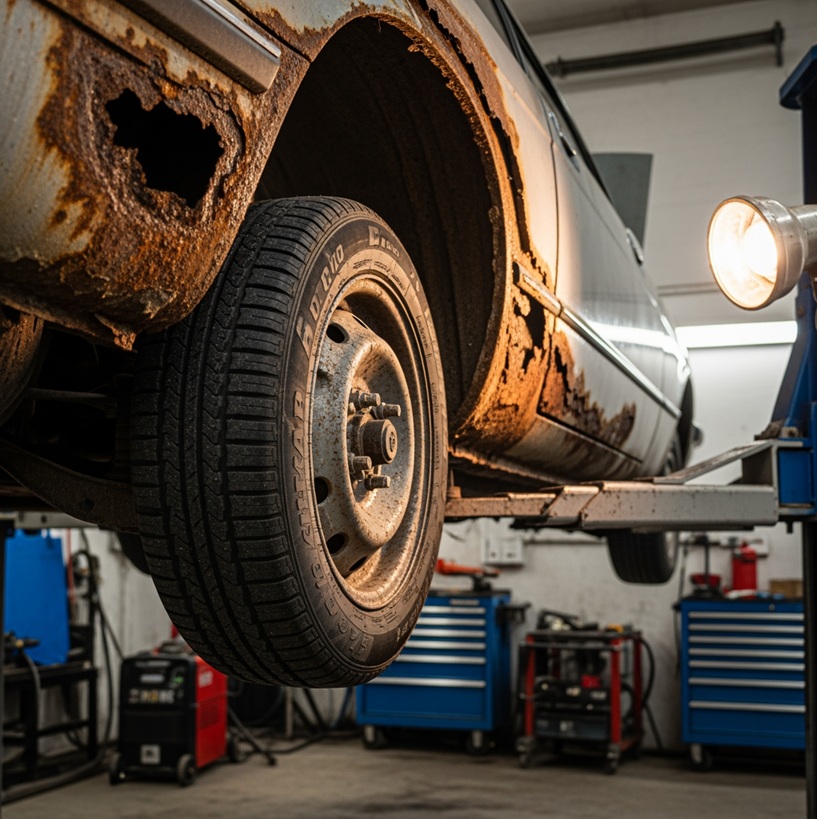
How Structural Rust MOT Failures Affect Scrap Decisions
5th May, 2026
A failed MOT due to structural rust is a serious problem that goes beyond a simple mechanical fault. It shows that a fundamental part of the vehicle has decayed and no longer offers safety. When a tester notes “excessive corrosion” in load-bearing areas, you face a difficult financial choice.
A structural rust mot failure is different from other defects because corrosion is a progressive problem. You can weld small patches or replace specific metal sections, but the underlying decay often continues elsewhere. Understanding why structural rust repairs rarely make economic sense helps you avoid wasting money on a terminal vehicle.
Experience shows that once structural rust fails a test, disposal is usually the smartest path. This guide explains the true impact of corrosion and how to make a solid choice for your wallet. By looking at the facts, you can decide whether to keep an aging car or move on to a safer model.
Understanding Structural Rust Failures
Not all rust is treated the same way during your annual vehicle inspection. Surface rust on a door or a wing might look untidy, but it won’t usually cause a failure. Structural rust is much more serious because it involves parts that hold the car together and protect passengers.
Testers look specifically for corrosion that weakens the vehicle’s strength or affects safety-critical areas. This includes any rust found within 30 centimetres of seatbelt mounts, steering parts, or suspension attachments. The failure notice will usually mention that the structural rigidity of the car is compromised.
Perforation is a technical term for rust that has eaten a hole all the way through the metal. While surface rust might only trigger an advisory warning, perforation in a load-bearing area almost always results in a fail. This indicates that the metal is no longer thick enough to handle the stresses of driving safely.
Common Structural Rust Failure Points
The UK climate accelerates metal decay because of high humidity and the salt used on winter roads. Certain areas underneath the car are more vulnerable because they trap moisture and road spray. These areas often rust from the inside out, making them hard to spot until the damage is severe.
Sills are a very common failure point. These are the metal panels that run along the bottom of the car between the wheels. They provide vital strength to the body and protect occupants during a side-on collision. If a sill becomes rotten, the car loses its ability to protect passengers in a crash.
Subframes are another high-risk area. These are the heavy metal frames that support the engine and suspension components. A subframe that is heavily corroded can lead to a wheel or engine mount detaching while the car is in motion. Repairs for these parts often require taking the whole car apart, which drives up the labour costs.
Structural Rust Repair Costs
Repairing structural metal is expensive because it is a slow and specialized process. Mechanics must grind away the rotten metal until they reach sound material before they can even begin welding. This fabrication work is labour-intensive and requires a high level of skill to ensure the car stays safe.
Professional welding rates usually fall between £50 and £80 per hour in a local garage. A simple patch job might take four hours, but a full sill replacement can take a dozen or more. These costs accumulate quickly and often lead to bills exceeding a thousand pounds.
There are also hidden costs that often appear once the repair work begins. A mechanic might start cutting into a small rust spot only to find that the entire inner section is rotten. Many owners find that arranging for auto recycling is much more attractive once these repair estimates start to spiral.
Why Structural Rust Often Signals Scrapping
Experienced mechanics often recommend disposal rather than repair for cars with heavy rust. The main reason is that rust is rarely a one-time problem on an older vehicle. Even if you fix one area, the salt and moisture that caused the original decay are still there.
Welded areas can also be more vulnerable to future rust if they aren’t protected perfectly. The heat from a welding torch can damage the factory rust protection in surrounding areas. This creates new weak spots that often fail the test within another twelve to twenty-four months.
Think of structural rust like finding termites in a house’s foundation. You can treat one small corner, but the problem is likely spread throughout the entire wooden frame. At a certain point, accepting reality is better than paying for endless and expensive treatments.
Age and Rust Correlation
There is a very strong link between a vehicle’s age and the severity of its rust problems. Most modern cars have good rust protection when they leave the factory, but this wears out after ten or twelve years. Once the protective coatings fail, the exposed steel deteriorates quickly in UK conditions.
For vehicles over fifteen years old, structural rust is often widespread rather than localised. By this age, many different areas approach their failure limits at the same time. This leads to a cycle where you pay for new welding every single year just to pass the test.
If you decide to look up the scrap value of my car, you can stop this expensive cycle immediately. This allows you to put the money you would have wasted on welding toward a newer car. Scrapping at this stage is often a natural part of a vehicle’s life cycle.
Temporary Versus Permanent Rust Repairs
Owners should understand that not all rust repairs offer the same level of durability. A budget “MOT-pass” repair involves welding a metal plate over the hole to meet the minimum test standard. While this is cheaper, it is rarely a permanent solution and often allows rust to grow underneath the patch.
A proper restoration involves cutting out the entire affected section and replacing it with a new, genuine panel. This work is incredibly expensive and usually costs more than the car is worth. Proper metal work can cost over £2,000, which is only sensible for classic or very valuable cars.
For a standard family car, budget repairs are simply buying time. They might buy you another year of driving, but the rust will likely return. Many owners find it is better to scrap my car online today rather than paying for a temporary fix.
Scrap Value With Structural Rust
A great benefit of vehicle disposal is that structural rust does not lower your scrap quote. Scrapyards and processing facilities pay based on the weight of the metal rather than its condition. A car riddled with rust is worth the same as a pristine one of the same weight.
Payments usually stay constant because the facility is buying the raw materials for recycling. Small cars often fetch between £150 and £300, while large SUVs can reach up to £500. This guaranteed payment provides a reliable safety net for owners of unroadworthy cars.
Owners who decide to salvage my van or heavy estate car often get the best returns. The extra weight of these vehicles translates directly into a higher bank transfer. This is true even if the chassis is heavily corroded or the sills are missing.
Making the Rust Repair Decision
Drivers should use a simple mathematical formula to decide between repair and disposal. First, get a firm written quote for all the identified rust areas and any advisories. Add a small margin of roughly 20% to cover any hidden decay the mechanic might find later.
If the total repair cost exceeds 50% of the vehicle’s market value, scrapping is the smarter choice. This is because a car with a history of structural welding is worth less to a buyer later. You are effectively investing money into an asset that continues to drop in value.
Consider a real-world example of a 2008 Ford Focus that failed on rear subframe corrosion. The owner was quoted £950 for a replacement, but the car was only worth about £1,100. By choosing a professional scrap car recycling service, the owner saved their funds for a more reliable replacement.
Legal and Safety Implications
Driving a car with structural rust is dangerous and can lead to severe legal problems. Compromised metal weakens the vehicle’s ability to withstand an impact in an accident. It can also cause suspension mounts to fail suddenly while the car is moving.
Insurance companies require that all vehicles remain in a roadworthy condition to maintain coverage. If you have a crash and the investigator finds unaddressed structural rust, your claim could be denied. This leaves you personally liable for any damage or injury costs.
Property owners in Newcastle or other busy cities often face extra pressure to resolve these issues. An unroadworthy car sitting on a public street can lead to fines or the vehicle being towed. Disposing of the car through a registered yard removes these risks immediately.
Environmental Considerations
Disposing of a rusty vehicle properly is vital for protecting the local environment. An old, corroded car can leak hazardous fluids like oil and coolant onto the ground. If these reach the soil or water table, they cause significant pollution.
A professional Authorised Treatment Facility (ATF) follows strict rules to prevent this. They drain all fluids safely and remove hazardous parts like batteries and airbags. Up to 95% of the vehicle’s materials are then recovered and reused in new products.
Drivers who use a service where we scrap any car safely are supporting a sustainable manufacturing cycle. This reduces the need to mine for new raw materials and lowers the energy used in production. It ensures that even a rotten car has a positive impact on the environment.
Conclusion
Structural rust MOT failures are a clear signal that a vehicle is reaching the end of its useful life. The progressive nature of corrosion means that repairs are often just temporary patches. When repair costs approach the car’s market value, disposal becomes the only sensible financial option.
Scrap value remains independent of a car’s structural condition. This means you can secure a guaranteed payment based on weight even if the car is undriveable. Taking this payment today allows you to walk away from an endless and expensive cycle of maintenance.
Professional networks provide a fast and legal way to handle the disposal process. They offer free recovery and ensure the DVLA record is closed with a formal certificate. This provides peace of mind and financial security for owners of failing vehicles.
When you are ready to make a choice, Scrap Car Network offers a simple route forward. We provide competitive quotes and handle all the paperwork for you. If your car has failed on rust today, please contact us to arrange a hassle-free collection.