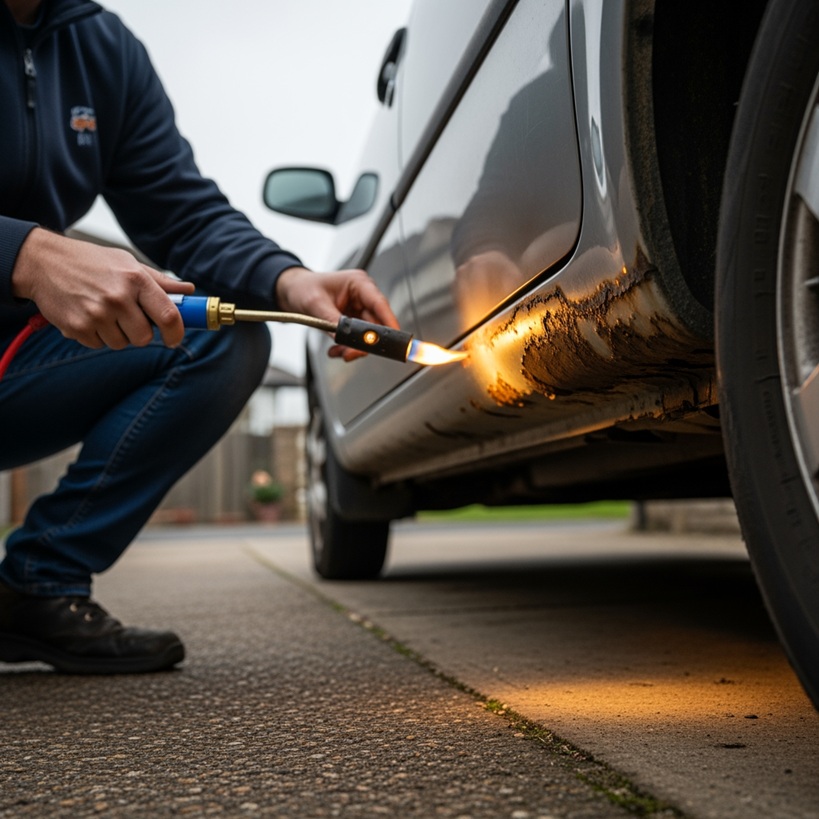
Describing Rust Levels for Online Quotes: Visual Assessment Guide
14th May, 2026
Getting an accurate quote for scrapping a car means describing its condition honestly, and rust is often the trickiest part to explain. Most people do not speak the language of corrosion, and when you are filling out an online form, there is no mechanic peering underneath to assess the damage for you.
The difference between “a bit of surface rust” and “structural rust” can affect your quote significantly. Scrap yards need to know what they are collecting because rust determines whether parts can be salvaged, how much usable metal remains, and what safety precautions the team needs during handling. Describing scrap car rust accurately is not about being a metallurgist; it is about knowing what to look for and how to translate what you see into terms that get you a fair price.
Why Rust Matters to Scrap Car Dealers
Rust is not just cosmetic. It fundamentally changes what a vehicle is worth to an Authorised Treatment Facility (ATF). When professional networks receive a car, they assess it for three things: reusable parts, recyclable metal, and handling risks.
Surface rust on a bonnet is manageable. Rust that has eaten through a sill or chassis rail is a different story. Heavily corroded vehicles cannot be safely lifted without risk of collapse, and structural rust means fewer parts can be resold. The scrap metal itself still has value, but if 20% of what should be steel has turned to iron oxide flakes, the weight drops accordingly.
The Four Categories of Rust You Will Encounter
Most online quote systems break rust down into four broad categories. Understanding these helps you assess your vehicle accurately.
Surface Rust (Cosmetic Only)
Surface rust appears as orange or brown discolouration on metal panels. It has not penetrated through the paint and metal. You can often feel it as a slightly rough texture, but the metal underneath remains solid. For scrap purposes, this level of corrosion is negligible.
Moderate Rust (Scale and Pitting)
Moderate rust has progressed beyond discolouration. The metal surface shows scaling, which are flaky layers that lift away when touched, or pitting, where small holes have formed. The rust has started eating into the metal but hasn’t yet penetrated through. This might slightly lower your quote as some body panels may not be resellable.
Heavy Rust (Structural Concerns)
Heavy rust means the corrosion has penetrated through the metal completely, creating holes, or has severely weakened load-bearing components. This is where rust stops being a cosmetic issue and becomes a structural problem.
Signs include visible holes in sills, flaking metal that breaks away easily, and sagging panels. This significantly affects scrap value because it reduces the amount of sound metal available for recycling.
Severe Rust (Structural Failure)
Severe rust represents advanced deterioration where major structural components have failed. Chassis rails may have separated, or floor pans might be missing entirely.
I once went to collect an old Land Rover that looked fine from ten feet away. As soon as I put the winch cable on the towing eye, the entire front bumper and crossmember pulled away from the chassis like wet cardboard. We had to strap the axles just to get it on the truck. That is severe rust.
How to Assess Your Car’s Rust Level
Describing rust accurately requires a bit of detective work. You do not need special tools, just good light and about 15 minutes.
Check door bottoms, wheel arches, and bonnet edges. Shine a light underneath to check the floor pans and chassis rails. Inside the car, pull back carpets in the footwells; if the floor feels spongy, that is heavy rust.
Common Rust Hotspots by Vehicle Type
Different vehicles rust in predictable patterns. Knowing where to look helps you give a more accurate assessment.
- Vans: Check load area floors and sliding door runners. If you need to sell your van for scrap, pay close attention to the chassis rails.
- Older vehicles: Pre-2000s cars often rust in sills and subframe mounts.
- 4x4s: Check the chassis rails, as these carry the vehicle’s weight.
What to Say When Filling Out the Quote Form
When you get a valuation for your vehicle, honesty is your best policy.
- Surface rust: Select “Good” or “Average.” Mention “minor surface rust” in comments.
- Moderate rust: Select “Average” or “Poor.” Be specific: “Moderate rust on sills.”
- Heavy rust: Select “Poor” or “Scrap.” Describe locations: “Holes in sills, floor pan rust.”
- Severe rust: Select “Scrap” or “Non-runner.” State clearly: “Severe chassis rust, structural integrity compromised.”
How Rust Affects Your Final Payout
The impact of rust on scrap value is based on measurable factors. Metal weight reduction is the primary factor. Rust is iron oxide, which is lighter and less dense than steel. A car that should weigh 1,200kg might only yield 1,000kg of actual metal if heavily rusted.
Parts salvage value also drops. An engine from a rusty car might be fine, but if the mounting points are corroded, removal becomes difficult. This eliminates potential revenue for the ATF. You can verify our material handling process to see how we maximise recovery from even the rustiest vehicles.
Regional Rust Considerations Across the UK
Where a car has spent its life affects rust patterns. Coastal regions like Scotland expose cars to salt air, accelerating corrosion. Urban areas with heavy winter gritting, such as Newcastle upon Tyne, often see accelerated underbody rust.
When describing rust for a quote, mentioning where the car has been kept provides useful context for the dealer.
When Rust Makes a Car Unsellable But Still Scrapable
There is a point where rust makes a car worthless to private buyers but still valuable to scrap dealers. If sills have rusted through or suspension mounts are corroded, the car is unsafe and will likely result in an MOT failure.
However, the vehicle still contains hundreds of kilograms of recyclable metal. This is exactly the scenario where professional collection makes sense. The car has no retail value, but definite scrap value.
The Documentation You Need Regardless of Rust
Rust levels affect value but not the legal requirements. You will need the V5C registration certificate to transfer ownership. When you scrap your car, you must complete the relevant sections. Our guide on completing the V5C explains the notification process.
You will also receive a Certificate of Destruction from the ATF, proving the vehicle has been legally and environmentally disposed of.
Why Honest Rust Assessment Benefits Everyone
Transparency about rust serves everyone’s interests. You get an accurate quote upfront, the collection team arrives with appropriate equipment, and the ATF can plan processing efficiently.
Underreporting rust leads to awkward situations. The collection driver arrives expecting a drivable car, only to find it collapsing. This causes delays and often results in a revised lower quote on the spot.
Making the Most of Your Scrap Car Value
Even with significant rust, you can maximise what you receive. Remove personal items and aftermarket additions before collection. Drain aftermarket fluids if you have added premium oil recently.
Provide clear access for collection. If the car is parked in a difficult location, move it to a street-accessible spot if possible. To ensure you get the best price, consider checking our scrap metal market guide to understand current trends.
If you are unsure about the condition of your vehicle, you can always get in touch with the Scrap Car Network for advice. We can help you assess the description to ensure you get the right quote.
Conclusion
Accurate rust assessment is the key to a smooth scrapping experience. By taking ten minutes to check the key areas and describing them honestly, you ensure the quote you receive is the price you get paid.
Rust is inevitable, but it doesn’t mean your car is worthless. It just means the value has shifted from “vehicle” to “recyclable commodity.” Whether your car has a few bubbles on the wheel arch or a chassis that resembles Swiss cheese, there is a legal, environmentally friendly route to dispose of it.
If you are ready to turn that rusty hulk into cash, use our online valuation tool to find out what your car is worth today.
Alternatively, contact our team on 01772 665 909 or contact us online to discuss your specific vehicle.