How Free Scrap Car Collection Works: Complete Process Guide
7th May, 2026
That old banger sitting on the drive isn’t going to shift itself. The MOT has expired, the clutch sounds like a bag of spanners, and you have finally accepted it is time to say goodbye. Free scrap car collection exists, and it is much simpler than arranging a flatbed truck yourself.
Most reputable services collect vehicles at no cost throughout the United Kingdom. Whether you are in a bustling city centre like London or Manchester, or a quieter rural village, the process removes the hassle of transportation. It ensures your car reaches an Authorised Treatment Facility (ATF) legally and safely. Understanding this process protects you from dodgy operators and ensures you get paid fairly for your scrap metal.
The Economics Behind Free Collection
You might wonder why a business would drive a massive truck to your house and pay you for a broken car. The economics are straightforward. Your car is essentially a mobile mine of valuable materials. It contains:
- Steel
- Aluminium
- Copper wiring
- Catalytic converters loaded with precious metals
Licensed scrap dealers factor collection costs into their business model. They are making a calculated investment rather than being charitable. The metal content typically covers fuel and labour for the pickup across British roads. Profit comes from processing the materials.
Think of the scrap yard like a very aggressive recycling plant. They aren’t buying the car for what it is; they are buying it for the raw ingredients. This market value exceeds the cost of sending a driver out to fetch it. This is why you get paid via bank transfer, and the collection costs you nothing. Ensuring you recycle your car responsibly keeps the UK’s circular economy turning.
The Initial Quote Process
Getting started requires basic vehicle information. Legit operators use sophisticated data to give you a price. This is based on the weight and current market value of your specific make and model.
To get an accurate figure, you will typically need to provide:
- Vehicle registration number: This tells the dealer the exact weight and engine size.
- Postcode for collection: This calculates the logistics costs based on local UK partners.
- Vehicle condition: Whether it is running, has wheels, or has fire damage.
- V5C status: Whether you have the logbook available.
The quote you receive reflects current rates. The Scrap Car Network updates these prices daily to match UK and global metal markets. A quote valid today might differ slightly next week, though reputable operators usually honour quotes for a reasonable period. If you are curious about current rates, you can check what your vehicle is worth in just a few seconds using online tools.
Booking Your Collection Slot
Once you accept a quote, booking the collection takes minutes. Most services offer flexible scheduling, including weekends and bank holidays. You will choose a date and provide the collection address. This address does not need to be your home if the car is located at a garage.
The collection company needs access to the vehicle and space for a recovery truck. Standard recovery vehicles measure about 7 metres long and 2.5 metres wide. Consider whether your street allows parking for a vehicle this size during the collection window. This is especially important in narrow Victorian terraced streets common in many British towns. When you schedule your free pickup, simply let the team know about any access restrictions.
You will receive confirmation of your booking via email or text. This usually includes a collection time window of roughly 2 to 4 hours. Some operators provide tracking or call ahead when they are 30 minutes away, similar to how parcel delivery services work.
Required Documentation
Getting your paperwork in order prevents headaches on collection day. While the recovery driver does the heavy lifting, you need to handle the legal side.
The V5C Logbook
The V5C logbook (vehicle registration certificate) is the primary document needed. You must complete Section 9 (or Section 4 on newer style logbooks) if you are scrapping the car. This notifies the DVLA that the vehicle is being sold or transferred to a motor trader.
Important: Don’t send the entire V5C to the DVLA yourself. You keep the yellow section (often labelled “sell, transfer or part-exchange to the motor trade”) as your receipt. This proves you have legally transferred liability.
Think of the V5C yellow slip like a receipt at the supermarket. You wouldn’t walk out with your groceries without proof you paid. In the same way, you don’t let your car leave the driveway without that yellow slip proving you have handed it over.
If you have lost the V5C, you can still scrap your car. The process takes slightly longer as you will need to write to the DVLA directly in Swansea. You must provide the registration number, make, model, date of sale, and the name and address of the scrap yard.
Additional Identification
Additional documents that smooth the process include:
- Photo ID: A valid UK driving licence or passport is essential. Under the Scrap Metal Dealers Act 2013, it is illegal to pay cash for scrap cars or buy them without verifying the seller’s identity.
- Proof of address: If your ID shows a different address to the collection point, a utility bill helps verify residency.
- Keys: Make sure you have the keys and the locking wheel nut key if the wheels are coming off.
The Collection Day Experience
I remember a customer years back, Mrs. Higgins, who was terrified about the collection. Her old Rover was stuck halfway down a muddy farm track, and she thought we would need a helicopter to get it out. The recovery lad just backed the truck up, hooked the winch on, and had it loaded in ten minutes flat. Professional equipment makes light work of tricky spots.
Vehicle Inspection
The recovery driver arrives within the agreed time window. They will verify your identity and inspect the vehicle briefly. They confirm it matches the description provided during booking. This inspection isn’t an MOT. They are simply checking it is the right car and that the engine hasn’t been removed if you quoted it as complete.
Loading and Removal
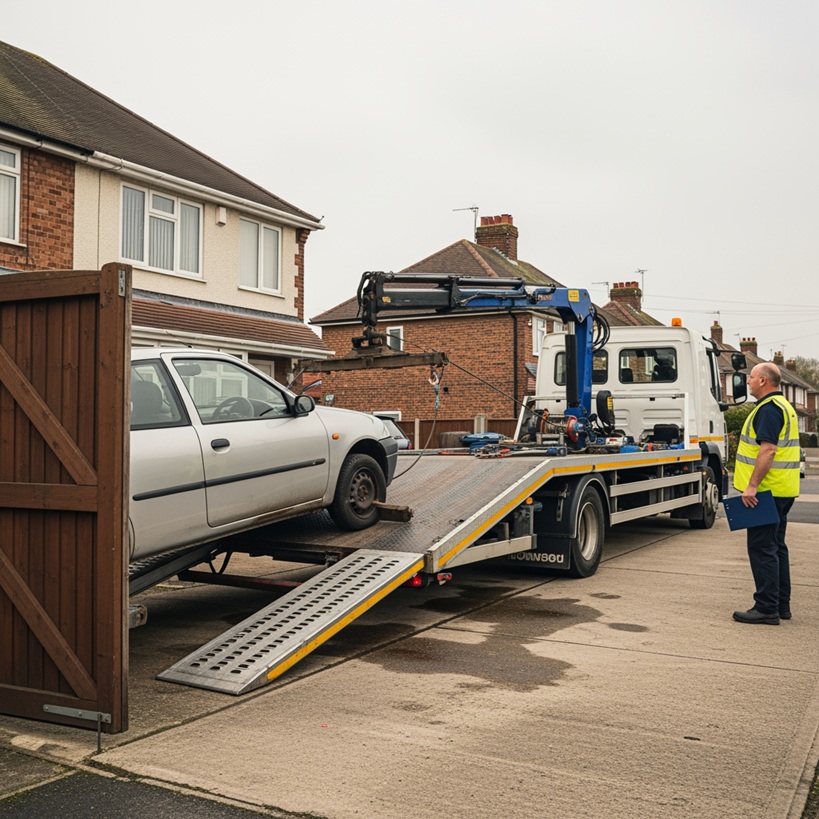
You will hand over the keys and any relevant documents. The driver provides a receipt or collection note. The actual loading takes 10 to 15 minutes for a standard car. The driver uses a hydraulic ramp or winch system to load non-running vehicles. You don’t need to be present for the entire process, but someone over 18 must be available to sign paperwork.
Payment methods are strict due to the Scrap Metal Dealers Act. Legitimate operators will never pay cash. Instead, you will receive payment via bank transfer, which is secure and leaves a proper audit trail.
What Happens After Collection
Your car travels directly to an Authorised Treatment Facility (ATF). The process usually follows these steps:
- Depollution: Hazardous materials are removed before crushing. Fluids like engine oil, coolant, and brake fluid are safely extracted and disposed of to meet UK environmental standards.
- Part Removal: Valuable components get removed for resale. Catalytic converters, batteries, and undamaged body panels often have more value as parts.
- Shredding: The remaining shell is crushed and shredded. Powerful magnets separate ferrous metals (steel and iron) from non-ferrous metals.
These materials are sold to recyclers who melt them down for reuse. It is vital to ensure eco-friendly disposal so that hazardous materials don’t end up leaching into the ground.
Legal Obligations and DVLA Notification
The scrap dealer must notify the DVLA within one week of collecting your vehicle. However, you have a responsibility here too. This notification removes the car from your name. It stops you from receiving tax reminders or parking fines for a vehicle you no longer own.
The Certificate of Destruction (CoD) is the most critical document in this process. It serves as your permanent record that the vehicle has been destroyed and is no longer on the road. Keep it somewhere safe. To ensure you receive this vital paperwork, you should always connect with an authorised dealer who is licensed to issue them.
Common Collection Scenarios
Non-Running and Damaged Vehicles
Non-running vehicles present no additional cost with legitimate services. The recovery truck comes equipped with a winch system designed for vehicles that won’t start. You don’t need to warn them about a flat battery. However, if the car has no wheels or is sitting on bricks, you must mention this. It requires a hiab (crane) truck to lift the vehicle rather than drag it.
Commercial Vehicles and Vans
Vans and commercial vehicles follow the same collection process. They often command higher prices due to greater metal content. If you have a larger vehicle to dispose of, you can get a commercial vehicle quote specifically tailored to the heavier weight of vans.
Nationwide Coverage
One of the benefits of using a national network is coverage. Whether you are in the Scottish Highlands, the Welsh Valleys, or down in Cornwall, collection is generally available. While remote areas might have slightly longer lead times than urban centres like Birmingham or Leeds, the service remains free.
Red Flags and Scam Prevention
Legitimate scrap car collection is free, but dodgy operators exist. Watch for these warning signs:
- Requests for payment upfront: You should receive money, not pay it.
- Offering Cash: Paying cash for scrap cars is illegal in the UK.
- No ATF authorisation: Legal recycling requires licensing from the Environment Agency.
- No Certificate of Destruction: This document is legally required.
Always verify the collector is taking your car to an ATF. Using a trusted service ensures you are protected from illegal operators who might fly-tip your vehicle. You should always choose a verified network to guarantee that your car is handled legally and safely.
Conclusion
Free scrap car collection removes the logistical headache of disposing of an unwanted vehicle. The process ensures legal and environmental compliance. From initial quote to final recycling, it typically takes less than a week and requires minimal effort from you.
Choosing legitimate operators protects you from legal complications. The Certificate of Destruction and DVLA notification are crucial documents that prove you have disposed of the vehicle correctly. It is one of the few transactions in life that is genuinely as simple as it sounds.
If you are ready to clear that space on your driveway, call our team on 01772 665 909. You can also contact us through our website to arrange your free collection.