Get Instant Quote for Fire-Damaged Car: Free Assessment and Collection
15th Jun, 2026
Fire is a traumatic event for any vehicle owner. It often leaves behind a shell that looks like it belongs in a museum of modern art rather than on a suburban driveway. Even though the interior is reduced to ash and the paint is blistered, the skeleton of the vehicle remains a valuable asset. A fire-damaged car is rarely an eyesore without value: it is a collection of high-grade industrial metals waiting to be reclaimed. Understanding the true state of a burnt vehicle is the only way to ensure owners are not left out of pocket after a total loss.
Most motorists assume that because their car cannot be driven or even sat in, it has lost all its worth. In the scrap metal market, appearance is secondary to mass. A blackened engine block and a scorched chassis still weigh exactly the same as they did before the flames. This report provides the technical depth and financial data needed to help secure a fair return for the vehicle. In the 2026 UK market, where recycling technology for burnt materials has advanced significantly, obtaining a professional fire damaged car quote is a critical step in clearing property and recouping losses.
What Determines a Fire-Damaged Car’s Value
The severity of a fire dictates whether a vehicle is categorized as salvage or pure scrap. Localized engine bay fires often leave the rear of the car intact, meaning parts like the rear axle or fuel tank might still be recovered. However, a “cabin fire” that consumes the interior often reaches temperatures high enough to melt the glass and warp the thin body panels. In these cases, the car is almost always classified as a Category B write-off. According to strict UK salvage laws, a Category B write-off can never return to the road, meaning the shell must be crushed by an Authorised Treatment Facility.
Weight and metal content are the primary value determinants for fire-damaged cars. As of early 2026, UK scrap prices generally track between £140 and £260 per tonne. A fire-damaged SUV weighing 2.2 tonnes can still return between £300 and £500 based on its raw material weight alone. While the fire might have destroyed the soft components like leather seats or plastic dashboards, the ferrous steel and non-ferrous aluminium remain fully intact.
For older vehicles over ten years old, fire damage rarely impacts the scrap value because the primary worth is already rooted in the metal weight. However, for newer vehicles, fire damage significantly reduces the valuation compared to a standard mechanical failure, as the opportunity for lucrative parts salvage is eliminated. In these severe cases, owners must evaluate their asset objectively, knowing the valuation will focus almost exclusively on the tonnage rate of the remaining steel and aluminium. Securing an accurate scrap a vehicle quote ensures the financial return reflects the true industrial weight of the remaining chassis.
How the Quote Process Actually Works
Obtaining a definitive fire damaged car quote in 2026 is a digital process that removes the need for a physical inspection. By entering the vehicle registration number, a professional network can pull the exact build specifications directly from the DVLA database. This official data includes the original kerb weight and the exact ratio of aluminium and steel used during the manufacturing of that specific model. This allows for a precise valuation based on current, real-time commodity market rates rather than a visual guess.
The process is designed for maximum speed and efficiency. Once a collection postcode is provided, the system automatically calculates the logistics cost of dispatching a specialized recovery vehicle to that exact location. For fire-damaged cars, complete honesty is absolutely essential during the initial disclosure phase. Owners must clearly indicate if the tyres have melted to the tarmac or if the wheels are completely seized from the heat.
Providing accurate details regarding the state of the vehicle’s rolling gear ensures the correct heavy-duty recovery equipment is dispatched. Sending a standard flatbed for a vehicle that cannot roll creates massive delays on collection day. Ensuring the correct winch or crane is sent prevents these logistical bottlenecks entirely, creating a seamless car scrapping experience for the owner.
Why Fire-Damaged Cars Still Have Worth
A car fire does not destroy heavy industrial metal: it simply changes its chemical state or burns away protective factory coatings. The underlying steel frame of a vehicle remains highly sought after by national recyclers because it can be remelted with significantly less energy compared to producing virgin steel. Aluminium components are even more valuable in the current industrial market. In 2026, recycled aluminium trades at a massive premium compared to standard mild steel.
Premium vehicles from luxury brands utilize extensive aluminium in their chassis designs to save weight and improve performance. This thick, aerospace-grade aluminium survives all but the most extreme, prolonged infernos. Securing an objective car recycling valuation ensures owners extract the absolute maximum baseline worth from these high-value non-ferrous metals despite the horrific cosmetic damage.
Specific exhaust components also retain significant value after a severe fire. The catalytic converter features a dense ceramic core containing rare earth metals like platinum, palladium, and rhodium. These specific precious metals possess a melting point far higher than a standard automotive fire, meaning they can still be profitably recovered and reintroduced into the manufacturing supply chain.
What Happens During Free Collection
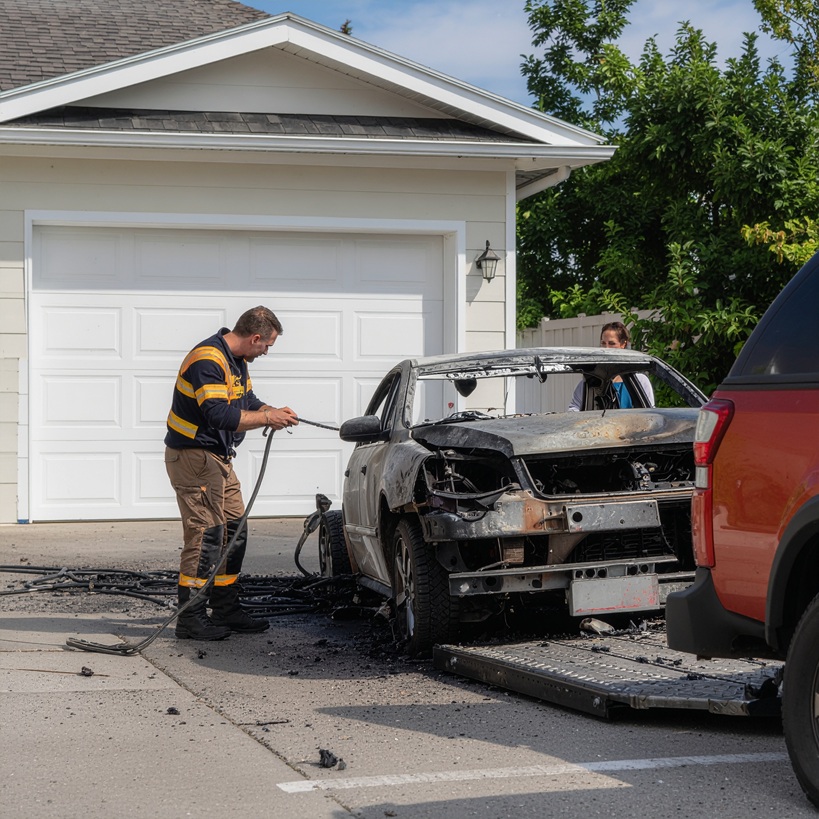
Fire-damaged cars present unique, complex logistical challenges for recovery drivers. Because they frequently suffer from melted tyres or severely compromised braking systems, they cannot be simply rolled or driven onto a standard trailer. Professional collection networks dispatch drivers equipped with highly specialized heavy recovery vehicles. A standard flatbed truck featuring a high-capacity hydraulic winch is the minimum requirement for extracting a burnt vehicle.
In complex cases where the vehicle is located in a tight residential driveway with seized wheels, a Hiab crane truck is often required. The operator uses heavy-duty lifting straps to hoist the burnt shell directly into the air and safely onto the flatbed. Utilizing a professional scrap car collection service prevents the dragging of bare metal across the property, which could cause severe secondary damage to the paving or tarmac.
The physical collection process typically takes between twenty and forty minutes depending on the specific location. Upon arrival, the recovery specialist verifies the vehicle registration and checks the surrounding area for any remaining hazardous debris. Clearing shattered glass and melted plastic pools prior to the truck arriving ensures a swift, safe extraction without unnecessary delays.
Legal Requirements and Environmental Recycling
A catastrophic car fire triggers several strict legal obligations that differ slightly from a standard disposal scenario. When a vehicle is designated as a Category B write-off by an assessor, the V5C logbook is often completely destroyed inside the burning glovebox. Owners do not need to wait weeks for a costly replacement document from the DVLA to initiate the scrapping process. A written notification to the DVLA, explaining the fire damage and providing the ATF details, satisfies the primary legal requirement.
Owners must also notify their insurance provider regarding the fire, even if they choose not to file a formal financial claim. The insurer is legally obligated to update the vehicle’s status on the Motor Insurance Anti-Fraud and Theft Register. This critical database update prevents criminals from cloning the identity of the burnt vehicle for illicit purposes. Securing the official Certificate of Destruction through a licensed legal vehicle disposal service is the final, vital administrative step.
From an environmental standpoint, fire-damaged cars require intensely specialized handling protocols. The burning of modern automotive plastics, rubber hoses, and synthetic seat foams leaves behind highly toxic, acidic residues. Professional Authorised Treatment Facilities neutralize these dangerous chemical byproducts, ensuring the acidic ash and melted plastic residues are safely stripped away before the main metal shell enters the heavy industrial shredder.
The 95% Material Recovery Target
In strict accordance with the UK End-of-Life Vehicle Directive, licensed facilities must achieve a minimum 95 percent material recovery target. This ambitious mandate ensures that even the most severely damaged shells contribute positively to the global circular economy. Processing a burnt vehicle transforms a localized environmental hazard into sustainable raw materials for future manufacturing.
Professional ATFs possess the industrial infrastructure required to separate the various metals surviving the fire. Massive shredders reduce the burnt chassis into fist-sized chunks within seconds. Powerful magnets then extract the ferrous steel, while eddy current separators sort out the non-ferrous aluminium and copper.
This highly efficient mechanical separation ensures zero valuable material is lost to landfill. Finding an authorized vehicle recycling facility guarantees this advanced processing technology is utilized, maximizing the financial return for the final metal yield. The recovered metals are then shipped directly to foundries to be melted down and repurposed into new commercial goods.
Conclusion
A fire-damaged car is a definitive signal that a vehicle’s operational lifespan has concluded in the most abrupt manner possible. While the sight of a scorched, melted shell is deeply distressing, the financial recovery process remains highly straightforward when utilizing a licensed disposal network. Scrapping the remains provides a guaranteed, fast bank transfer, a definitive legal break, and the ultimate peace of mind that all hazardous residues are handled by licensed professionals.
Motorists must look at the objective numbers rather than focusing on the blistered paint and melted interiors. Securing a professional valuation based entirely on the raw tonnage of the surviving metal provides a clear path forward. The immediate cash injection from a raw material sale helps offset the sudden shock of a total vehicle loss.
When it is time to remove the scorched remains and reclaim that valuable property space, the Scrap Car Network provides instant valuations across the entire UK.
For clear, grounded advice regarding severe fire damage and the safe extraction of seized vehicles, please speak with us directly.
Alternatively, owners can reach the support team at 01772 665 909 to request a comprehensive fire damaged car quote and discuss specific collection logistics for their destroyed asset.