Abandoned Car on Your Property: Fast Removal and Cash Offer
28th May, 2026
Discovering an abandoned car on private property presents a unique and highly frustrating logistical challenge for landowners. A vehicle left to rot is not merely an unsightly nuisance taking up valuable real estate; it represents a complex web of legal liabilities, environmental hazards, and administrative hurdles. Whether dealing with a rusted hatchback left behind by a former residential tenant or a commercial van dumped mysteriously in a business park, property owners are suddenly tasked with resolving someone else’s problem.
Many individuals mistakenly assume that private property ownership grants the immediate right to tow or scrap any unauthorised vehicle. Unfortunately, property law in the UK is heavily structured to protect the assets of vehicle owners. Disposing of a vehicle without following highly specific statutory procedures can result in severe legal consequences, including civil claims for the full replacement value of the car.
However, understanding the correct abandoned car removal process transforms this legal headache into a manageable, step-by-step administrative task. By meticulously following the statutory requirements to locate the owner and issue formal notices, landowners can legally clear their property. Once the correct legal threshold is met, professional recovery networks can facilitate safe removal, ensure total environmental compliance, and potentially provide financial compensation for the scrap metal value.
Understanding What Legally Counts as Abandoned
The initial step in this process requires determining if the vehicle meets the strict legal definition of abandonment, rather than simply being a case of nuisance parking. Nuisance parking involves an identified owner parking without permission, which requires a different legal approach. True abandonment implies that the owner has intentionally relinquished all rights and interest in the vehicle, with no intention of ever returning to collect it.
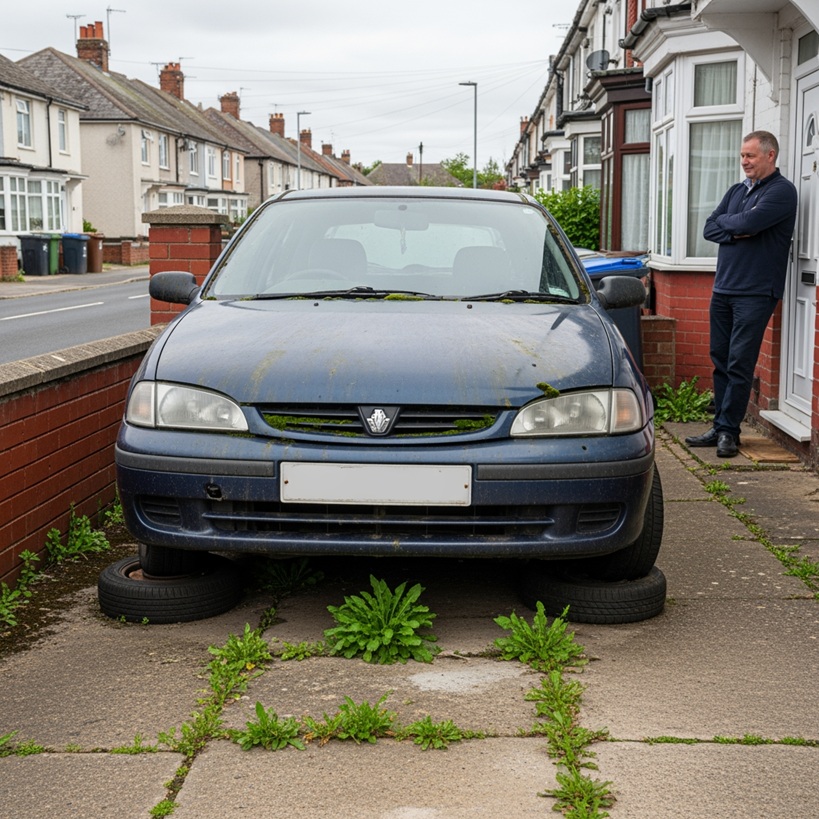
Building a reasonable legal case for abandonment requires documenting physical evidence. Vehicles that have been genuinely discarded typically exhibit clear signs of long-term neglect. Flat tyres that have warped from sitting on the rims for extended periods are a primary indicator. Additional signs include broken glass, accumulated moss around window seals, and a heavy, undisturbed layer of environmental grime.
Missing number plates serve as a massive red flag, often indicating a deliberate attempt to distance the owner from the vehicle. Furthermore, checking the vehicle’s status through the public DVLA database is crucial. A car that has been untaxed and lacking a valid MOT certificate for several months, whilst remaining stationary on private land, strongly supports a legal claim of abandonment.
Your Legal Rights as a Property Owner
Private landowners possess a fundamental right to the peaceful enjoyment of their property, which inherently includes the right to remove unauthorised vehicles. However, the execution of this right is strictly governed by the Torts (Interference with Goods) Act 1977. This legislation establishes the exact protocols for handling goods left on private land without permission.
The Torts Act dictates that landowners hold a legal “duty of care” towards the vehicle, regardless of the fact that it is trespassing. Property owners cannot deliberately damage the vehicle, move it recklessly, or dispose of it immediately. The law mandates that genuine, provable efforts must be made to locate the original owner and provide them with a reasonable opportunity to collect their property.
Failure to adhere to these statutory requirements leaves the landowner exposed to significant civil liability. If a vehicle is scrapped without proper notice, the original owner can successfully sue for the financial value of the car. Proving that reasonable, legally compliant conduct was maintained throughout the process is the only way to shield a property owner from these civil claims.
The DVLA Keeper Enquiry Process
Fulfilling the legal obligation to locate the owner begins with the Driver and Vehicle Licensing Agency (DVLA). As the central repository for vehicle registration data in the UK, the DVLA can provide the registered keeper’s details to individuals who demonstrate a “reasonable cause.” Resolving a matter of property trespass and intending to issue a legal tort notice is universally recognised as a valid reasonable cause.
Landowners must submit a V888 form to request this information. The application requires the vehicle’s registration number, make, and model. If the registration plates are missing, the 17-digit Vehicle Identification Number (VIN) must be located, typically visible through the lower passenger side of the windscreen.
The application must include a clear explanation of why the data is required, accompanied by supporting evidence such as date-stamped photographs showing the vehicle’s stationary position and deteriorated condition. The DVLA generally processes these requests within ten working days, returning either the current keeper’s details or confirming that no details are held. This official response must be retained as critical evidence of a legal search attempt.
When to Contact Your Local Council
A common misconception is that local councils are responsible for clearing all abandoned vehicles. Under the Refuse Disposal (Amenity) Act 1978, local authorities have a strict statutory duty to remove abandoned vehicles from public roads and highways. However, their jurisdiction and willingness to intervene on private land are significantly limited.
Most local councils will decline to remove vehicles from private residential driveways or commercial car parks, as they lack the budget and legal remit to clear private land for free. The primary exception occurs when a vehicle presents an immediate, severe environmental health hazard. If a car is actively leaking significant quantities of engine oil into the soil, or if it has been burnt out and poses a public danger, the council’s environmental health department may step in.
For standard abandonment issues on private property, landowners must manage the administrative removal process independently. Property owners who attempt to report abandoned car issues to the council regarding private land will typically be directed to follow the procedures outlined in the Torts Act.
The Formal Notice Requirement
Upon receiving the registered keeper’s details from the DVLA, the landowner must serve a formal tort notice. If the DVLA has no record of a keeper, this notice must be securely attached directly to the vehicle in a highly visible, waterproof sleeve. This formal correspondence acts as the definitive legal warning before disposal.
The notice must be uncompromising, professional, and factually accurate. It must contain the landowner’s contact information, the exact location of the vehicle, and a clear description of the car. The letter must explicitly state that the vehicle is considered abandoned and reference the Torts (Interference with Goods) Act 1977.
Crucially, the notice must establish a firm deadline for the owner to remove the vehicle. Standard legal practice dictates providing a minimum of 14 days from the date of receipt. The letter must state that failure to collect the vehicle by this deadline will result in its disposal. Sending this notice via recorded delivery is absolutely essential, as the signed receipt or the returned, unopened envelope provides undeniable proof that the legal duty of care was fulfilled.
Working with Authorised Treatment Facilities
Once the 14-day notice period has expired without resolution, the landowner is legally cleared to arrange disposal. Choosing the correct disposal method is vital to avoid subsequent environmental and legal liabilities. Vehicles must only be transferred to Authorised Treatment Facilities (ATFs), which are heavily regulated industrial sites monitored by the Environment Agency.
Modern vehicles contain numerous hazardous materials, including explosive airbag charges, heavy metals, and toxic fluids. When you arrange to scrap my car through a licensed ATF, the facility is legally bound to follow strict environmental depollution protocols. This ensures that harmful chemicals do not leach into the local water table or soil.
Utilising a professional network to connect with an ATF also provides significant logistical advantages. Licensed operators possess the correct heavy-duty winching equipment required to move vehicles that have completely seized brakes or missing wheels. Furthermore, professional facilities handle the complex DVLA notification process, ensuring the vehicle’s disposal is officially recorded on the national database.
Getting Paid for an Abandoned Vehicle
Landowners frequently inquire about the legality of retaining any financial compensation received for scrapping an abandoned vehicle. The legal framework surrounding this is nuanced, but the practical outcome generally favours the property owner. Under the Torts Act, if abandoned property is sold, the seller is entitled to deduct reasonable costs incurred during the process, with the remaining balance held for the owner.
Reasonable costs legally include the DVLA V888 application fee, recorded delivery postage, and a fair daily storage rate for the space the vehicle occupied. Because the vast majority of abandoned vehicles hold only basic scrap metal value, the accumulated administrative and storage costs almost invariably exceed the financial yield of the scrap metal.
Consequently, the landowner is legally justified in retaining the payment to offset their financial losses. If a property owner is dealing with a large commercial vehicle occupying multiple revenue-generating parking bays, choosing to scrap my van through an ATF can help recover a small portion of that lost income, whilst primarily solving the spatial issue.
The Certificate of Destruction: Your Protection
The legal liability surrounding an abandoned vehicle is not fully extinguished until an official Certificate of Destruction (CoD) is issued. When property owners take the legal steps to scrap my vehicle through a licensed channel, this document acts as the ultimate proof of legal disposal. Only an ATF with a secure, direct link to the DVLA database can generate a valid CoD.
The issuance of a CoD conclusively proves that the vehicle has been destroyed in accordance with strict environmental legislation. Most importantly for the landowner, this document permanently severs any future connection between the vehicle shell, the property, and the original owner.
If the discarded vehicle was previously involved in criminal activity, or if cloned registration plates are subsequently used illegally, the CoD serves as an unassailable legal defence. It proves that the original physical shell was crushed legally under the authority of the Torts Act, completely protecting the property owner from future police inquiries or council fines.
Regional Variations and Local Procedures
While the overarching principles of the Torts Act apply universally across England and Wales, local logistics and slight regulatory variations can influence the speed of the removal process. Landowners in densely populated urban centres face unique spatial pressures, often prompting immediate legal action the moment a vehicle appears abandoned.
Because metropolitan areas boast a high concentration of licensed ATFs, securing same-day or next-day collection is highly achievable once the 14-day notice period concludes. Conversely, landowners in rural locations, such as agricultural estates or isolated commercial parks, must account for extended travel times for heavy recovery vehicles.
Despite these logistical differences, the fundamental statutory requirements remain identical nationwide. A property owner in a remote location cannot bypass the mandatory 14-day notice period simply because the vehicle is out of public sight. Consistency in following the legal framework is mandatory, regardless of the property’s geographical location.
Common Mistakes That Cost You Money
Frustration often drives property owners to make impulsive decisions that result in severe financial penalties. The most prevalent and dangerous mistake is attempting to physically tow an abandoned vehicle off private land and push it onto a public highway or grass verge.
Moving an unauthorised vehicle onto public land instantly transfers the legal liability. The property owner becomes guilty of fly-tipping and creating a dangerous highway obstruction. Local authorities actively investigate these incidents using CCTV and witness statements, resulting in massive fines and criminal records for the landowner.
Another significant risk involves utilising unlicensed, “cash-in-hand” scrap metal collectors found on social media. These operators frequently strip valuable parts and illegally dump the remaining shell, which can easily be traced back to the property owner. Additionally, landowners must exercise caution regarding personal belongings left inside the vehicle, documenting everything thoroughly to prevent subsequent claims of theft from the original owner.
What Happens During Collection
Once the legal waiting period has elapsed and removal is officially booked, the physical collection process is highly efficient. When you arrange car scrapping, the recovery operator will arrive with a specialised flatbed truck engineered for immobile vehicles.
Because abandoned vehicles rarely have keys and typically suffer from heavily corroded, seized brakes, standard towing is impossible. Professional drivers utilise heavy-duty metal skates or wheeled dollies, which are positioned under the locked tyres. A powerful electric winch then smoothly pulls the vehicle up the ramps without causing friction damage to the driveway or car park surface.
Prior to loading, the operator will conduct a final visual inspection and verify the VIN to guarantee the correct vehicle is being removed. Following the loading procedure, official transfer paperwork is exchanged, and payment for the scrap value is processed via secure bank transfer, adhering to the Scrap Metal Dealers Act 2013, which strictly prohibits cash payments.
Preventing Future Abandoned Vehicle Issues
Dealing with the administrative burden of one abandoned vehicle should prompt property managers to implement robust preventative measures. For commercial landlords and managers of multi-tenant residential blocks, reviewing and strengthening lease agreements is the crucial first step. Contracts should explicitly prohibit the storage of untaxed, uninsured, or unroadworthy vehicles on the premises.
Physical deterrents are equally important. Installing clearly visible warning signage outlining the legal consequences of unauthorised parking creates an immediate psychological barrier. For persistent issues, installing lockable access gates, rising bollards, or strict permit parking systems drastically reduces the likelihood of vehicles being dumped.
Regular property inspections are vital for early detection. If landowners identify and report abandoned car indicators early, such as a flat tyre or a buildup of leaf debris, the 14-day formal notice process can be initiated promptly, preventing the vehicle from becoming a long-term, deteriorating hazard.
The Environmental Angle
Expediting an abandoned car removal is a critical environmental intervention. Vehicles are engineered for regular operation; when left entirely static exposed to the elements, their internal systems degrade rapidly and catastrophically. Rubber brake hoses perish and split, whilst steel fuel tanks rust from the inside out due to moisture condensation.
This degradation inevitably leads to highly toxic substances, including brake fluid, stale petrol, and corrosive lead-acid, leaking directly into the ground. These chemicals easily penetrate the soil and contaminate local groundwater supplies. By securing the scrap value of my car through a licensed facility, these environmental disasters are prevented.
ATFs execute a meticulous depollution process, safely draining all fluids into sealed, specialised containment vats before the physical crushing begins. The remaining steel and aluminium are then shredded and melted down, re-entering the manufacturing supply chain and significantly reducing the massive carbon footprint associated with mining raw iron ore.
Dealing with Stolen or Criminal Vehicles
Property owners must always maintain vigilance for indicators that an abandoned vehicle may be the result of criminal activity. Vehicles are frequently stolen for joyriding or to facilitate burglaries, and subsequently dumped in quiet, private car parks to avoid immediate police detection.
Clear signs of theft include shattered driver’s side windows, violently forced door locks, or a damaged steering column where the ignition wiring has been exposed. Mismatched or crudely attached number plates are also significant indicators of criminal involvement.
If any of these signs are present, the Torts Act procedures must be immediately suspended. The landowner must contact the police using the non-emergency 101 number. If the vehicle is confirmed as stolen, it becomes active criminal evidence. Law enforcement will assume total responsibility for its forensic recovery, entirely relieving the property owner of any administrative or logistical duties regarding the vehicle’s removal.
Conclusion
Resolving the issue of an unwanted vehicle on private property demands a methodical, patient approach that strictly adheres to statutory law. While the administrative steps may seem tedious, they are the only mechanism that provides total legal immunity for the property owner. Rushing the process or taking matters into your own hands inevitably leads to severe financial and legal repercussions.
By diligently submitting DVLA enquiries, serving formal 14-day notices via recorded delivery, and maintaining an exhaustive paper trail, landowners fulfill their legal obligations. Once this threshold is crossed, the burden of the vehicle can be entirely transferred to licensed professionals who possess the equipment and authority to process it safely.
When the legal waiting period has concluded, our network is prepared to assist with the final logistical steps. The Scrap Car Network partners with licensed Authorised Treatment Facilities nationwide to ensure swift, compliant removal once you have clearance.
For expert guidance on the final stages of collection or navigating the necessary paperwork, please feel free to contact us to arrange a fast, legal, and environmentally sound resolution to your property dispute.