Car Won’t Start: Non-Runner Emergency Scrap Collection
28th May, 2026
A car that won’t start is incredibly frustrating. It stops being a useful mode of transport and instantly becomes a heavy metal weight on your driveway. Whether you are dealing with a sudden mechanical failure, a seized engine, or the accumulated fatigue of too many harsh winters, a non-runner presents a unique headache.
You cannot simply drive it to a dealership for a trade-in, and private buyers generally avoid cars they cannot test drive. If you have decided that your best option is a car won’t start scrap solution, you need to understand exactly how the system works.
The process is heavily regulated in the UK to protect the environment and prevent vehicle crime. However, with the right approach, getting rid of a dead vehicle is remarkably straightforward. The good news is that your car still holds inherent value, even if the engine hasn’t turned over in years. The sheer weight of the steel, the recyclable components, and the precious metals hidden in the exhaust system all contribute to its worth.
Why Cars Refuse to Start
Mechanics will quickly tell you that cars refuse to start for dozens of reasons. Some are minor inconveniences, while others are terminal diagnoses. Understanding exactly why your vehicle has died helps you decide whether to open your wallet for repairs or finally call the recovery truck.
Common Electrical and Battery Failures
Battery failure is the most common culprit. A simple dead battery just needs a jump start, but on an older vehicle, it often masks deeper electrical gremlins. If your alternator has failed, putting a new battery in will only solve the problem for a few days until that one drains completely too.
Electrical faults on older cars can take hours of expensive diagnostic labour just to locate a single broken wire. Starter motor issues present another significant obstacle. When you turn the key and hear a single, heavy click, your starter is likely jammed or burnt out. Replacement costs typically range from £150 to £400 depending on the make and model. If you are driving an early 2000s hatchback, a £400 repair bill often exceeds the actual residual value of the entire car.
Terminal Mechanical Issues
Engine seizure is the ultimate terminal diagnosis. This happens when internal metal components literally fuse together due to a lack of oil pressure or extreme overheating.
Think of a seized engine like a heavily rusted padlock. No matter how hard you turn the key, the internal mechanisms are permanently welded together and cannot be fixed without completely replacing the unit. When an engine seizes, scrapping is almost always the only sensible financial choice. The cost of a replacement engine, paired with the intense labour required to fit it, simply does not make sense for an older vehicle.
The True Cost of a Non-Running Car
Leaving a broken car to sit on your property is rarely a cost-free decision. Every single day a non-runner occupies space, it creates hidden financial complications.
The most obvious drain is your ongoing insurance premium. Even if the car cannot move, you are legally required to keep it insured unless you have officially declared it off the road. Many owners delay making a Statutory Off Road Notification (SORN) out of sheer procrastination. While they wait, the vehicle tax continues to direct debit from their account.
Rapid Physical and Mechanical Decay
But what actually happens when a car sits unused for months on end? The physical deterioration of a stationary car is shockingly fast. Tyres develop permanent flat spots within a few months of sitting in one position. Brake discs corrode so heavily that the brake pads literally bind to the metal surface, seizing the wheels completely solid.
Engine fluids also degrade horribly over time. This creates a cascade of mechanical failures:
- Brake fluid absorbs moisture from the air, rusting your brake lines from the inside out.
- Old petrol turns into a thick, sticky varnish that permanently clogs delicate fuel injectors.
- Engine oil separates and drops vital protective additives to the bottom of the sump.
This rapid decay is even more problematic for larger commercial vehicles that take up massive amounts of space. It often makes much better financial sense to arrange to scrap my van promptly rather than letting it become a rusty storage shed. Local councils are also becoming incredibly strict, often issuing enforcement notices for untaxed, deteriorating eyesores left on driveways.
What Emergency Scrap Collection Actually Means
When a vehicle cannot be driven safely, standard disposal methods go out the window. You cannot legally tow a modern non-runner with a simple rope on a public road. Without the engine running, you have no power steering and no power brakes, making the car dangerously heavy and impossible to control safely.
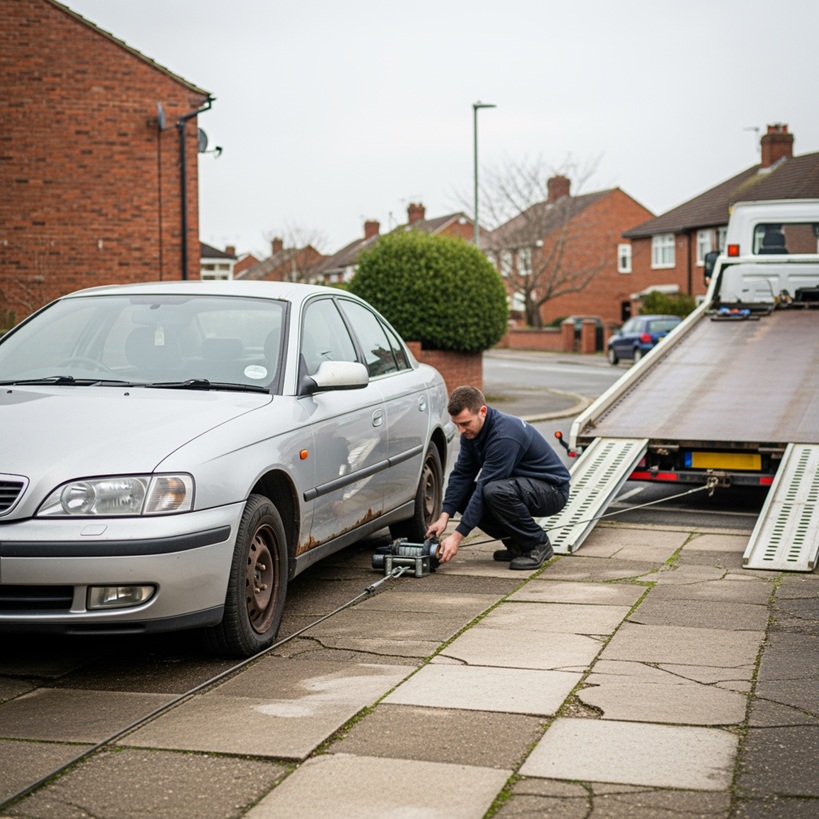
This is where professional emergency collection services step in. These operators utilise specialised recovery vehicles designed specifically for immobile cars. They are trained to extract vehicles smoothly without damaging your driveway or surrounding property.
Heavy Equipment Used by Professionals
Collection teams typically arrive in a 3.5-tonne or 7.5-tonne flatbed truck equipped with heavy-duty electric winches and sturdy metal ramps. The driver knows exactly where to attach the winch cables to the vehicle’s structural towing eyes.
If your wheels are completely seized from sitting too long, the operator will bring specialised equipment. They use strong metal skates or wheeled dollies. These slide directly under your locked tyres, allowing the car to be winched smoothly up the ramps without dragging and gouging your driveway surface. Standard collection timeframes usually range from 24 to 72 hours, depending heavily on your exact location and local facility availability.
The Legal Framework for Scrapping Non-Runners
The UK government closely monitors the end-of-life vehicle industry. You cannot simply hand your keys to someone with a truck and forget about the car.
The V5C logbook remains absolutely essential, even when the vehicle is completely dead. As the registered keeper, you are legally obligated to notify the DVLA that the vehicle has been transferred to the motor trade for dismantling. If you have lost your logbook, do not panic. Reputable facilities can still accept the vehicle, but you will need to provide strong alternative proof of identity and ownership.
The Certificate of Destruction (CoD)
The most important document in this entire process is the Certificate of Destruction. Only a licensed Authorised Treatment Facility (ATF) can issue this official document through the DVLA’s secure system.
It proves conclusively that the vehicle has been subjected to proper car scrapping according to strict environmental laws. Once generated, this certificate immediately severs your legal responsibility for the car. It automatically updates the national database, protecting you from any future road tax demands or mysterious parking fines.
How Non-Runner Valuation Works
Many people worry that a dead car is worthless, but that is simply not true. When calculating the scrap value of my car, the valuation is based primarily on raw materials rather than mechanical health.
The overall weight of the vehicle is the biggest deciding factor. Scrap metal is traded on the global market, and prices fluctuate daily based on international demand. A standard family saloon weighs roughly 1.3 tonnes, which provides a solid baseline value in raw steel and aluminium.
Valuing Salvageable Components
Beyond the basic metal weight, salvageable components add significant extra value to the final quote. Facilities look carefully at parts that can be safely harvested and resold.
Catalytic converters are particularly valuable because they contain rare precious metals like rhodium, palladium, and platinum. If your car has an original, intact catalytic converter, it boosts the price nicely. Unmarked alloy wheels, intact body panels, and working digital dashboard displays also hold strong resale value for the facility, which is reflected in your initial quote.
Preparing a Non-Runner for Collection
You can make the collection day incredibly smooth by doing a little preparation beforehand. Start by completely clearing out your personal belongings.
Thoroughly check the glovebox, the deep door pockets, underneath the seats, and right down in the spare wheel well. Once the car goes onto the back of that recovery truck, it enters an industrial recycling process, and you will not get your sunglasses or loose change back. Next, focus on the physical access to the vehicle. Recovery trucks are wide and have a very poor turning circle.
I remember a job a few years ago where a customer had parked his dead estate car right at the bottom of a steep, curved driveway. He had lost the keys, so the steering lock was jammed on at a bizarre angle. We couldn’t get the truck down the slope safely. We had to put dollies under all four wheels and push it sideways by hand up the drive to the road. It took three of us over an hour in the pouring rain. Being totally honest about access issues when you book the collection saves everyone a massive headache on the day.
The Collection Process Step by Step
Knowing exactly what happens when the truck arrives takes all the stress out of the situation. Your collection driver will usually call you an hour before they arrive to confirm their estimated time of arrival.
Once they pull up, they will perform a quick visual inspection of the non-runner. This inspection is simply to verify that the car matches the description you provided. They check that the vehicle actually has four wheels, that the engine is still in the bay, and that it is the correct make and model.
Once they are happy, you handle the paperwork. You will show your ID, hand over the relevant section of the V5C logbook, and sign the transfer documents. The physical loading of the vehicle is usually surprisingly fast. Payment is strictly regulated in the UK; cash payments for scrap metal are illegal, so you will receive your funds via a secure, traceable bank transfer.
What Happens at the Authorised Treatment Facility
Once your car leaves your driveway, it heads straight to a heavily regulated site for processing. Cars are full of incredibly toxic substances that cannot be allowed to seep into the ground.
This rigorous depollution process is what makes official car recycling so vital for protecting our local environment. After depollution, the vehicle is carefully stripped of any highly valuable, working parts.
The Depollution Process
Trained technicians follow strict environmental guidelines to neutralise the vehicle. This involves several critical steps:
- Draining fluids: Engine oil, gearbox fluid, brake fluid, and engine coolant are drained into sealed vats.
- Fuel removal: The fuel tank is safely punctured to drain any remaining petrol or diesel.
- Gas evacuation: Air conditioning refrigerant gas is safely evacuated using vacuum pumps so it doesn’t escape and damage the ozone layer.
- Battery disposal: The heavy lead-acid battery is removed for separate chemical recycling.
The remaining bare metal shell is then placed into a massive industrial baler. It is crushed into a dense metal cube and transported to a high-speed shredder. The shredder rips the cube into fist-sized chunks of metal in seconds, allowing powerful magnets to separate the steel for melting and reuse.
Common Concerns About Scrapping Non-Runners
It is entirely normal to have questions before handing over your vehicle. The most common worry is whether the price drops massively because the engine is dead.
In reality, the price difference between a runner and a non-runner is usually minimal. The slight reduction simply covers the extra time and fuel required for the recovery truck to winch it, rather than a driver just hopping in and driving it away. Another frequent concern involves missing wheels or keys.
If your car has been sitting on bricks for two years, it is absolutely still collectable. You simply need to declare this clearly when arranging to scrap my vehicle. The recovery team will bring a truck equipped with a heavy-lift crane to physically lift the shell onto the bed, bypassing the need for wheels entirely. You can absolutely scrap a car that has been officially off the road (SORN) for years without filling in any extra forms.
Why Emergency Collection Services Exist
The entire infrastructure for collecting dead vehicles exists because society desperately needs it. Without an easy way to dispose of broken cars, our streets and rural lanes would be permanently clogged with rusting, abandoned vehicles.
Local councils spend millions every year dealing with dumped cars that leak toxic oil into public drains. By providing a streamlined collection service, the industry ensures these vehicles are channelled safely into legal, environmentally friendly treatment facilities.
Handling Insurance Write-Offs
This system also provides the only legal solution for severe insurance write-offs. If your car has been caught in a flood or suffered massive structural damage in a crash, an insurance assessor will classify it as a Category A or B write-off.
These specific categories mean the structural integrity of the car is permanently compromised. These vehicles are legally banned from ever returning to the road. Arranging proper collection is the only lawful way to dispose of the dangerous wreckage and ensure it is crushed securely.
When to Choose Scrapping Over Repair
Are you tired of staring at a broken vehicle every time you look out the window? Deciding exactly when to give up on a car is tough, but applying some simple mechanic’s logic usually makes the choice clear.
You have to calculate the true economic repair threshold. If your local garage quotes you £1,200 to replace a blown head gasket on a fifteen-year-old hatchback that is only worth £900 with a working engine, the maths simply does not add up.
The Money Pit Scenario
You also have to watch out for the dreaded money pit scenario. As cars age well past the 100,000-mile mark, components don’t just fail in isolation; they fail systemically.
You might spend £400 fixing the suspension this month, only for the clutch to completely shatter next month. You end up chasing faults around the vehicle, spending thousands on a car that continues to depreciate. There is also a massive emotional component to this decision. Making the firm decision to let it go instantly removes that background stress and provides immediate closure.
Regional Considerations for Collection
While the legal rules for scrapping are identical across the UK, the physical logistics change depending on your postcode. If you live in a dense urban environment like Greater London, Birmingham, or Manchester, the collection process is usually incredibly fast.
Because there are dozens of licensed facilities located closely together, recovery trucks spend less time driving between jobs, often allowing for same-day removal. If you live in a rural village or out in the Scottish Highlands, the logistics require a bit more planning.
A recovery truck might need to travel fifty miles just to reach your driveway. You might have to wait a few extra days to fit into a scheduled rural collection route. However, distance should not negatively impact the professionalism of the service. Reputable, nationwide networks ensure that all participating facilities adhere to the same strict environmental and customer service standards.
Conclusion
Dealing with a car that refuses to start does not have to be a drawn-out, stressful ordeal. Whether your vehicle has suffered a catastrophic engine failure, severe crash damage, or simply reached the natural end of its mechanical life, it still holds genuine value as a recyclable resource.
Stop wasting your hard-earned money on insurance premiums for a driveway ornament. Stop stressing about the deteriorating brakes and the leaking fluids. By using a professional, licensed collection service, you completely remove the logistical headache of moving a heavy, dead vehicle. You ensure the car is depolluted safely and recycled legally, putting a fair bank transfer payment directly into your account.
The Scrap Car Network specialises in matching your vehicle with the best local Authorised Treatment Facilities. Our vetted partners handle all the heavy lifting, the legal DVLA paperwork, and the secure payment process on your behalf.
If you are finally ready to reclaim your driveway and safely dispose of your non-runner, you can get an instant quote to scrap my car today. Our team will arrange a convenient time to winch and collect your vehicle, entirely regardless of its current mechanical state.
For any specific questions about missing V5C logbooks or complicated driveway access, please feel free to contact us directly, and our experienced team will guide you through the next steps.