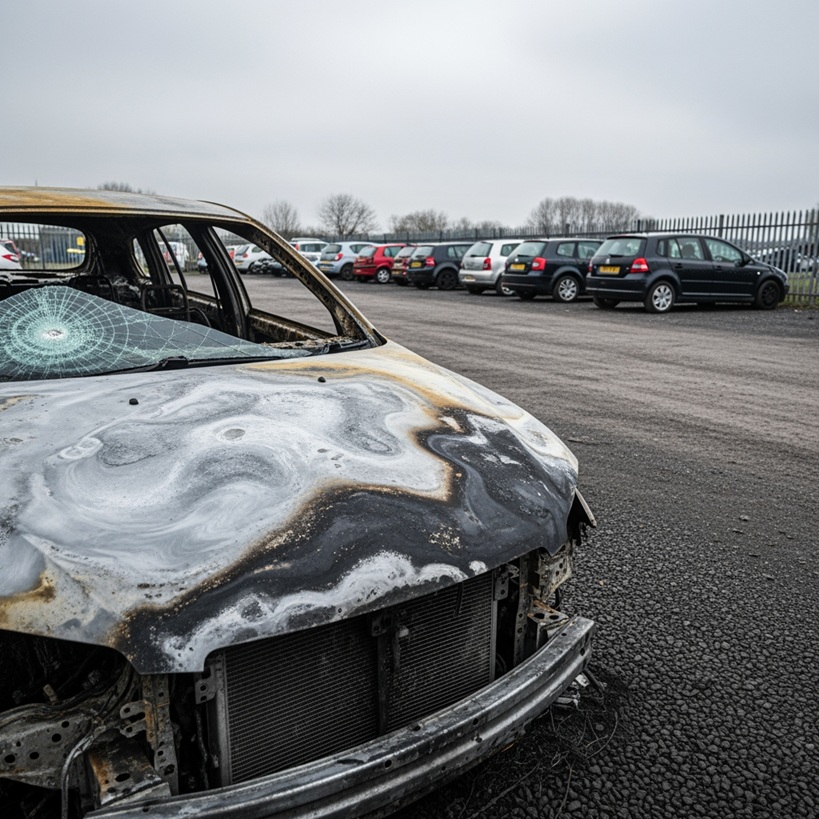
Fire Damage Categories: Minor vs Total Loss Scrap Values
18th May, 2026
A car fire transforms metal and memories into a question of pounds and pence. The difference between minor fire damage and total loss isn’t just academic; it determines whether you will get £150 or £1,500 when you scrap what is left.
Fire damaged car scrap vehicles occupy a unique space in the market. Unlike accident-damaged cars where structural integrity can often be assessed visually, fire damage penetrates deep into a vehicle’s systems. Heat warps metal, melts wiring, and compromises components in ways that are not always immediately visible. For anyone facing the reality of a burnt-out car, understanding how authorised treatment facilities categorise fire damage becomes essential to managing expectations and maximising value.
How Fire Damage Gets Categorised
Insurance companies and scrap dealers use distinct classification systems, but both revolve around the same core question: what is salvageable? The categories are not standardised across the industry, but patterns emerge consistently.
Minor fire damage typically affects isolated areas, perhaps an engine bay fire that was quickly extinguished, or interior damage from a small electrical fault. The vehicle’s structural integrity remains sound, and key mechanical components survive intact. These cars often retain significant scrap value because major systems can be harvested for parts.
Total loss fire damage means the fire consumed or compromised virtually everything. Whether the car burned for extended periods or the fire reached critical areas like fuel systems, these vehicles offer minimal recovery value. What remains is predominantly fire damage scrap value based on metal weight, with almost no salvageable parts.
What Determines Minor Versus Total Loss
The line between categories is not drawn by flame height or burn duration alone. Several factors combine to determine where a fire-damaged vehicle lands on the value spectrum.
Location of the fire matters enormously. An engine bay fire that never reaches the cabin preserves the interior, electronics, and many valuable components. A fire that starts in the cabin and spreads outward typically causes more comprehensive damage because it affects wiring looms, computer modules, and the structural elements that hold everything together.
Duration and intensity obviously play crucial roles. A fire extinguished within minutes causes different damage than one that burns for twenty minutes. High-intensity fires reach temperatures that melt aluminium components and warp steel chassis members.
Scrap Values for Minor Fire Damage
Minor fire damage doesn’t mean minor consequences, but it does preserve significant scrap value. These vehicles typically fetch higher sums depending on make, model, and which components survived intact.
The value stems from salvageable parts rather than whole-vehicle recovery. A 2018 BMW with fire damage confined to the engine bay might yield a working gearbox, suspension components, interior trim, wheels, and numerous electrical modules. The same fire on a 2008 Ford Focus produces lower returns simply because the parts market values newer, premium components more highly.
Catalytic converters often survive minor fires, and these alone can contribute significantly to scrap value. Modern catalytic converters contain platinum, palladium, and rhodium, precious metals that retain value regardless of fire damage.
Total Loss Fire Damage Values
Total loss fire damage vehicles represent the opposite end of the spectrum. These burnt-out shells typically fetch values aligned with basic scrap metal prices, offering minimal parts recovery potential.
The calculation becomes brutally simple: weight multiplied by current scrap metal prices. A typical family car yields a set amount in pure steel value. Aluminium components might add a small amount if they are identifiable and recoverable.
The harsh reality for total loss vehicles is that collection and processing costs eat into already minimal values. Some scrap dealers charge collection fees for severely damaged vehicles. You can arrange specialist vehicle collection with our partners who handle these vehicles nationwide without hidden charges.
I recall picking up a burnt-out Range Rover from a country lane. The fire had been so hot the alloy wheels had melted into puddles on the tarmac. There wasn’t a single salvageable part left, just two tonnes of scorched steel. We still paid the owner for the weight, but he was shocked that a £40,000 car was now worth less than a weekly grocery shop.
The Parts Market for Fire-Damaged Cars
Understanding what survives fire damage helps explain the value differential between categories. The automotive parts market operates on supply, demand, and condition.
Mechanical components show varying fire resistance. Engines directly involved in fires typically suffer catastrophic damage. However, gearboxes positioned slightly away from the fire’s centre might survive with minimal damage. Suspension components often remain serviceable if the fire didn’t reach them.
Interior components from minor fire damage vehicles can retain surprising value. Seats from unaffected areas, dashboard sections, and trim pieces find ready markets if they are undamaged.
Insurance Write-Offs and Scrap Categories
Insurance companies use Category A, B, S, and N designations that intersect with scrap market categories. Understanding these helps navigate the post-fire process.
Category A represents the most severe damage; vehicles so thoroughly destroyed they must be crushed entirely. No parts can be salvaged legally. Most total loss fire damage vehicles fall into Category A or B.
Category B allows parts recovery but prohibits the chassis or body shell from returning to roads. These vehicles can be broken for parts, but the main structure must be destroyed.
When you need to notify the DVLA of disposal, the insurance category affects the process. Category A and B vehicles require specific documentation to ensure they are permanently removed from road use.
Current Market Factors Affecting Fire Damage Values
Fire damage scrap value fluctuates based on broader market conditions that affect all vehicles but impact fire-damaged cars particularly acutely.
Global metal prices drive baseline scrap values. Steel and aluminium prices show volatility, which can mean a noticeable difference in scrap value for the same vehicle at different times. You can check current trends in our scrap metal market overview.
Getting Maximum Value from Fire-Damaged Cars
Several practical steps help extract the best possible value from a fire-damaged vehicle, regardless of category.
Obtain multiple quotes from different scrap dealers. Values can vary significantly depending on the dealer’s current inventory needs. Document the damage thoroughly with photographs showing the fire’s extent and which components survived intact. Clear documentation helps dealers provide accurate quotes without inspection visits.
The Scrap Car Network can help connect you with vetted dealers who understand how to price these complex vehicles fairly.
Legal Requirements for Scrapping Fire-Damaged Vehicles
Fire damage does not exempt owners from legal obligations around vehicle disposal. Several requirements apply regardless of the car’s condition.
DVLA notification remains mandatory. You must inform the DVLA when scrapping a fire-damaged vehicle. Failure to do this leaves you legally responsible for the vehicle.
The Certificate of Destruction provides proof that your vehicle was scrapped at an Authorised Treatment Facility. This document protects you from future liability. Only ATFs can issue valid Certificates of Destruction, a crucial reason to use an authorised scrap dealer.
Regional Variations in Fire Damage Scrap Values
Geography affects scrap values more than many people realise. Collection costs, local scrap metal prices, and regional parts demand all create variations.
Urban areas typically offer slightly higher scrap values because collection costs are lower and dealer competition is stronger. A fire-damaged car in London might fetch more than an identical vehicle in rural Scotland simply due to logistics and market density.
Making the Decision: Repair or Scrap
For minor fire damage vehicles, the repair-versus-scrap decision isn’t always straightforward. Several factors determine the sensible choice.
Repair costs for fire damage typically exceed initial estimates because hidden damage emerges during work. Wiring looms might appear intact but fail under testing. Structural elements might show heat stress that isn’t immediately visible.
Safety considerations must take priority. Fire damage compromises structural integrity in ways that aren’t always repairable to original safety standards. Given these risks, getting an instant quote to scrap often provides the cleanest break from a compromised vehicle.
Conclusion
Fire damage categorisation determines whether a burnt-out car represents a basic scrap metal transaction or a parts recovery opportunity. The difference between minor damage and total loss is not just about flame height; it is about which components survived intact and what the parts market will bear for your specific vehicle.
Minor fire damage preserves significant value through salvageable components, particularly in newer or premium vehicles. Total loss cases reduce to basic scrap metal calculations with minimal recovery potential.
Understanding these categories helps set realistic expectations. For most fire-damaged vehicles, scrapping through legitimate channels provides the most sensible outcome, recovering whatever value remains while ensuring proper environmental disposal and legal compliance.
When you are ready to resolve the situation, get in touch with details about the fire’s extent. You can value your fire-damaged car online now.
Alternatively, our team can help you understand the true value of what remains. Call us on 01772 665 909 or contact us directly.