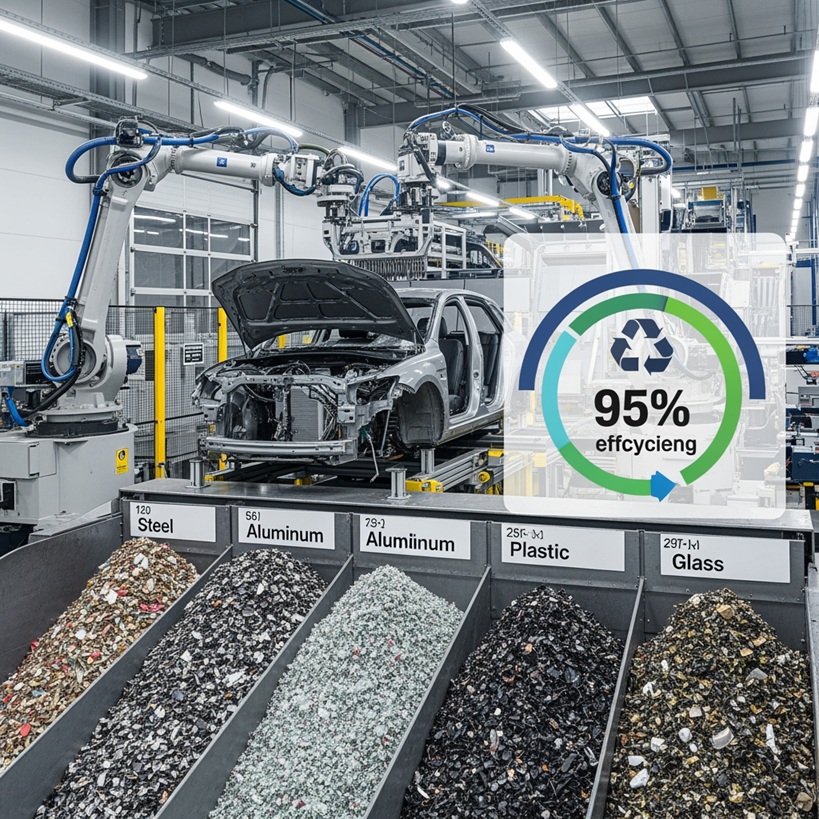
Zero-Waste Goals: Achieving 95% Recyclability in End-of-Life Vehicles
15th Dec, 2025
The car recycling industry has come a long way from the days when end-of-life vehicles were simply crushed and left to rust. Today, the goal is far more ambitious: a zero-waste system where every possible material is recovered, reused, or recycled.
It’s not about getting rid of old cars; it’s about recycling end-of-life vehicles so effectively that nothing valuable is wasted. Every nut, bolt, and bumper can have a second life. Think of your old car not as scrap, but as a collection of materials waiting for a comeback.
This target, achieving 95% recyclability, isn’t just a nice round number. It’s a critical milestone in reducing waste, conserving resources, and building a truly sustainable automotive industry.
Why 95% Recyclability?
So, why is everyone in the industry talking about that magic 95% recyclability figure? It’s not arbitrary; it’s a target set by environmental policy, engineering progress, and a need for change.
When a vehicle reaches the end of its life, it still contains valuable metals, plastics, glass, and textiles. If these materials end up in a landfill, we lose resources that took energy and time to create. By recycling or reusing them, we cut down waste, save energy, and reduce the environmental footprint of manufacturing.
In short, 95% recyclability means:
- Less waste in landfills.
- Lower energy demand for producing new materials.
- More sustainable car production for future generations.
It’s like fixing something rather than throwing it away, it saves money and the planet in one go.
Key takeaways:
- The 95% target reduces waste and conserves energy.
- It’s an environmental and economic milestone.
- Every recycled part supports sustainability.
You can understand our environmentally responsible car recycling process to see how Scrap Car Network helps achieve these goals daily.
The Current State of Car Recycling
We’re already doing well, but there’s more to be done. Across the UK and much of Europe, recycling end-of-life vehicles has become standard practice.
Most modern recycling facilities recover metals like steel and aluminium, along with glass, rubber, and some plastics. These materials are then melted, reshaped, and reused in manufacturing everything from new cars to construction materials.
But while the recycling rate has risen dramatically over the past decade, reaching that 95% goal means tackling the tougher stuff, composites, mixed plastics, and materials that are difficult to separate.
Back in the day, a bloke might strip a car down in his back garden, oil stains on the driveway, and bits of metal everywhere. But those days are gone. Now, Authorised Treatment Facilities (ATFs) use strict environmental standards to ensure every part is processed properly.
Key takeaways:
- Current recycling systems recover most car materials.
- Metals, glass, and plastics are already widely recycled.
- The challenge lies in dealing with complex, multi-material components.
For a deeper look into modern recycling systems, explore how to scrap your car easily and legally through Scrap Car Network.
How 95% Recyclability Is Achieved
Reaching 95% recyclability isn’t luck, it’s precision. The process of recycling end-of-life vehicles involves several coordinated stages, each designed to extract as much value as possible.
Step 1: Depollution
Before any car is dismantled, technicians remove all hazardous materials, engine oil, brake fluid, fuel, and coolant. These substances are collected and disposed of safely, preventing contamination of soil and water.
Step 2: Parts Harvesting
Next, the reusable parts are removed. Engines, gearboxes, alternators, lights, and body panels can often be refurbished or sold. This not only saves materials but also extends the life of quality components.
Step 3: Material Separation
Once stripped, the car’s shell is shredded. The metal is magnetically sorted, steel, aluminium, copper, and other metals go into separate streams. Plastics, glass, and textiles are recovered through advanced sorting systems.
Scrap Car Network ensures all this happens through its network of licensed Authorised Treatment Facilities, maintaining high environmental and safety standards.
Key takeaways:
- The recycling process includes depollution, dismantling, and material sorting.
- Reusable parts are harvested to reduce waste.
- Proper separation ensures 95% of materials are recovered.
Innovations in Car Recycling Technology
The drive towards achieving vehicle recyclability goals is powered by innovation. As technology evolves, recycling facilities are becoming more efficient and precise.
Here are some of the most exciting developments in the field:
- AI-powered sorting systems: Artificial intelligence now helps identify and separate materials faster and more accurately than ever before.
- Advanced shredders: Modern shredding machines can handle different materials without contamination, improving recovery rates.
- Chemical recycling: New processes are emerging to break down complex plastics into reusable base materials.
- Composite reclamation: Researchers are developing ways to separate bonded materials like fibreglass and carbon composites.
These innovations make it possible to reclaim valuable resources once thought too difficult to recover. It’s a bit like having a mechanic with X-ray vision, seeing through each part to find exactly what can be reused.
Scrap Car Network works closely with ATFs using cutting-edge recycling technology, ensuring your old vehicle contributes to a cleaner, more sustainable future.
Key takeaways:
- Advanced technology boosts recycling efficiency.
- AI and automation improve accuracy and speed.
- Chemical recycling and composite recovery expand possibilities.
Challenges to Reaching 95% Recyclability
Of course, no system is perfect. There are still hurdles to overcome before the 95% recyclability target becomes a universal reality.
Composite Materials
Many modern vehicles include composite components, dashboards, bumpers, and interior trims made from multiple materials bonded together. Separating these is complex and costly.
Economic Barriers
Advanced recycling systems require investment. Smaller recycling operators may struggle to afford the technology needed to process every component efficiently.
Legacy Vehicles
Older cars often contain materials that are hard to recycle, such as certain rubber blends and plastic composites. These vehicles may fall short of the 95% goal simply due to age.
Even so, progress continues. Facilities working within the Scrap Car Network are adopting more efficient systems every year to reduce the gap.
If you’re based in the North West, you can even scrap your car in Preston and know it’s handled according to the latest recycling standards.
Key takeaways:
- Complex materials make full recyclability difficult.
- Economic factors limit access to advanced technology.
- Older vehicles contain non-recyclable materials.
The Role of Legislation and Standards
Government policy is another driving force in achieving vehicle recyclability goals. Legislation pushes manufacturers and recyclers to raise their standards.
A key example is the EU End-of-Life Vehicles (ELV) Directive, which sets mandatory recycling and recovery targets for vehicles. It also requires manufacturers to design cars that are easier to disassemble and contain fewer hazardous materials.
This legislation encourages a “design for recycling” approach, thinking about how a car will be dismantled long before it’s ever built.
UK regulations, aligned with these principles, continue to evolve post-Brexit to maintain high environmental standards.
For compliance advice, see our guide on notifying the DVLA when you scrap your car to ensure all legal boxes are ticked.
Key takeaways:
- Legislation ensures cars are designed with recyclability in mind.
- The ELV Directive sets recyclability and recovery targets.
- Manufacturers are incentivised to reduce hazardous materials.
What Can Car Owners Do?
While most of the heavy lifting is done by the recycling industry, car owners have an important role too.
Here’s how you can help reach the zero-waste goal:
- Use licensed scrap dealers: Always choose a reputable service like Scrap Car Network that partners only with ATFs.
- Maintain your car: A well-cared-for vehicle lasts longer and reduces premature waste.
- Recycle responsibly: Don’t abandon or illegally dump cars, it’s harmful and illegal.
- Request documentation: Ensure you receive a Certificate of Destruction when your car is recycled.
- Encourage others: Share the benefits of responsible car scrapping with others in your community.
Scrap Car Network also offers a free nationwide scrap car collection service, making it easy to do the right thing no matter where you live.
Key takeaways:
- Always use licensed, environmentally responsible scrappers.
- Maintaining vehicles reduces premature waste.
- Request proper documentation and collection services.
The Future of Car Recycling
The future of recycling end-of-life vehicles looks bright. With continued investment and innovation, hitting the 95% target is no longer a dream, it’s a realistic goal.
Manufacturers are already designing cars with recyclability in mind, using modular components and fewer mixed materials. Electric vehicle (EV) recycling is also improving, with new facilities focused on battery recovery and reuse.
Over the next decade, expect to see:
- Fully automated dismantling systems using robotics.
- Improved EV battery recycling to reclaim lithium, cobalt, and nickel.
- Smart materials that can be disassembled easily.
- Increased collaboration between manufacturers and recyclers.
The ultimate vision? A closed-loop automotive economy, where end-of-life vehicles feed directly into the creation of new ones.
If you’re curious about how Scrap Car Network supports this shift, you can see our commitment to compliant processing through our ATF partners.
Key takeaways:
- The industry is moving towards complete recyclability.
- EV recycling and automation are key developments.
- Collaboration between sectors ensures a sustainable future.
The Bigger Picture: Towards Zero Waste
Hitting 95% recyclability is part of a larger global movement toward zero waste. In practice, that means designing systems that produce minimal waste at every stage, from manufacturing to disposal.
The automotive industry is leading by example. Through improved engineering, smarter legislation, and responsible scrapping services, the sector is proving that sustainability and practicality can coexist.
Every car recycled properly is a step closer to a cleaner planet and a circular economy where nothing goes to waste.
If you’re ready to be part of that change, get an instant quote to scrap any car and help build a more sustainable future.
Conclusion
Achieving vehicle recyclability goals like the 95% target isn’t just about ticking environmental boxes, it’s about creating a smarter, more efficient, and more sustainable automotive world.
Through technological innovation, government regulation, and consumer responsibility, the industry is proving that even the most complex products can be reused, repurposed, and reborn.
When you scrap your car responsibly through Scrap Car Network, you’re not just clearing space on your driveway, you’re contributing to a zero-waste future where every material finds a new purpose.
So, whether your car’s seen better days or you’re simply ready for something new, make sure it goes out the right way, responsibly, efficiently, and sustainably.