Why Scandinavian Countries Are Leaders in Scrap Car Sustainability
3rd Mar, 2026
After four decades of working with cars, it’s clear that Nordic neighbours have turned what most see as a headache – getting rid of old bangers – into something resembling an art form. Whilst the UK is still figuring out the best ways to handle end-of-life vehicles, countries like Sweden, Norway, and Denmark have been quietly revolutionising the industry for years.
That’s Scandinavia when it comes to car recycling. They’ve taken what used to be a messy, environmentally questionable process and turned it into a model that the rest of the world is scrambling to copy.
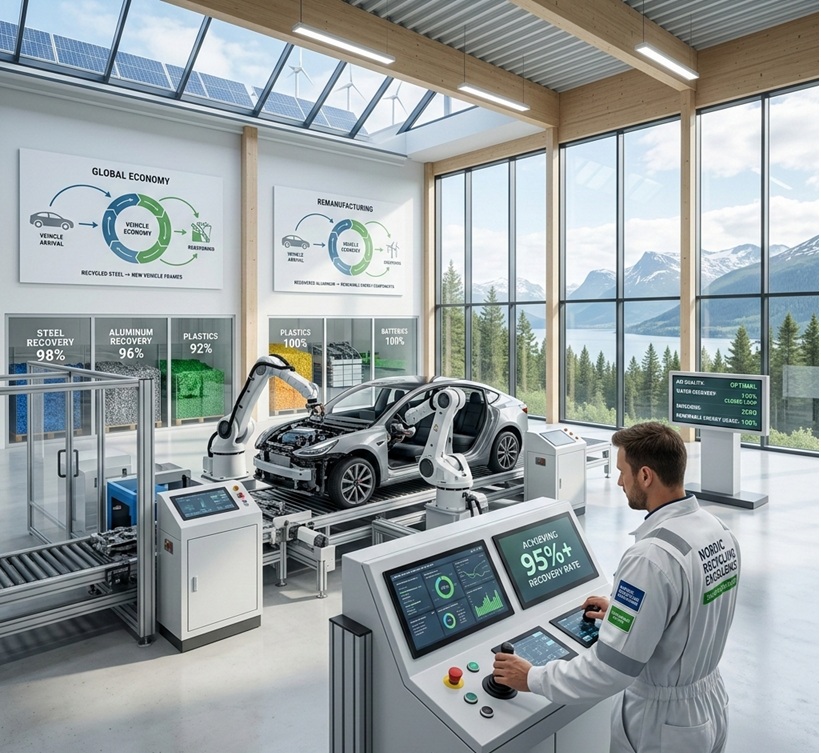
The thing that strikes observers most about their approach isn’t just the impressive recycling rates – though achieving over 95% material recovery from scrapped vehicles is nothing to sneeze at. It’s the way they’ve built entire systems around the idea that every car will eventually need to go somewhere, and that somewhere should benefit everyone involved.
What Makes Nordic Car Recycling Different from Other Countries
Here’s where it gets interesting. Most countries, including ours, treat car scrapping as an afterthought – something that happens when a vehicle finally gives up the ghost. The Scandinavians? They’ve been thinking about a car’s end of life from the moment it rolls off the production line.
Take Sweden’s approach, for instance. They’ve created what’s essentially a circular economy for vehicles. When your Volvo finally decides it’s had enough of Swedish winters, it doesn’t just disappear into a scrapyard. Every component gets catalogued, assessed, and channelled into the most appropriate recycling stream.
The steel goes back to steel production, the aluminium gets reprocessed for new applications, and even the plastics get broken down and reformed. It’s like watching someone completely strip down an engine and use every single bolt, gasket, and spring for something useful.
But here’s the clever bit – they’ve made it profitable for everyone involved:
- Car manufacturers benefit from reduced material costs
- Recycling facilities operate profitably
- Metal dealers get consistent, high-quality supply
- Consumers receive fair compensation for old vehicles
When everyone benefits from doing the right thing, people actually do it. This commitment to sustainability shows how Scandinavian countries lead in scrap car recycling. Connecting with certified facilities nationwide helps UK vehicle owners access Authorised Treatment Facilities that follow similar principles of comprehensive material recovery.
Government Policies That Actually Work in Scandinavia
Plenty of government initiatives come and go over the years, with most proving about as effective as a chocolate teapot. But the Scandinavian governments have done something different – they’ve created policies that work with human nature rather than against it.
Norway’s extended producer responsibility scheme is a perfect example. Car manufacturers aren’t just responsible for building vehicles; they’re financially accountable for what happens when those vehicles reach the end of their useful life. It’s like making a mechanic guarantee their work for the lifetime of the car – suddenly, they’re a lot more careful about how they do things.
The result? Norwegian car manufacturers have become incredibly innovative about designing vehicles that are easier to dismantle and recycle. They’re using fewer problematic materials, making components more accessible for recycling, and even building in features that help recycling facilities do their job more efficiently.
Denmark has taken a slightly different approach with their deposit system for vehicles. When you buy a car, you’re essentially putting down a deposit that you get back when you properly dispose of it at an authorised facility. Simple, effective, and it means old cars don’t end up abandoned in car parks or fly-tipped in the countryside.
These Nordic environmental policies have created a framework that other nations are now studying closely. The policies don’t just mandate compliance – they incentivise innovation and reward responsible behaviour throughout the entire vehicle lifecycle. The environmentally responsible car recycling that partner facilities practise follows these same principles.
Advanced Recycling Technology in Scandinavian Facilities
Walking through a modern Scandinavian car recycling facility feels like stepping into the future. These aren’t the scrapyards of decades past – they’re sophisticated operations with remarkable precision and efficiency.
I remember visiting an automated dismantling plant outside Stockholm a few years back. The moment I stepped inside, it was clear this was something different. Robots worked alongside human technicians, every movement purposeful, every component tracked through computerised systems. The facility manager showed me how they could process a complete vehicle in under two hours, recovering materials with accuracy that traditional yards couldn’t match. It changed how I thought about end-of-life vehicles entirely.
These facilities use advanced sorting technology with infrared sensors for plastics, magnetic separators for ferrous metals, eddy current systems for aluminium and copper, and spectroscopic analysers for complex alloys.
But here’s what’s truly impressive – they’ve figured out how to profitably recycle materials that most facilities just throw away. Those plastic bumpers that usually end up in landfill? They’re getting turned into new automotive components. The foam from car seats? It’s becoming insulation for buildings.
Sweden’s Stena Recycling has developed processes that can recover rare earth metals from electronic components in cars. These are materials that are incredibly valuable but traditionally difficult and expensive to extract.
The automation isn’t just about efficiency – it’s about safety and environmental protection. Fluids are drained in closed systems, airbags safely deployed, refrigerants captured, and hazardous materials handled without human exposure.
Circular Economy Success Stories from Nordic Countries
Here’s something that happened in Finland that perfectly illustrates how this circular approach works in practice. A major automotive manufacturer realised they could use recycled steel from scrapped cars to produce new vehicle frames. The clever part? They created a tracking system that could trace the steel through its entire lifecycle.
Your old Ford could literally become part of someone else’s new car, and they can prove it. The quality of the recycled steel meets the same specifications as virgin materials, but with a fraction of the environmental impact.
Norway has taken this concept further with remanufacturing programmes. Instead of just recycling materials, they’re taking functional components from scrapped vehicles and refurbishing them to like-new condition. Engine blocks, transmissions, even electronic control units are getting second lives in other vehicles.
Documented cases show transmissions pulled from scrapped cars, completely rebuilt, then performing flawlessly for another 200,000 kilometres. It’s the automotive equivalent of turning rubbish into treasure, except it’s been systematised and scaled up to an industrial level.
The economic benefits are substantial too. A remanufactured component typically costs 40-60% less than a new one whilst providing the same performance and warranty. For consumers, it means cheaper repairs and reduced costs. For the environment, it means fewer resources consumed. When you get an instant quote to scrap any car, you’re contributing to this valuable resource recovery system.
Environmental Impact and Innovation Achievements
The environmental benefits extend far beyond just keeping old cars out of landfills. These countries have fundamentally changed the environmental equation of vehicle ownership.
The average car contains about 1,400 kilograms of steel, 150 kilograms of aluminium, and smaller amounts of copper, zinc, and other valuable materials. In traditional scrapping operations, you might recover 70-80% of these materials in a usable form. Scandinavian facilities routinely achieve recovery rates above 95%.
But what’s particularly impressive is how they’ve tackled the tricky materials – the ones that used to be considered unrecyclable waste. Sweden has developed processes that break down old tyres into rubber for new tyres, steel wire for construction, and carbon black for manufacturing.
Even more impressive is what they’ve done with automotive plastics. Swedish researchers developed chemical recycling processes that can break mixed plastics back down to their molecular components, essentially turning them back into raw materials for new plastic production.
Danish researchers discovered that certain automotive catalysts contain platinum group metals worth more per gram than gold – essential for reducing vehicle emissions and incredibly valuable for recovery.
Comparing Global Approaches to Car Recycling
Working with vehicles from all over the world reveals a stark contrast between Scandinavian approaches and what happens elsewhere. In many countries, including parts of the UK, car scrapping is still largely an informal process with minimal environmental oversight.
The European Union has made progress with its End-of-Life Vehicles Directive, but implementation varies dramatically between member states. While countries like Germany and the Netherlands have made significant improvements, others are still struggling with basic compliance.
The United States presents an interesting case study. They actually recycle a higher total volume of vehicles than Scandinavia – simply because they have more cars – but their recovery rates lag behind. American facilities might recover 80% of a vehicle’s materials, compared to the 95%+ achieved in Scandinavia.
The robust infrastructure that makes Scandinavian countries leaders in car recycling means that even old, seemingly worthless cars retain some residual value. The comprehensive nature of Nordic environmental policies ensures consistent standards across all facilities. When disposing of an end-of-life vehicle, arranging free collection through certified partners brings similar convenience to UK vehicle owners.
Economic Benefits Beyond Material Recovery
The economic impact of effective car recycling extends far beyond the immediate value of recovered materials. Scandinavian countries have built entire industries around the circular automotive economy, creating jobs and generating export revenue from their expertise.
Sweden exports recycling technology and expertise worldwide. Their companies design and build automated dismantling systems for facilities from Australia to Canada.
A modern car recycling facility employs technicians operating advanced equipment, engineers optimising processes, logistics specialists coordinating collections, and environmental compliance officers ensuring standards. These aren’t the low-skilled jobs that people often associate with scrapyards – they’re technical positions that require training and expertise. The same professional approach applies to commercial vehicles, ensuring comprehensive processing regardless of vehicle type.
Norway’s approach has created what economists call a “green cluster” – a concentration of related industries that support and reinforce each other. You’ve got the recycling facilities themselves, companies that manufacture recycling equipment, research institutions developing new processes, and logistics companies specialising in automotive waste streams.
Denmark’s automotive recycling industry generates over €500 million annually in direct revenue, with additional indirect benefits through reduced waste disposal costs and decreased need for virgin material imports. When you understand the advantages of choosing a responsible service, you’ll see how proper recycling creates value for everyone involved.
Challenges and Solutions in System Development
Of course, it hasn’t all been smooth sailing. Even the Scandinavians have faced significant challenges. The transition from traditional scrapyard operations to high-tech recycling facilities required massive investments and substantial retraining of workers.
One of the biggest hurdles was dealing with legacy contamination at old disposal sites. Many traditional scrapyards had decades of accumulated environmental problems – soil contamination from leaked fluids, groundwater pollution, and accumulated waste that couldn’t be processed with older technology.
Sweden’s solution was typically methodical. They created a national programme to assess and remediate contaminated sites, funded through a combination of government investment and industry contributions.
Norwegian engineers solved many technology challenges through “collaborative innovation” – bringing together car manufacturers, recycling companies, and research institutions to work on common challenges. Instead of each company trying to solve problems independently, they shared costs and expertise.
Future Innovations on the Horizon in Nordic Countries
What’s coming next in Scandinavian automotive recycling is even more impressive. Researchers at the Technical University of Denmark are working on “molecular recycling” – processes that can break down complex automotive materials at the molecular level and rebuild them into exactly what’s needed.
Swedish companies are developing artificial intelligence systems that can optimise recycling processes in real-time, identifying valuable components, determining efficient processing sequences, and predicting maintenance needs.
Finland is pioneering “urban mining” – systematically recovering valuable materials from the built environment, including end-of-life vehicles, to reduce dependence on traditional mining. They’ve calculated that the metals contained in vehicles currently in use represent a significant strategic resource.
The integration with electric vehicle recycling is particularly exciting. As EVs become more common, Norwegian companies are already developing specialised processes for recovering lithium, cobalt, and rare earth metals from EV components.
Learning from Scandinavian Success: UK Applications
What can the rest of us learn from all this? Successful recycling systems require long-term thinking and substantial upfront investment. You can’t just bolt environmental considerations onto existing processes and expect transformational results.
The second insight is making environmental responsibility economically attractive. The Scandinavians haven’t succeeded by asking people to sacrifice – they’ve created systems where doing the right thing is also the profitable thing.
The third lesson is about collaboration. No single company or organisation could have created these comprehensive recycling systems.
For UK vehicle owners, when ready to dispose of an unwanted vehicle, choosing facilities that follow best practices makes a real difference. Understanding how collection services work helps ensure proper environmental processing.
The most important lesson is about changing how we think about vehicle ownership. In Scandinavia, the end-of-life phase isn’t an afterthought – it’s planned for from the beginning.
Why Scandinavian Methods Matter for UK Car Owners
But what does all this mean for someone who just needs to get rid of an old car? The Scandinavian example shows that proper vehicle recycling isn’t just about environmental responsibility – it’s about creating value from what would otherwise be waste.
When you receive a quote through a reputable service, you’re participating in a system influenced by best practices. The better the recycling processes, the more value can be recovered from your vehicle, and the better the price you’re likely to receive.
The environmental benefits compound over time too. Every properly recycled vehicle reduces the demand for virgin materials, decreases energy consumption in manufacturing, and prevents environmental contamination.
From a practical standpoint, choosing recycling services that follow Scandinavian-inspired practices means better customer service, more transparent pricing, and confidence that your vehicle is being processed responsibly.
As UK regulations increasingly align with EU standards and best practices, using services that already meet higher standards protects vehicle owners from potential future liability issues. Working with approved facilities ensures elevated environmental and processing standards throughout the disposal process.
Looking Forward: The Future of UK Car Recycling
The trajectory is clear – Scandinavian approaches to automotive recycling are becoming the global standard. Countries and companies that adapt these methods early will have significant competitive advantages as environmental regulations tighten and resource scarcity increases.
For the UK, this represents both a challenge and opportunity. We can either lead in adopting these proven approaches, or lag behind and face higher costs and environmental problems down the road.
What’s needed is the political will, industry investment, and public awareness to drive change. When you choose to work with responsible operators who prioritise environmental standards, you’re voting with your wallet for better practices.
The lessons from how Scandinavian countries lead in scrap car sustainability aren’t just about recycling technology or government policy – they’re about creating systems that work for everyone involved.
Nordic environmental policies have demonstrated that environmental responsibility and economic prosperity aren’t opposing forces – they’re complementary goals that reinforce each other.
If you need to scrap a vehicle and want to ensure it’s handled responsibly, reaching out for guidance helps connect with facilities that meet the highest environmental standards. It’s not just about getting rid of an old car – it’s about being part of a system that’s building a more sustainable future.