The Hidden Economy of Recycled Auto Parts
6th Mar, 2026
When your old motor finally gives up the ghost and gets towed away, you might assume its story is over. For decades, that was the harsh truth. Cars were simply crushed into metal cubes and melted down without a second thought. However, things have changed drastically in recent years.
Forty years of working under the bonnet as a mechanic reveals a fascinating truth. During that time, the recycled auto parts economy has transformed completely. It has evolved from a handful of blokes in muddy yards into a highly sophisticated, high-tech network. Today, this massive industry operates quietly in the background, keeping millions of cars safely on the road.
The numbers alone tell a brilliant story about modern engineering. Every single year, around two million vehicles reach the end of their usable life in the UK. Amazingly, modern facilities ensure that roughly 85% of each vehicle gets successfully recycled or reused. This fantastic achievement supports thousands of jobs while actively protecting the environment.
What Makes Old Cars So Valuable
Think of a scrapped car like an old house being demolished to make way for a new build. The roof might be completely caving in, and the foundations might be ruined beyond repair. However, the copper pipes, the cast-iron radiators, and the solid oak beams inside are still perfectly good. You absolutely do not throw those valuable pieces away.
Cars work in exactly the same way. The industry thrives on one simple, undeniable fact. A car is just a massive collection of thousands of parts, and they absolutely do not wear out at the same rate.
Because of this, relying on networks that connect you with approved vehicle dismantling partners ensures maximum efficiency. These experts identify exactly which bits still have plenty of life left in them. A typical family hatchback might easily yield hundreds of perfectly reusable parts, ranging from simple alloy wheels to complex interior trims.
For example, an engine might have completely seized up, rendering the car undriveable. However, the wing mirrors, door handles, and suspension struts could easily run perfectly for another decade. The body panels might be absolutely pristine, just waiting to replace a dented wing on an identical model halfway across the country.
The Electronics Goldmine
The real hidden treasure in today’s scrapyards isn’t the heavy steel or the lightweight aluminium. In fact, it is the highly sophisticated electronics. Modern cars are essentially highly advanced computers rolling around on rubber tyres, packed to the brim with intricate wiring.
These vehicles are absolutely loaded with engine control modules (the car’s “brain”), parking sensors, and sophisticated touch screens. In many cases, these salvageable electronic components are actually worth significantly more than the scrap metal value of the entire vehicle shell. A modern infotainment screen alone can cost over a thousand pounds to replace brand new at a main dealer.
Extracting these delicate electronic parts requires serious skill and specialist knowledge. They cannot just be yanked out with a pair of pliers. Instead, they need to be carefully disconnected, safely stored, and rigorously tested using digital diagnostic equipment to ensure they still work perfectly.
The Numbers Behind the Industry
The sheer scale of this hidden market might actually astound you. In the UK alone, this vital sector generates approximately £1.2 billion in revenue every single year. It is a massive, self-sustaining economic engine that most folks do not even know exists.
Let’s break down exactly where that money comes from in a typical year:
- Reusable parts sales: Bringing in £400 to £500 million per year from garages and private buyers.
- Scrap metal recovery: Generating £300 to £400 million annually as crushed shells are sent to steel mills.
- Precious metal extraction: Yielding £150 to £200 million from catalytic exhausts, which contain valuable trace metals.
- Fluids and materials: Earning £100 to £150 million from safely recycled engine oil, coolant, and assorted plastics.
It is a remarkably efficient system that turns what looks like rubbish into pure capital. But how exactly does an old banger get transformed into these valuable commodities? The modern dismantling process is incredibly clinical, clean, and systematic.
From Scrapyard to Second Life
I remember a customer dragging in a completely ruined 2012 Ford Focus a few years back. The head gasket had blown, the engine was cooked, and he was convinced the whole thing was worthless junk. Yet, I managed to carefully pull an almost-new alternator and a flawless catalytic converter before the shell was crushed. Those two parts ended up saving another family’s holiday trip down to Cornwall just a week later! It goes to show you should never judge a book by its rusty cover.
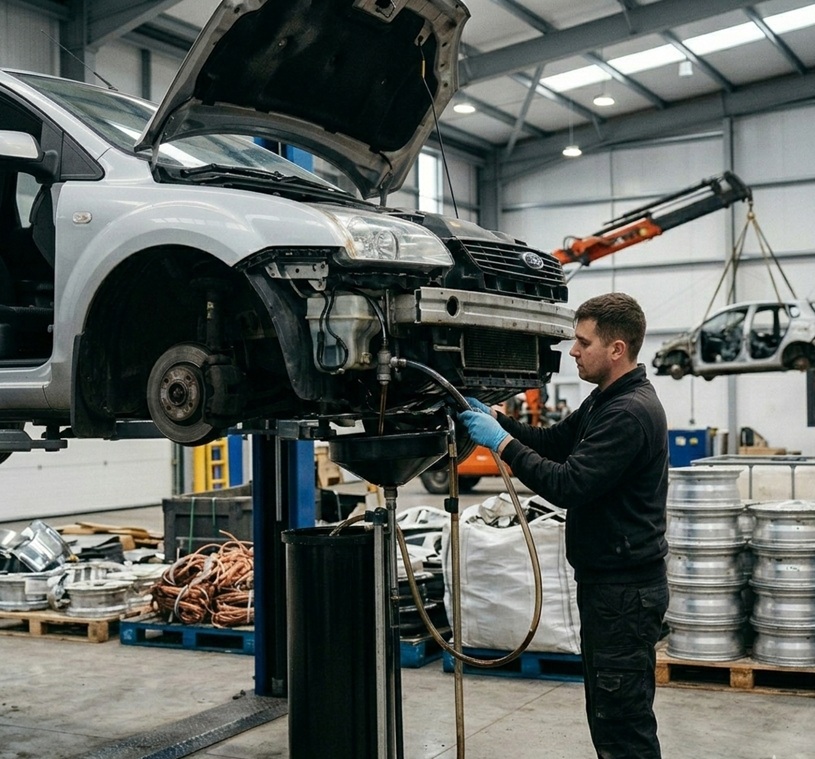
When motorists arrange free vehicle collection to pick up an old motor, it triggers a highly choreographed sequence. First, the vehicle undergoes strict “depollution.” This simply means technicians carefully drain all the hazardous fluids, including engine oil, brake fluid, coolant, and old fuel.
These dangerous liquids aren’t simply dumped down a drain. Instead, they are refined and recycled into brand new industrial products. Old engine oil, for instance, can be thoroughly cleaned and used as industrial heating fuel.
Next comes the detailed component assessment. Skilled technicians evaluate the car from top to bottom. They check to see exactly what can be safely saved and resold. The main wiring harness alone holds several kilograms of valuable copper. Ultimately, it takes a sharp eye to spot the real winners among the wreckage.
The Art of Component Grading
Not all salvaged parts are created equal, and the industry knows this perfectly well. As a result, the professional trade uses a highly specific grading system to ensure buyers know exactly what they are getting. This rigorous process builds vital trust with independent garages and everyday consumers alike.
Grade A Components
These are the absolute cream of the crop in the recycling world. Grade A parts are in nearly new condition. They are almost always pulled from late-model vehicles that suffered severe accident damage in a completely unrelated area.
If a brand new car gets rear-ended and officially written off, the front bumper and headlights are likely still in pristine condition. These premium parts naturally command top dollar. They almost always include comprehensive warranties that rival brand new dealer parts, offering incredible value for money.
Grade B Components
These parts represent the absolute bread and butter of the entire recycling trade. Grade B components show signs of normal, everyday wear. However, they remain entirely functional, totally reliable, and structurally sound.
They are the perfect solution for everyday motorists trying to keep their running costs down. If a ten-year-old starter motor gives out, a Grade B replacement is a brilliant, affordable alternative. It will keep a car running smoothly without completely breaking the bank.
Grade C Components
These are the rough diamonds of the salvage yard. Grade C parts usually feature noticeable cosmetic damage. For example, they might have deep surface scratches, faded paint, or small dents. However, their core mechanical function remains perfectly intact and safe to use.
They are generally bought by owners of older, low-value vehicles who just need a practical fix. If a driver just needs an old work van to pass its MOT, they do not care if the replacement wing mirror is scuffed. As long as the glass is intact, a Grade C part is the smartest economic choice.
Who Buys Recycled Auto Parts
You might think only penny-pinching DIY mechanics buy these parts on the weekends. In truth, the reality of the customer base is far more diverse and highly professional. If you are looking to safely scrap your unwanted vehicle, it is reassuring to know its parts will help a massive variety of drivers.
Independent Garages and Insurers
Local, independent garages are easily the biggest buyers in this market by a massive margin. From a purely economic standpoint, fitting a salvaged gearbox into a twelve-year-old hatchback makes total sense. Buying a brand new gearbox would often cost significantly more than the entire car is actually worth.
Fascinatingly, major insurance companies are also getting heavily involved in this space. They are increasingly authorising the use of quality recycled parts for standard accident repairs. Ultimately, this helps keep everyone’s insurance premiums down and speeds up the overall repair process significantly.
Export Markets and Enthusiasts
British cars have a fantastic global reputation for strict MOT testing and reliable maintenance. Because of this excellent reputation, massive quantities of UK components are exported worldwide every week. A sturdy steering rack pulled from a scrapped saloon in Birmingham could easily end up keeping a taxi running smoothly in Mumbai.
Classic car enthusiasts also rely entirely on this vital network to keep their pride and joy on the road. When main manufacturers stop making replacement parts for a thirty-year-old model, the salvage yard becomes the only place left to find genuine components.
The Technology Revolution
The days of wandering around a muddy yard with a rusty spanner are largely over. The modern component trade has undergone a massive, sweeping technological revolution. It is now incredibly slick, highly organised, and driven by sophisticated digital data.
Today, advanced computer systems connect dismantling yards across the entire country in real-time. If a mechanic needs a very specific passenger door mirror for a 2016 Ford Fiesta in frozen white, they can type it into a database and locate one instantly. It is brilliantly efficient and saves hours of frustrating phone calls.
Furthermore, every valuable part is carefully photographed from multiple angles, heavily tested, and meticulously catalogued with a unique barcode. This total transparency has completely transformed customer confidence. Buying a used part isn’t a massive gamble anymore; it is a smart, calculated, and highly reliable choice.
Environmental Impact and Sustainability
This is where the industry truly proves its massive, undeniable worth to modern society. The sheer volume of physical waste prevented by this sector is absolutely phenomenal. By diligently reusing existing parts, the trade drastically reduces the massive global demand for new, energy-intensive manufacturing.
The material recovery rates UK facilities currently achieve are genuinely impressive. This success is largely because reputable network partners use environmentally responsible recycling processes at every single stage. Think about a simple steel car door for a moment. Manufacturing a brand new one requires mining raw iron ore, smelting it in massive industrial furnaces, and shipping it globally. Reusing an existing door bypasses almost all of that heavy environmental damage instantly.
The raw energy savings involved in recycling are also completely staggering. Melting down recycled automotive steel uses about 75% less energy than creating brand new steel from scratch. For recycled aluminium components, that massive energy saving jumps up to an incredible 95%. It is a massive win for the environment, reducing greenhouse gas emissions by millions of tonnes annually.
Regional Variations and Challenges
The vehicle recycling trade has actually developed unique regional flavours across the country. Different areas naturally specialise in different things, creating highly focused pockets of specific automotive expertise.
The Midlands, with its rich manufacturing history, handles massive volumes of newer fleet vehicles. Up in Scotland, the rugged geography naturally dictates a heavy specialisation in rugged 4x4s and agricultural machinery. Down in London, the strict ultra-low emissions zones have created a booming, highly lucrative market for hybrid vehicle parts.
However, the industry does face incredibly tough, evolving challenges. Cars are becoming terrifyingly complex with each passing year. A simple replacement bumper used to just be a piece of painted plastic. Today, that exact same bumper contains delicate radar sensors and high-definition parking cameras that require specialist computer coding to work properly.
The Premium Parts Market
At the very top end of the spectrum sits a fascinating, highly lucrative niche that most people never see. The premium salvage market deals exclusively in high-value parts carefully extracted from wrecked luxury cars and supercars.
If a wealthy driver unfortunately wraps a £150,000 sports car around a lamppost, the car might be written off. However, the undamaged parts are still worth an absolute fortune. A pristine set of lightweight carbon fibre seats can easily sell for tens of thousands of pounds on the second-hand market.
This elite market operates much more like an exclusive art auction than a traditional scrapyard. Specialist buyers hunt down incredibly rare components to finish high-end restoration projects. In this rarefied world, price is often no object when a builder desperately needs that one specific, discontinued part.
Future Trends and Opportunities
The entire automotive landscape is currently shifting underneath our feet at an unprecedented pace. The rapid adoption of electric vehicles (EVs) represents both the biggest mechanical challenge and the greatest financial opportunity this industry has ever seen.
When you choose sustainable vehicle recycling, you are supporting an industry that is actively preparing for the impending EV revolution.
Electric motors have far fewer moving mechanical parts than traditional engines, meaning they generally break down less often. However, the massive lithium-ion battery packs that power them are incredibly valuable. Safely dismantling and carefully repurposing these heavy batteries requires entirely new skills and seriously expensive safety equipment. Upgrading these facilities creates even more jobs and drives further investment into local communities.
The industry is also seeing a massive shift toward complex software integration. In newer cars, it is impossible to simply swap a broken mechanical part for a recycled one and drive away. The car’s main computer often actively rejects the “foreign” part until it is digitally coded and recalibrated by a specialist. Bridging this difficult gap between physical spanner-work and complex software programming is the future of the trade.
Quality Control and Regulation
The modern industry is strictly regulated, and for very good reason. The sector has entirely moved away from the dodgy, unregulated back-alley operators of the past. Today’s professional facilities must meet incredibly strict environmental and safety standards just to keep their doors open.
The strict Authorised Treatment Facility network operates under tight, heavily monitored guidelines. These are government-approved sites designed specifically to handle scrap safely. They possess highly professional diagnostic testing equipment that genuinely rivals main dealership tools. Before an engine or a complicated automatic gearbox is sold to a customer, it undergoes rigorous compression testing to guarantee its performance.
This level of intense, uncompromising quality control ensures that legitimate businesses thrive. Crucially, it actively protects the everyday consumer from dangerous, substandard parts. It is a highly professional setup that gives immense peace of mind to garages and private buyers alike.
Government regulations also play a vital, active role behind the scenes. Taking the necessary steps to process official DVLA paperwork correctly guarantees that once a vehicle is officially scrapped, it is permanently and legally removed from the road network. Strict environmental permits dictate exactly how every single drop of hazardous fluid is safely handled and eventually recycled.
If any guidance is needed navigating this process, do not hesitate to contact our support team to arrange a collection or assist with the paperwork. It is always better to get it right the first time and avoid any nasty fines. The days of treating cars as disposable rubbish are thankfully long gone. Today, through Scrap Car Network, they are finally recognised as the incredible, valuable resources they truly are.