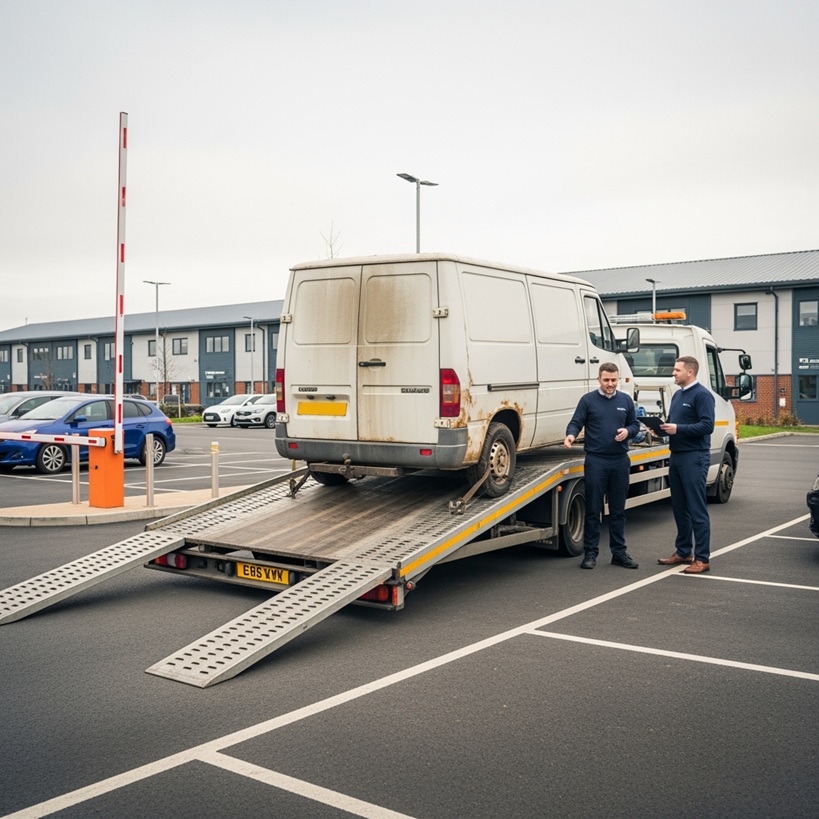
Scrap Car Collection from Work Address: Business Services
12th May, 2026
That old car taking up space in the company car park isn’t doing anyone any favours. Whether it is a former fleet vehicle, an employee’s abandoned motor, or a company car that has reached the end of its useful life, arranging scrap car collection work address services requires a slightly different approach than scrapping from home.
Commercial premises operate under different rules than homes. Most business parks, office complexes, and industrial estates have specific access requirements, loading bay schedules, and security protocols that do not exist at residential addresses. A scrap car collection vehicle, typically a flatbed recovery truck, needs adequate space to manoeuvre and load. That warehouse car park with tight corners and height barriers might need a different approach than a standard residential pickup.
Business collections also involve different stakeholders. The person arranging the collection is not always the registered keeper. Sometimes it is a fleet manager, facilities coordinator, or office administrator handling the paperwork while someone else holds the V5C document.
What Collection Teams Need to Know
Before booking a collection at a business address, gather this information:
- Operating hours: When are collections permitted?
- Security protocols: Are there sign-in requirements or gate codes?
- Access restrictions: Height barriers, width restrictions, or weight limits.
- Exact location: Car park level, bay number, or loading area.
- Contact person: Who will be on-site to hand over the keys?
The more detail provided upfront, the smoother the collection runs. Nobody wants a recovery driver turning up at a secure business park only to discover they cannot access the site because of an unreported height barrier.
The Legal Side: Who Is Responsible?
Here is where business collections get interesting. The registered keeper listed on the V5C logbook holds legal responsibility for the vehicle, regardless of where it is parked.
If the car belongs to the company, the business must provide the V5C and authorise the collection. If it is an employee’s vehicle abandoned on company property, that employee remains the registered keeper and must handle the paperwork, even if they have left the organisation.
When a company scraps a fleet vehicle, the process mirrors the standard DVLA notification process. The V5C/3 section must be sent to the DVLA, and the Authorised Treatment Facility (ATF) will issue a Certificate of Destruction.
Timing Collections Around Business Operations
Most businesses cannot have recovery vehicles blocking the car park during peak hours. Collection timing matters more at commercial premises than residential addresses.
Early morning slots work well for many businesses, getting the vehicle removed before employees arrive. Late afternoon collections can also suit, though traffic considerations apply. Some industrial estates have specific time windows for deliveries and collections. When booking, specify any time constraints.
I recall collecting a fleet of vans from a secure distribution centre that only allowed non-freight vehicles between 2am and 4am. We had to coordinate three trucks in the middle of the night, get signed in by security, and load up under floodlights. It was surreal, but we got the job done without disrupting their morning shift.
What Happens to Business Fleet Vehicles?
Commercial fleet disposal follows the same recycling process as private cars, but there is often more documentation involved. Companies need records proving proper disposal for tax purposes, fleet management systems, and environmental compliance reporting.
The ATF receiving the vehicle will process it according to End-of-Life Vehicle regulations. Fluids get drained and disposed of safely. Reusable parts are removed and catalogued. The remaining shell goes through a depollution process before the metal is recycled. You can verify our environmentally responsible process to ensure your company meets its CSR goals.
Multiple Vehicle Collections
Businesses replacing entire fleets or clearing out several end-of-life vehicles can arrange multiple collections. However, logistics become more complex with volume.
A single recovery vehicle typically handles one car at a time. Collecting five vehicles means five separate truck visits, unless a larger transporter can be arranged. This requires more coordination, more space, and potentially a full day’s access to the premises.
When the Vehicle Won’t Start or Move
Non-runners present extra challenges at business locations. If the car has been sitting for months with a flat battery and seized brakes, it cannot simply be pushed onto a flatbed.
Recovery teams bring equipment for loading immobile vehicles, winches, dollies, and ramps, but they need space to work. A car wedged between two others in a tight parking bay creates difficulties. Moving surrounding vehicles temporarily makes everyone’s life easier.
The Paperwork Trail
Businesses need more documentation than private individuals when scrapping vehicles. Beyond the standard V5C notification and Certificate of Destruction, companies often require:
- Proof of collection: Signed receipt with date/time.
- Certificate of Destruction: Essential for company audits.
- Waste transfer documentation: Proof of legal disposal.
- Tax records: Evidence for writing off the asset.
The Certificate of Destruction is the crucial document. It proves the vehicle was processed by an authorised facility and won’t reappear with outstanding fines or parking tickets attached to the company’s name.
Regional Variations for Business Collections
Collection availability and procedures vary by location. A business in central London faces different logistics than one in rural Scotland.
Urban locations often have better collection availability but worse access. Congestion charges might apply to recovery vehicles. Parking restrictions could prevent stopping on nearby roads. Height barriers and underground car parks create physical obstacles.
For businesses in specific areas, our network covers locations including London, Newcastle upon Tyne, and Scotland, with local scrap partners who understand regional requirements.
What Business Vehicles Are Worth
Scrap value depends on the same factors for business vehicles as private cars: weight, metal content, and current scrap metal prices. However, company car scrapping can sometimes yield higher returns if the vehicles are vans.
Commercial vehicles like vans often have greater metal content. If you need to scrap your van, you might find the valuation is higher than a standard passenger car due to the heavier chassis and larger panels.
Making the Collection Smooth
A few simple steps prevent collection day complications:
- Prepare the vehicle: Remove all company property, equipment, and personal items.
- Clear the area: Ensure the recovery vehicle can access the car.
- Have documents ready: The V5C logbook and proof of business ownership should be available.
- Brief site security: Inform them about the collection to avoid access delays.
The Scrap Car Network can coordinate these details with your facilities team to ensure minimal disruption.
Environmental Compliance for Businesses
Companies face stricter environmental reporting requirements than individuals. Duty of care regulations require businesses to ensure waste is handled by authorised carriers and disposed of legally.
Using our network of Authorised Treatment Facilities ensures compliance with End-of-Life Vehicle regulations. These facilities hold the necessary permits and follow proper depollution procedures.
Conclusion
Arranging scrap car collection from a work address involves a few extra considerations compared to residential pickups, but it is far from complicated. The key is providing clear information about access requirements, timing constraints, and vehicle condition upfront.
Whether it is a single company car or an entire fleet reaching end-of-life, professional services handle business location collections throughout the UK. Our network of authorised facilities understands commercial premises requirements and can work around business operations.
For businesses ready to clear that unwanted vehicle, you can get a commercial quote to start the process.
Alternatively, call our team on 01772 665 909 or contact us directly to discuss your specific site requirements.