From Scrap to 3D Print: Using Recycled Car Materials in Manufacturing
16th Feb, 2026
Across the automotive industry, sustainability is no longer a buzzword. It’s a requirement. The move towards cleaner, smarter production has driven innovation in how materials are recovered, reused, and repurposed. One of the most exciting developments is the use of recycled car materials in 3D printing, a process that turns old vehicles into raw materials for new manufacturing.
By merging recycling with additive manufacturing, engineers and recyclers are closing the loop, transforming yesterday’s scrap into tomorrow’s products.
The Promise of Recycled Car Materials
Every year, millions of vehicles reach the end of their usable life. In the past, much of that material would have gone to waste. Today, however, recycled car materials are finding new purpose. Through advanced recycling processes, these materials are cleaned, refined, and prepared for reuse across a wide range of industries.
Incorporating these recovered materials into 3D printing with recycled metals and plastics is an important step toward reducing the automotive sector’s environmental impact.
Key takeaways:
- Recycling vehicle components reduces landfill waste
- Repurposed materials require less energy to process than creating new ones
- Advanced recovery systems enable high-quality material reuse
Reducing Waste, Boosting Sustainability
When a car is scrapped, it creates a large volume of recyclable materials, from metals and plastics to glass and rubber. By recovering and reusing these, the automotive and manufacturing sectors can drastically cut waste.
Why it matters:
Landfill reduction: Fewer materials end up buried, preserving land and reducing pollution.
Energy efficiency: Recycled materials consume up to 75% less energy to process than virgin resources.
Resource conservation: Reduces dependence on raw mineral extraction, protecting natural ecosystems.
This shift toward sustainability aligns with the broader principles of the circular economy, where products and materials are kept in use for as long as possible.
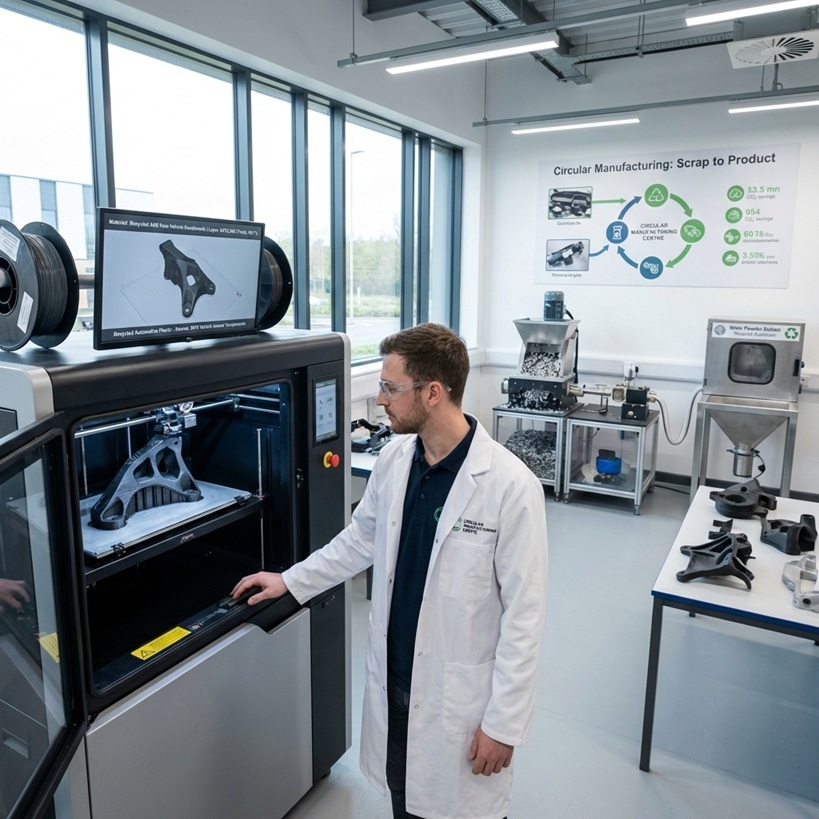
I spoke with an engineer at a Birmingham 3D printing facility who showed me a car dashboard that had been ground down into pellets, melted, and extruded into filament. He then printed a new interior trim panel from that same filament. The whole process took less than a day, and he reckoned the energy used was about a tenth of what it would take to make virgin plastic. It’s like turning yesterday’s rubbish into today’s raw material without the factory in between.
Key takeaways:
- Car scrapping generates substantial recyclable materials
- Recovery and reuse drastically reduce environmental impact
- Circular economy principles drive sustainable manufacturing
Types of Recycled Car Materials Suitable for 3D Printing
Not every component of a car is destined for the crusher. Many parts are now being repurposed as feedstock for 3D printing technologies.
Materials suitable for recycled manufacturing include:
Plastics: Dashboards, bumpers, and interior trims can be processed into filament for plastic 3D printers.
Metals: Aluminium and steel are melted down and used in 3D printing with recycled metals, producing strong, durable parts.
Glass and composites: Certain recycled glass materials are being tested in industrial printing applications.
Rubber and polymers: Used tyres and flexible components can be refined into new composites for design or structural uses.
Each type of material offers unique advantages depending on its application, from structural strength to lightweight flexibility. These materials begin their journey at authorised recycling centres where proper sorting ensures quality for manufacturing.
Key takeaways:
- Multiple vehicle materials are suitable for 3D printing
- Plastics and metals lead current recycling applications
- Each material type serves different manufacturing purposes
3D Printing: A Modern Manufacturing Revolution
Also known as additive manufacturing, 3D printing is a method of creating objects layer by layer from digital models. Instead of subtracting material through cutting or milling, the process adds only what is needed, reducing waste dramatically.
A 3D printer works by heating and extruding material, whether plastic filament or metal powder, following a precise design. Once printed, components can be used immediately or refined for production.
Think of 3D printing like building with Lego bricks. Traditional manufacturing is like carving a statue from a block of marble, you start with excess and chip away what you don’t need, creating waste. With 3D printing, you only add the bricks you need, one layer at a time, until you’ve built exactly what you want. Nothing wasted, everything intentional.
Key takeaways:
- 3D printing builds parts layer by layer using digital blueprints
- It’s ideal for custom parts, prototypes, and short production runs
- Combining recycling with additive manufacturing creates a low-waste production model
How 3D Printing Works in Practice
The workflow for using recycled car materials in 3D printing typically involves several stages:
Material recovery: Scrapped vehicle components are collected and sorted at Authorised Treatment Facilities (ATFs).
Processing and refinement: Materials are cleaned, shredded, and prepared for reuse. Plastics turned into pellets, metals into powder.
Filament or powder production: Recycled material is extruded into filament or ground into fine powder suitable for printers.
Additive manufacturing: The 3D printer deposits material layer by layer to form the final part.
Finishing and testing: The part is polished, hardened, and inspected for quality before use.
This approach offers precision, repeatability, and sustainability in equal measure.
Key takeaways:
- Material recovery begins at certified recycling facilities
- Multi-stage processing ensures quality and consistency
- Final products meet manufacturing standards
Benefits of 3D Printing in Automotive Manufacturing
The use of 3D printing has expanded rapidly within the automotive industry. From concept cars to repair components, it’s changing how manufacturers think about design and production.
Benefits include:
Reduced material waste: Only essential material is used.
Customisation: Perfect for producing unique components or restoring vintage parts.
Faster turnaround: Prototypes and spare parts can be created in hours rather than weeks.
Lower production costs: Especially effective for small batches or specialist parts.
By merging these advantages with sustainable sourcing, recycled car materials 3D printing is becoming a practical solution for manufacturers and restorers alike. Understanding green vehicle recycling demonstrates how material quality standards support manufacturing applications.
Key takeaways:
- 3D printing reduces waste and speeds up production
- Custom and small-batch manufacturing becomes economically viable
- Sustainability and efficiency work hand in hand
Combining Recycling and 3D Printing: The Perfect Match
When recycling meets 3D printing, it creates a closed-loop manufacturing cycle. The same material that once formed part of a car can be reborn as a replacement component or an entirely new product.
The advantages of closing the loop include:
Reduced demand for virgin materials.
Lower manufacturing emissions.
Prolonged material lifecycle and reduced industrial waste.
Imagine a car bumper being recycled into plastic filament that’s then used to print interior trim for another vehicle. That’s the circular economy in action. Scrap Car Network connects vehicle owners with facilities that support these closed-loop systems.
Key takeaways:
- Closed-loop systems maximise material value
- Recycling and 3D printing create sustainable manufacturing
- Circular economy principles reduce environmental impact
Examples of Recycled Car Materials in 3D Printing
Real-world applications are already proving the potential of 3D printing with recycled metals and plastics.
Current examples include:
Automotive suppliers using recycled plastic from dashboards to produce lightweight prototype components.
Engineering firms experimenting with recycled aluminium powder for high-strength brackets and fittings.
Sustainable design companies printing furniture and tools from reclaimed car polymers.
These examples highlight how technology and sustainability can merge to create innovative, eco-conscious manufacturing solutions. Vehicle owners looking to contribute can get a free online quote to see how their end-of-life vehicle supports these innovations.
Key takeaways:
- Recycled plastics and metals are already used in 3D printing
- Industry trials show strong potential for future large-scale adoption
- Innovation spans automotive, engineering, and design sectors
Challenges and Opportunities
Whilst progress is impressive, some technical and logistical challenges still stand between recycled car materials 3D printing and mass-market adoption.
1. Material Quality and Consistency
Recycled materials can vary in composition and purity. For 3D printing to be reliable, materials must meet strict quality standards. Innovations in material sorting and chemical analysis are helping to improve this consistency.
2. Production Scalability
Although small-scale projects are thriving, scaling up remains a challenge. Industrial 3D printers are becoming faster, but full production capability will require continued investment in recycling systems.
3. Cost and Accessibility
Whilst 3D printing has become more affordable, the initial setup cost for large operations can still be significant. Over time, economies of scale are expected to lower these barriers.
Choosing services with best price guarantee ensures vehicle owners receive fair value whilst supporting facilities investing in advanced recycling technology.
Key takeaways:
- Material consistency is essential for quality control
- Scaling up and cost efficiency remain ongoing challenges
- Continued innovation addresses technical limitations
The Future of Recycled Car Materials in 3D Printing
As both recycling and additive manufacturing technologies advance, the role of recycled car materials in 3D printing is expected to expand rapidly.
Predicted developments include:
Greater use of recycled metals: More automotive parts produced using 3D printing with recycled metals for structural strength.
Hybrid materials: Combining recycled plastics and carbon fibre for lightweight, durable components.
Improved printer efficiency: Faster printing speeds and reduced energy consumption.
Circular manufacturing systems: Factories using waste from one process as input for another, minimising environmental impact.
The collaboration between recycling companies and 3D printing manufacturers will be key to achieving a fully circular production model.
Key takeaways:
- Recycling and 3D printing are converging into a sustainable production model
- Future innovation will focus on efficiency, strength, and closed-loop systems
- Industry collaboration drives progress
Real-World Applications and Innovations
Leading manufacturers and recyclers are already embracing this technology:
Prototype design: Car manufacturers use recycled materials in 3D printing to speed up testing and reduce waste.
Custom restoration: Vintage and specialist car restorers use 3D printing to recreate obsolete components.
DIY innovation: Enthusiasts use recycled plastics to print custom car accessories, personalising vehicles whilst promoting sustainability.
The trend reflects a growing public interest in responsible consumption and environmentally conscious craftsmanship.
Key takeaways:
- 3D printing enables innovation in design, repair, and restoration
- Both major manufacturers and independent enthusiasts benefit from this approach
- Quality materials from certified facilities support better outcomes
Environmental Impact
The use of recycled car materials in 3D printing delivers measurable benefits for the planet.
Environmental advantages include:
Reduced landfill waste: Reusing old car parts keeps valuable materials in circulation.
Lower carbon emissions: Recycling consumes less energy than creating new materials.
Sustainable manufacturing: Encourages green production and reduces dependency on virgin resources.
This approach directly supports national sustainability targets by closing material loops and minimising waste across the automotive supply chain.
Key takeaways:
- Material reuse significantly reduces environmental impact
- Energy savings translate to lower carbon emissions
- Circular systems support national sustainability goals
How to Get Involved
There are several ways individuals and businesses can contribute to this sustainable shift:
Recycle responsibly: Always use a certified network to ensure your vehicle is processed properly and materials are recovered for reuse.
Arrange convenient collection: Look for services that schedule vehicle pickup to make responsible disposal straightforward.
Choose proper disposal: When ready to proceed, recycle your car properly through facilities equipped to recover materials for advanced manufacturing.
Support sustainability: Back businesses committed to eco-friendly practices and circular economy principles.
Stay informed: Learn about proper legal steps and ensure compliance with vehicle disposal regulations.
For questions or guidance, get in touch with teams who understand both recycling and emerging manufacturing technologies.
By recycling responsibly, every driver can play a role in supporting a greener, smarter automotive future.
Key takeaways:
- Responsible recycling supports circular manufacturing
- Certified facilities ensure materials meet quality standards
- Individual choices contribute to industry-wide sustainability
Conclusion: A Greener Future for Automotive Manufacturing
The integration of recycling and additive manufacturing marks a turning point for the automotive world. Through recycled car materials 3D printing, the industry is finding new ways to reduce waste, conserve resources, and design with sustainability in mind.
What was once seen as scrap is now a valuable resource for innovation. As technology progresses, 3D printing and recycling will continue to redefine what’s possible, creating a cleaner, circular future for vehicles and beyond.
Every vehicle recycled properly contributes to this transformation, turning waste into opportunity and supporting a sustainable manufacturing ecosystem.
Key Takeaways:
- Recycled car materials in 3D printing transforms automotive manufacturing
- 3D printing with recycled metals and plastics creates sustainable, efficient production
- Circular economy principles reduce waste and conserve resources
- Real-world applications span prototyping, restoration, and custom manufacturing
- Proper recycling through certified facilities ensures material quality
- Technology advancement and industry collaboration drive future growth