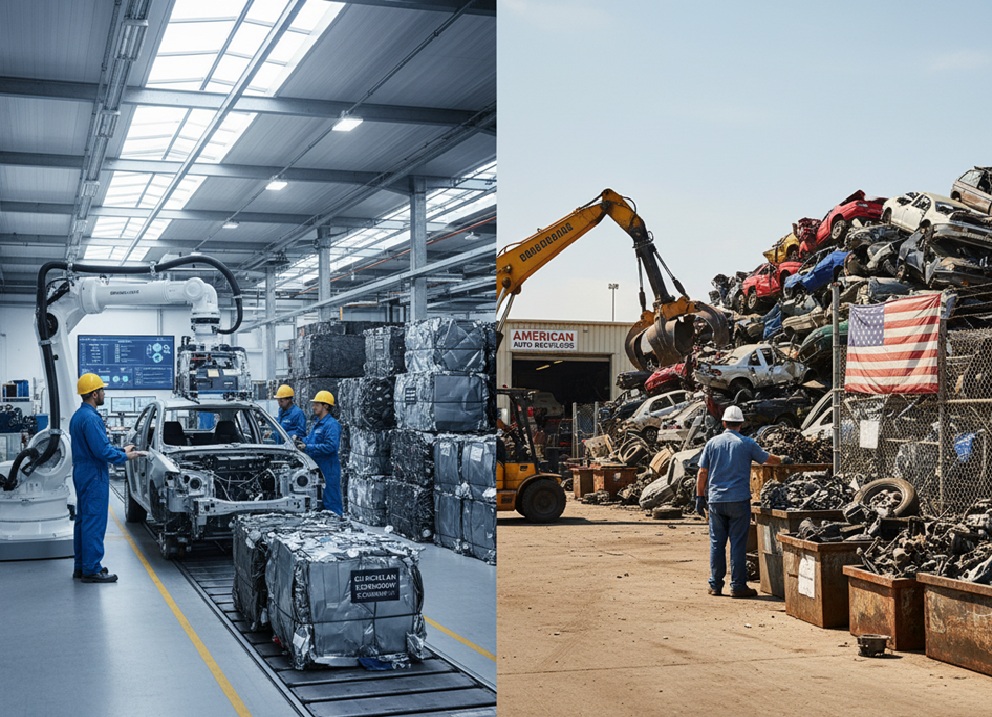
EU vs. US: Who Recycles Cars More Efficiently?
19th Dec, 2025
Recycling plays a vital role in reducing waste and conserving valuable materials across the automotive industry. Each year, millions of vehicles reach the end of their lives, and how those vehicles are treated can make a major difference to the planet. When comparing EU vs US car recycling, both regions have made significant progress, but their systems differ in structure, efficiency, and long-term sustainability.
This car recycling efficiency comparison explores the frameworks, technologies, and environmental outcomes shaping car recycling across Europe and the United States, and what lessons can be drawn from both sides.
The Regulatory Landscape
Regulation is at the heart of recycling efficiency. Rules determine who is responsible, how materials are processed, and what targets must be achieved. The European Union and the United States have both taken steps to regulate vehicle recycling, though they approach it in very different ways.
EU Regulations
The European Union’s vehicle recycling system is defined by the End-of-Life Vehicles Directive (2000/53/EC). Introduced to minimise the environmental impact of scrapped vehicles, this directive sets strict legal obligations for manufacturers, recyclers, and treatment facilities.
The directive aims to:
- Ensure producers take responsibility for vehicles at the end of their life.
- Set mandatory reuse and recovery targets (currently 85% reuse and recycling, and 95% total recovery).
- Restrict the use of hazardous substances such as lead, mercury, and cadmium.
- Require free take-back of vehicles at authorised centres.
This system creates consistency across all member states. Facilities known as Authorised Treatment Facilities (ATFs) must meet strict environmental standards, providing a transparent and traceable recycling process. UK drivers can benefit from similar systems when they get an instant quote to scrap any car through Scrap Car Network, which partners only with licensed ATFs.
US Regulations
The United States lacks a single, nationwide vehicle recycling law. Instead, it relies on a patchwork of state and federal regulations, supported by environmental laws such as the Resource Conservation and Recovery Act (RCRA) and the Clean Air Act.
The main features of the US approach include:
- A state-based framework, resulting in varying standards.
- Oversight from the Environmental Protection Agency (EPA), focusing on pollution prevention.
- No national take-back scheme equivalent to the EU’s.
Some states, such as California, lead the way with strong environmental standards and oversight. Others rely more heavily on market forces to manage the recycling of end-of-life vehicles (ELVs).
Summary:
The EU operates under a unified and enforceable directive, while the US relies on decentralised state laws, creating different levels of performance across regions.
Recycling Infrastructure and Technology
Infrastructure determines how effectively vehicles are dismantled, depolluted, and repurposed. In this respect, Europe and the United States show both similarities and contrasts.
EU Recycling Infrastructure
The EU maintains a sophisticated network of Authorised Treatment Facilities that handle end-of-life vehicles responsibly. Each facility follows strict depollution and dismantling standards to ensure no harmful substances are released into the environment.
Stages of EU Vehicle Recycling:
- Depollution: All hazardous fluids, including oil, coolant, and brake fluid, are removed safely.
- Dismantling: Reusable parts like engines, tyres, and batteries are recovered.
- Shredding and Separation: Metals and plastics are shredded, then separated using magnets, flotation systems, or advanced optical sensors.
- Material Recovery: Reclaimed metals are melted down and reused in manufacturing.
The system ensures a consistent recycling rate across Europe. Those seeking to recycle a car responsibly can connect with Scrap Car Network’s Authorised Treatment Facilities for fully licensed processing.
US Recycling Infrastructure
The United States operates one of the largest recycling industries in the world, with over 12 million vehicles processed annually. Unlike the EU’s centralised system, the US approach relies on private scrapyards, large recycling plants, and regional processing centres.
Key Recycling Technologies Used in the US:
- Mega shredders capable of handling thousands of vehicles per day.
- Magnetic and eddy current separators to distinguish between ferrous and non-ferrous materials.
- Fluid extraction systems designed to remove hazardous materials safely.
- Computerised sorting systems that classify metals by composition for resale.
The result is a flexible, market-driven network that adapts quickly to changes in demand and technology.
Summary:
The EU prioritises regulation and standardisation, ensuring consistent results across member states. The US system relies on competition and innovation, resulting in a wide range of facility capabilities.
Recycling Rates and Efficiency
When assessing EU vs US car recycling, the numbers provide clear insight into how well each system performs.
EU Recycling Rates
Under the End-of-Life Vehicles Directive, all EU nations are expected to achieve at least 85% reuse and recycling, and 95% total recovery. Data from the European Commission confirms that most member states now meet or exceed these benchmarks.
Average EU Recycling Figures:
- Reuse and Recycling: Around 85%
- Energy Recovery: Around 10%
- Landfill: Below 5%
These figures are among the highest in the world, supported by comprehensive legislation and enforcement mechanisms.
US Recycling Rates
The US industry achieves significant recycling success, though not as consistently measured due to decentralisation. The Institute of Scrap Recycling Industries (ISRI) estimates that approximately 75% of a car’s materials are recycled, with another portion recovered through energy production.
Average US Recycling Figures:
- Recycling: Approximately 75%
- Reuse: Approximately 5%
- Energy Recovery: Around 15%
- Landfill: Around 5%
Summary:
The EU consistently achieves higher recovery rates due to clear legislation and accountability. The US performs strongly but remains influenced by market fluctuations and regional policy differences.
Economic Factors and Market Dynamics
Economic conditions influence how effectively vehicles are recycled. Stable regulation can encourage investment, while volatile markets can disrupt progress.
Economic Conditions in the EU
The European Union’s recycling sector operates within a policy-driven market. The Extended Producer Responsibility model ensures manufacturers and importers are accountable for vehicle disposal, creating a steady demand for recycling services.
Main Economic Drivers in the EU:
- Government incentives supporting circular economy initiatives.
- Consistent demand for recycled metals and components.
- Stable business environment created by legal obligations.
The system also promotes employment within green industries and innovation in recycling technologies. Drivers across the UK can participate in this eco-conscious model when they find out how to scrap a car easily and legally through Scrap Car Network’s regulated services.
Economic Conditions in the US
In the United States, vehicle recycling is heavily influenced by commodity prices and market competition. When global demand for steel, aluminium, or copper increases, recycling rates typically rise.
Main Economic Drivers in the US:
- Scrap metal pricing fluctuations tied to global trade.
- Private sector investment in advanced recycling facilities.
- Limited government regulation, allowing rapid adaptation.
Summary:
The EU’s regulatory stability supports consistent recycling activity, while the US model thrives on market flexibility and entrepreneurial competition.
Environmental Impact and Sustainability
Car recycling plays an essential role in protecting the environment by reducing waste, pollution, and the need for raw material extraction.
EU Environmental Impact
The EU’s structured approach to car recycling delivers measurable environmental benefits. By enforcing depollution standards and minimising hazardous materials, Europe reduces both emissions and landfill waste.
Environmental Advantages:
- Lower carbon emissions through reduced raw material extraction.
- Reduced landfill dependency due to strict recovery targets.
- Better protection of soil and water from contaminants.
Individuals interested in sustainable car disposal can learn more about the environmentally responsible car recycling process offered by Scrap Car Network.
US Environmental Impact
Although less uniform, the US car recycling industry still contributes significantly to sustainability. The Environmental Protection Agency reports that the recycling of end-of-life vehicles saves millions of barrels of oil each year by reducing the need for new manufacturing.
Environmental Advantages:
- Reduced energy consumption through material reuse.
- Prevention of toxic fluid leaks from improper disposal.
- Decreased dependence on virgin resources for production.
Summary:
Both the EU and US contribute to environmental protection, but the EU’s coordinated system ensures more consistent results across all member nations.
Future Trends and Innovations
European Trends
The EU continues to pioneer sustainability by promoting circular economy principles. Manufacturers are encouraged to design vehicles for easier dismantling and recycling, while new research explores recovery of rare earth materials from hybrid and electric vehicles.
Key Areas of Innovation:
- AI-powered sorting for improved material purity.
- Robotic dismantling of complex vehicle components.
- Electric vehicle battery recycling technologies.
- Design-for-recyclability standards for new car models.
Regional recycling centres such as Scrap Car Network Preston and Scrap Car Network Scotland continue to apply these innovations in practical, community-level operations.
American Trends
The United States is focusing on technological efficiency and resource recovery within existing systems. Automakers are increasing the use of recycled metals and plastics in new vehicles, while research into electric vehicle recycling expands rapidly.
Key Areas of Innovation:
- Closed-loop recycling systems between manufacturers and recyclers.
- Increased use of recycled materials in new production lines.
- High-speed separation technologies for mixed materials.
- Battery recycling for electric vehicles.
Summary:
The EU leads in regulatory-driven innovation, while the US leads in market-based technological progress. Both regions are contributing to global advancements in sustainable vehicle recycling.
Legal and Consumer Guidance
In both regions, compliance and consumer awareness are crucial to responsible car recycling. In the UK, owners must ensure they follow the DVLA notification process when a car is scrapped. The guide on how to tell the DVLA a car has been scrapped explains each step to avoid penalties.
It’s equally important to obtain a Certificate of Destruction (CoD), confirming that the vehicle has been recycled at an authorised facility. Drivers can rely on Scrap Car Network’s trusted partners to ensure all documentation is issued correctly.
Conclusion
The EU vs US car recycling comparison highlights two very different yet effective systems. The European Union benefits from clear directives, strict oversight, and high recycling rates, while the United States leverages innovation and competitive industry practices to achieve strong performance without federal mandates.
Both regions continue to evolve, driven by environmental responsibility and technological advancement. Their combined efforts are crucial in achieving a sustainable, resource-efficient future for global automotive recycling.
Anyone looking to contribute to that future can begin by recycling responsibly through Scrap Car Network. The platform offers a free nationwide scrap car collection service, connecting users to licensed treatment facilities. Drivers can also contact the team for guidance on eco-friendly car disposal.
Key Takeaways
- The EU achieves higher recycling efficiency due to unified laws and strict targets.
- The US performs strongly through innovation and private sector competition.
- Both systems demonstrate the importance of sustainable vehicle management.
Responsible car recycling remains essential to reducing waste and conserving natural resources.