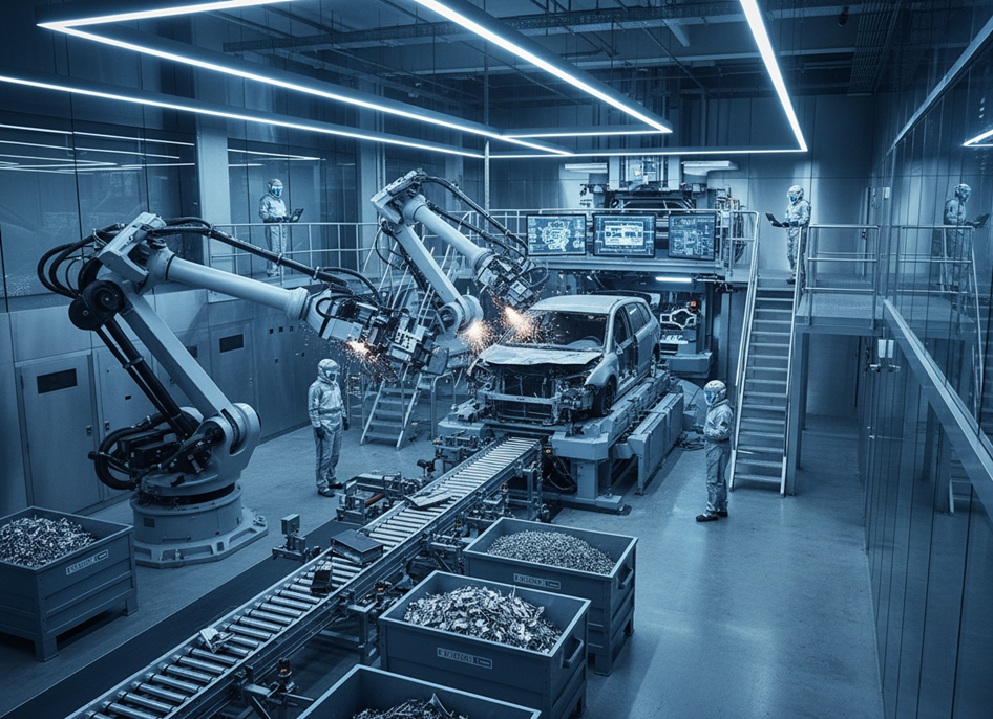
Circular Economy Case Studies: Global Scrap Car Innovations
19th Dec, 2025
The global automotive industry is rapidly changing, and the concept of the circular economy has emerged as one of the most powerful tools for driving sustainability. Unlike the traditional linear model of production, where products are made, used, and discarded, the circular approach focuses on keeping materials in use for as long as possible.
Within this model, end-of-life vehicles (ELVs) present both a challenge and an opportunity. Through global scrap car innovations, countries and manufacturers are finding smarter ways to reuse, recycle, and repurpose materials from old vehicles, transforming waste into valuable resources.
This article examines how the automotive sector is adapting to international circular economy models, highlighting real-world case studies, new technologies, and future trends that define the next generation of car recycling.
The Circular Economy and Its Role in Car Scrapping
The circular economy aims to eliminate waste and pollution while maximising the value of products and materials. In the automotive world, this means designing cars for easier dismantling, reusing components, and recovering valuable materials once a vehicle reaches the end of its life.
Car scrapping plays a vital role in this cycle. When an old vehicle is processed correctly, steel, aluminium, copper, plastics, and rubber can all be reclaimed and reused. The process also ensures that hazardous materials such as oils, coolants, and batteries are disposed of safely, reducing environmental impact.
Core Objectives of Circular Car Recycling:
- Reduce waste by extending the life of parts and materials.
- Reuse components through refurbishment and resale.
- Recycle metals, plastics, and rubber into new products.
- Recover energy from non-recyclable materials where safe.
Authorised Treatment Facilities (ATFs), such as those connected to Scrap Car Network’s nationwide recycling service, play an essential role in achieving these goals by processing vehicles in compliance with environmental legislation.
Summary:
The circular economy transforms vehicle disposal into a sustainable process, ensuring valuable resources remain in use and waste is minimised.
Innovative Scrap Car Recycling Technologies
The transition towards global scrap car innovations is powered by advanced recycling technologies that improve efficiency, recovery rates, and environmental performance.
Advanced Dismantling
Modern dismantling facilities focus on precision. Rather than immediately shredding vehicles, skilled technicians remove high-value components first, such as engines, gearboxes, catalytic converters, and electronic modules. These parts are cleaned, tested, and resold, extending their lifespan and reducing the need for new manufacturing.
Shredding and Sorting
After dismantling, the remaining vehicle shell is fed into large industrial shredders that break it into small fragments. Magnetic and air-based separation systems then sort materials into categories like steel, aluminium, copper, plastics, and glass.
These recovered materials are recycled to create new automotive parts, construction products, or consumer goods, supporting the principles of international circular economy models.
Material Recovery
Recycling doesn’t end at separation. The recovered materials are processed in foundries and refineries to produce high-quality raw materials. For example:
- Steel is remelted for use in new car frames or building structures.
- Aluminium is used in vehicle panels and electronics.
- Plastics are reformed into bumpers and dashboards.
- Rubber from tyres is repurposed for sports surfaces or road construction.
Depollution
Depollution remains one of the most critical steps. Fluids such as oil, coolant, and fuel are drained and stored for safe disposal. Batteries, air conditioning gases, and brake fluids are removed following strict environmental guidelines to prevent pollution.
These practices align with the environmentally responsible car recycling process promoted by Scrap Car Network, which ensures every vehicle is processed safely and sustainably.
Summary:
Modern recycling technologies maximise resource recovery while preventing environmental contamination, forming the technical backbone of the circular automotive economy.
Global Case Studies in Scrap Car Innovation
Countries around the world are developing unique approaches to car recycling, each adapting circular economy principles to their specific economic and environmental conditions. These examples highlight how global scrap car innovations are shaping a more sustainable future for the automotive industry.
European Union: Setting the Global Standard
The European Union remains a leader in vehicle recycling due to its End-of-Life Vehicles Directive (2000/53/EC), which mandates strict recovery and recycling targets. Member states must ensure at least 85% of a vehicle’s weight is reused or recycled, and 95% is recovered overall.
This directive has driven major investment in infrastructure and advanced sorting technologies. Countries such as Germany, the Netherlands, and Sweden now operate fully automated dismantling systems capable of separating and reusing a wide range of materials with minimal waste.
Additionally, European manufacturers are incorporating “design for recyclability” principles into new models, using fewer hazardous materials and simplifying disassembly.
Learn more about sustainable UK practices through Scrap Car Network’s guide to compliant car scrapping, which follows similar EU-aligned standards.
Summary:
The EU’s integrated policy framework has created a highly efficient recycling ecosystem, setting benchmarks for circular economy implementation worldwide.
Japan: Precision in Material Recovery
Japan has long been known for technological innovation and efficiency, and its approach to car recycling reflects that same philosophy.
The country’s recycling framework focuses on resource recovery and waste minimisation, with strong collaboration between manufacturers, dismantlers, and government agencies. One of Japan’s key achievements has been the development of technologies to recover rare earth metals from hybrid and electric vehicles.
These metals, used in batteries and motors, are critical for sustainable energy systems. Japan’s investment in rare earth recovery supports both environmental protection and national resource security.
Summary:
Japan’s focus on precision dismantling and advanced material recovery technologies ensures that even complex components, such as hybrid batteries, are responsibly recycled.
United States: Sustainable Dismantling and Market Adaptation
The United States employs a decentralised recycling model, with a combination of large industrial recyclers and independent dismantling businesses. Many US companies now prioritise sustainable dismantling, removing reusable parts before shredding.
Growing consumer interest in classic cars and aftermarket parts has also created a thriving market for used components. Some recycling businesses specialise in sourcing, refurbishing, and reselling these parts, reducing waste and extending vehicle lifespans.
These market-driven adaptations show how economic opportunity and environmental responsibility can coexist under international circular economy models.
Summary:
The US recycling sector demonstrates how diverse markets can promote circular principles through entrepreneurial innovation and efficient resource reuse.
Challenges and Opportunities in Circular Vehicle Recycling
While car recycling has advanced rapidly, the shift towards a fully circular system presents both technical and economic challenges.
Challenges
Vehicle Complexity:
Modern cars feature advanced electronics, composites, and lightweight materials, which are often difficult to dismantle or recycle cost-effectively.
Commodity Price Volatility:
The value of recycled materials such as steel and aluminium fluctuates with global markets, affecting profitability for recycling businesses.
Illegal and Informal Operations:
Unregulated dismantling remains a problem in some regions, where hazardous waste is not properly managed. This creates environmental and reputational risks.
Opportunities
Technological Innovation:
New technologies such as AI-powered sorting and robotic dismantling are improving recycling rates and material recovery precision.
Rising Demand for Recycled Materials:
Manufacturers increasingly prefer recycled materials to meet sustainability targets and reduce carbon emissions.
Public Awareness:
Consumers now recognise the environmental importance of responsible vehicle recycling, boosting demand for reputable recycling services such as Scrap Car Network’s certified collection programme.
Summary:
The key to overcoming recycling challenges lies in continuous technological advancement, regulatory consistency, and transparent industry practices.
The Future of Global Scrap Car Innovations
Looking ahead, the future of global scrap car innovations is tied closely to the expansion of international circular economy models. The automotive sector is expected to adopt even more integrated systems that connect design, manufacturing, and recycling into a single sustainable loop.
Design for Recycling
Manufacturers are rethinking vehicle design to simplify dismantling. By using standardised materials, modular components, and fewer mixed composites, future vehicles will be easier and cheaper to recycle.
Advanced Sorting and Material Identification
Artificial intelligence, infrared spectroscopy, and robotic systems are being integrated into sorting lines to separate materials with greater accuracy. This reduces waste and improves the quality of recycled outputs.
Closed-Loop Recycling
A growing number of companies are investing in closed-loop systems where materials recovered from end-of-life vehicles are reused in the production of new ones. This reduces dependency on virgin materials and reinforces circularity.
Sustainable Global Collaboration
Cross-border partnerships between governments, manufacturers, and recyclers will drive the exchange of knowledge, technology, and investment. International frameworks inspired by the EU’s ELV Directive are being developed in Asia, South America, and the Middle East to align standards globally.
Summary:
Future innovation will be driven by design improvements, digital automation, and global cooperation, creating a fully circular automotive economy.
Integrating Circular Principles Locally
The success of circular recycling models depends on implementation at every level, from global frameworks to local action.
In the UK, services such as Scrap Car Network ensure that every car is recycled responsibly through licensed Authorised Treatment Facilities. The company’s model aligns with circular economy principles by maximising material recovery and minimising waste.
Residents across the country can participate directly through free nationwide car collection, or explore regional solutions like Scrap Car Network Preston and Scrap Car Network Scotland for locally managed recycling services.
Educational resources, such as the guide on notifying the DVLA after scrapping a ca,r also help drivers remain compliant while supporting sustainability goals.
Summary:
Implementing circular economy principles locally ensures that environmental progress made at the global level translates into measurable action within communities.
Conclusion
The evolution of the car recycling industry demonstrates how international circular economy models can turn environmental challenges into sustainable opportunities. From Europe’s advanced regulations to Japan’s precision recycling and America’s entrepreneurial dismantling networks, innovation continues to transform the global automotive landscape.
Through global scrap car innovations, vehicles that once symbolised waste are now essential contributors to sustainable resource management. By connecting policy, technology, and responsible consumer choices, the world is moving towards a truly circular automotive economy.
Individuals and businesses can play a part in this movement by ensuring their vehicles are recycled responsibly. Those ready to take the next step can get an instant quote to scrap any car or contact Scrap Car Network for expert guidance on environmentally compliant car recycling.
Key Takeaways:
- The circular economy keeps resources in use for longer, reducing waste and emissions.
- Global scrap car innovations are redefining recycling efficiency and material recovery.
- International circular economy models encourage collaboration and sustainability.
Responsible car recycling supports a cleaner, more resource-efficient world.