Same-Day Scrap vs Next-Day: Collection Speed and Payment Comparison
28th May, 2026
The decision to permanently dispose of a vehicle often comes after weeks of deliberation, but once the choice is made, most owners want the car gone instantly. The automotive recycling industry generally offers two distinct timelines: rapid immediate dispatch or scheduled 24-hour service. When searching for a same day scrap car service, it is crucial to understand the vast logistical machinery operating behind the scenes.
Timing matters significantly in vehicle recovery. A broken car sitting safely at the back of a private driveway is merely a nuisance, but a vehicle suffering a catastrophic breakdown on a busy public road is an active hazard. The speed at which a recovery operator can respond directly dictates the convenience of the transaction. However, rushing an end-of-life vehicle disposal without understanding the financial and legal implications can lead to severe complications.
Understanding the precise differences between rapid dispatch and next-day scheduling allows vehicle owners to make informed, practical decisions. From how recovery fleets are managed to the legalities of bank transfers, the collection speed impacts every facet of the transaction.
What Defines Same-Day Scrap Car Collection
Achieving a true same day scrap car collection requires an incredibly responsive logistical network. It means an Authorised Treatment Facility (ATF) must have an available recovery truck, a trained operator, and an open slot on their processing yard, all aligning within a few hours of the initial quote acceptance. This is a highly complex balancing act for transport managers.
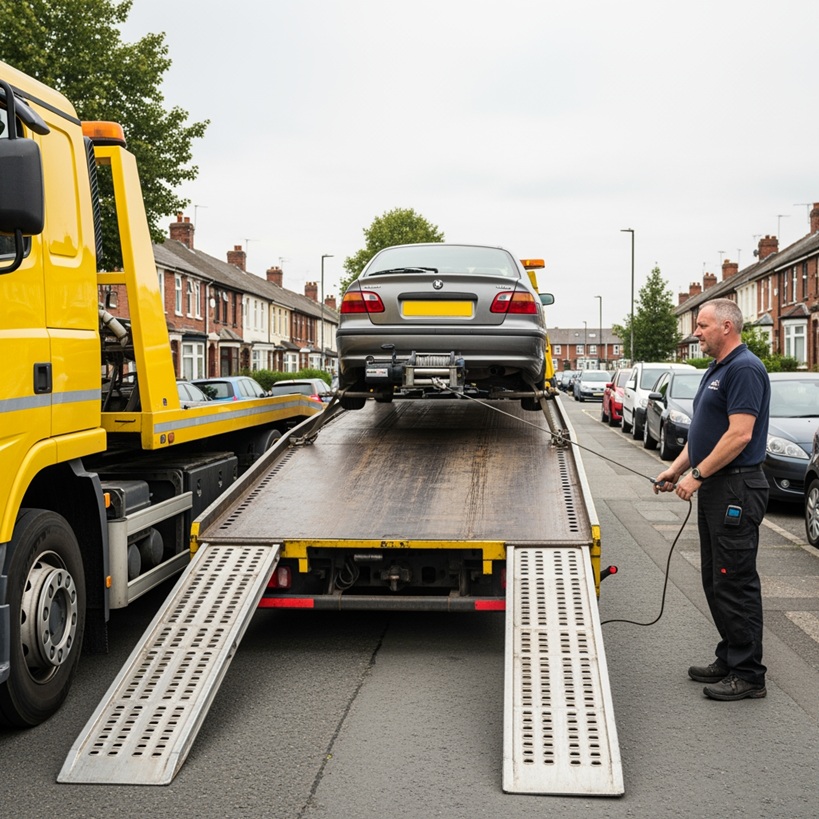
The physical condition of the vehicle heavily dictates the feasibility of rapid dispatch. If a car is simply old but still possesses four inflated tyres and working steering, it can be quickly winched onto a standard flatbed truck. However, if the vehicle has been sitting for years with seized brakes, or if it is missing wheels entirely following an accident, it requires a specialised truck equipped with a heavy-duty lifting crane.
Because these highly specialised crane trucks are fewer in number, securing one for an immediate, unannounced collection is mathematically difficult. Therefore, true same-day service is often dependent on both the simplicity of the collection and the immediate geographic availability of the correct equipment.
How Next-Day Collection Works Differently
Choosing a next day car collection provides the recovery facility with a vital 24-hour administrative buffer. This short delay fundamentally changes how the transport office operates. Instead of scrambling to dispatch a single truck to a single location, the facility can intelligently route their vehicles for maximum efficiency.
Think of next-day scheduled collection like a standard public bus route, whereas same-day service operates more like a private emergency taxi. The bus follows a highly optimised path, collecting multiple passengers logically without backtracking. A recovery truck planned a day in advance can collect three or four end-of-life vehicles from the same region in a single morning.
This logistical efficiency is the backbone of the modern car scrapping industry. By grouping collections logically, ATFs drastically reduce their fuel consumption and driver hours. This operational efficiency is precisely what allows reputable networks to offer collection entirely free of charge, absorbing the transport costs into the final value of the raw materials.
Payment Speed: The Real Difference
A common misconception among the public is that collection speed and payment speed are inextricably linked. In reality, the physical movement of the heavy metal shell is a completely separate process from the digital transfer of funds. A dealer might offer lightning-fast collection but utilize a slow, outdated accounting system.
Under the Scrap Metal Dealers Act 2013, it is a strict criminal offence to pay cash for scrap cars in England and Wales. This legislation was enacted to completely eradicate the untraceable trade of stolen vehicles and metal components. Therefore, all legitimate transactions must be processed electronically.
Most modern, reputable facilities utilise Faster Payments, a UK banking initiative that clears funds almost instantly. However, some traditional yards still rely on standard BACS transfers, which can take up to three working days to clear. Clarifying the specific digital payment method is far more critical than arguing over a few hours of collection time.
Price Variations Between Speed Options
Vehicle owners frequently wonder if demanding an immediate collection will negatively impact their quoted price. Generally, a legitimate facility will not penalise a customer for requesting rapid service if they genuinely have a truck available in the immediate vicinity.
The global scrap metal market, which dictates the core value of the vehicle, operates on daily index prices. The price of raw shredded steel does not change dramatically between Tuesday afternoon and Wednesday morning. The intrinsic value of the vehicle remains entirely static. If you decide to scrap my car, the quote is based overwhelmingly on the gross weight of the chassis and the presence of high-value recyclable components, like original catalytic converters.
If an operator demands a significant price reduction purely for collecting the vehicle today rather than tomorrow, it is often a red flag. It suggests they are not operating an efficient fleet and are attempting to pass their own poor logistical costs directly onto the consumer.
Geographic Limitations on Same-Day Service
Geography acts as the ultimate determining factor for collection speed. The UK features a wildly diverse landscape, ranging from ultra-dense metropolitan mega-cities to deeply isolated rural communities. The availability of rapid recovery services mirrors this population density perfectly.
In Greater London, Birmingham, or Manchester, vehicle owners are surrounded by dozens of competing industrial estates housing licensed ATFs. A recovery truck is rarely more than five miles away at any given time. In these urban environments, securing a collection within hours is a standard daily occurrence.
Conversely, attempting to secure a rapid collection in the Scottish Highlands, rural Wales, or coastal Cornwall presents immense challenges. The nearest legal processing facility might be forty miles away down winding, single-lane roads. In these regions, a scheduled 48-hour window is often the most realistic and reliable expectation, as trucks must dedicate half a day to a single journey.
Documentation Requirements Don’t Change
The speed at which a recovery truck arrives has absolutely zero bearing on the strict legal requirements governing vehicle disposal. The DVLA mandates a rigid administrative process that protects the registered keeper from ongoing legal liability, and this process cannot be bypassed or rushed.
The V5C logbook remains the central document. Whether the truck arrives in two hours or two days, the owner must complete Section 9 (or the yellow section on older logbooks) and ensure it is processed correctly. Handing a vehicle over without verifying the paperwork trail leaves the owner entirely liable for any future parking fines, speeding tickets, or missed vehicle tax payments.
Furthermore, the legal threshold of destruction is only met when an official Certificate of Destruction (CoD) is issued through the DVLA database. This secure document permanently links the vehicle’s chassis number to its final destruction. Licensed ATFs typically generate this certificate within seven days of the vehicle arriving at their depollution bay, regardless of how fast the physical collection occurred.
When Same-Day Collection Makes Sense
Certain scenarios genuinely require bypassing the standard 24-hour scheduling window. Emergency situations usually involve a severe safety risk or an escalating financial penalty for the vehicle owner.
If a vehicle has suffered catastrophic mechanical failure on a public road and is actively leaking significant quantities of engine oil or corrosive brake fluid into the drains, it becomes a severe environmental hazard. Local authorities can issue massive fines for environmental contamination. In this instance, immediate removal is the only responsible course of action.
Similarly, if you run a business and need to scrap my van because it has completely failed its MOT and is blocking vital commercial loading bays, the loss of business income justifies the urgency. Immediate collection is also crucial for severe insurance write-offs sitting in expensive, daily-rate impound lots, where every extra hour costs the owner money.
Why Next-Day Often Proves Smarter
For the vast majority of end-of-life vehicles, applying artificial urgency simply creates unnecessary stress. Booking a collection for the following day provides the owner with the breathing room required to execute the transaction flawlessly.
Consider a common scenario where a vehicle owner rushes a collection before leaving for work. In their haste, they forget to unpair their mobile phone from the car’s Bluetooth system, leaving sensitive contacts in the dashboard memory. They forget to check the CD player, leave their expensive sunglasses in the glovebox, and fail to locate the locking wheel nut key required by the recovery driver.
A scheduled next day car collection eliminates this panic. It provides ample time to sweep the interior thoroughly, gather the service history and logbook, and cancel the vehicle insurance policy calmly. Furthermore, scheduled collections usually offer precise two-hour arrival windows, meaning the owner does not have to sacrifice their entire day waiting for a truck to appear.
Red Flags in Speed-Based Offers
The end-of-life vehicle sector is heavily regulated, but unscrupulous, unlicensed operators still exist, often lurking on social media platforms. These rogue traders frequently use speed as a weapon to pressure vulnerable vehicle owners into making terrible legal decisions.
If an operator states that a high price is only valid if they can collect the car in the next thirty minutes, it is a classic high-pressure sales tactic. Legitimate metal prices do not plummet by the hour. These operators rely on creating panic, ensuring the owner hands over the keys without taking the time to verify the buyer’s ATF credentials or checking their official waste carrier license.
Unlicensed buyers often operate “cash-in-hand” schemes. They promise lightning-fast removal, hand over illegal cash notes, and drive away. The vehicle is then stripped of valuable parts in a residential garage, and the remaining shell is illegally dumped in a country lane. Because the paperwork was never processed legally, the local council traces the dumped chassis straight back to the original owner, resulting in severe criminal fly-tipping charges.
The Environmental Angle Doesn’t Change
The overarching purpose of the modern vehicle recycling industry is environmental protection. A car is essentially a mobile container of highly toxic chemicals, explosive charges, and heavy metals. The speed at which it travels from a driveway to an industrial yard does not alter the rigorous science of safely dismantling it.
When you secure the scrap value of my car, the vehicle enters a mandatory depollution phase upon arrival at the ATF. Highly trained technicians follow a strict protocol. They puncture the fuel tank to drain volatile petrol, extract the corrosive lead-acid battery, and use specialised vacuum pumps to safely remove the refrigerant gases from the air conditioning system, preventing catastrophic ozone depletion.
This meticulous process ensures that 95% of the vehicle’s total mass is safely recovered, recycled, or reused. Whether the recovery truck drove at top speed to collect the car, or carefully planned a route a week in advance, the environmental integrity of the depollution process remains absolutely identical.
Regional Service Examples
Understanding the specific logistical quirks of different UK regions helps vehicle owners set highly realistic expectations. The speed of service is inextricably linked to local industrial infrastructure and major motorway networks.
In dense urban corridors, such as the stretch between Manchester and Liverpool, recovery operators can cross the region in under an hour. The sheer concentration of ATFs in these industrial heartlands means that rapid dispatch is highly sustainable. A truck dropping off a vehicle in Salford might easily swing past Bolton for a rapid collection on its return journey.
Conversely, coastal regions facing the North Sea or remote agricultural counties in the West Country lack this dense infrastructure. A single accident on a major arterial A-road can cause hours of gridlock, completely destroying a transport manager’s daily schedule. In these areas, booking in advance is the only way to ensure reliable, punctual service.
Making the Right Choice
Choosing the correct collection speed requires an objective assessment of the vehicle’s exact situation. Vehicle owners should ask themselves a series of simple, practical questions to avoid unnecessary anxiety.
First, is the vehicle currently causing a legal obstruction or an active danger to the public? If the car is parked safely on private property, there is rarely a genuine reason to demand immediate removal. Second, are all the required documents immediately at hand? Searching frantically for a lost logbook while a heavy recovery truck idles in the street is a highly stressful experience.
If you are finally ready to officially scrap my vehicle, taking a breath and scheduling a convenient time is almost always the most logical approach. It guarantees a smooth handover, ensures all personal items are saved, and allows the recovery operator to arrive prepared for the specific access requirements of the property.
Payment Timing Matters More Than Collection Speed
When evaluating different disposal services, vehicle owners should pivot their focus away from the speed of the physical tow truck and concentrate intensely on the speed and security of the financial transaction.
A heavy metal shell disappearing from a driveway is only half of the agreement. The transaction is entirely meaningless until the agreed funds have securely cleared into the owner’s bank account. A service that collects a vehicle in two hours but takes five days to process a standard BACS payment is inherently less convenient than a service that schedules collection for tomorrow but triggers an instant Faster Payment the moment the vehicle is loaded.
Professional networks understand that financial security is paramount. They utilize modern, encrypted banking systems to ensure prompt, auditable transfers. Establishing explicit payment terms before handing over the V5C logbook protects the owner from unnecessary financial anxiety.
The Scrap Car Network Approach
Navigating the complexities of vehicle disposal requires a partner committed to absolute legal compliance and operational transparency. Finding a balance between rapid convenience and strict environmental safety is the core philosophy of a professional network.
The Scrap Car Network operates on a foundation of honesty regarding collection logistics. Our dedicated transport teams assess the exact location and condition of the vehicle to provide highly accurate, realistic collection windows. We do not engage in artificial pressure tactics or offer unachievable timeframes simply to secure a booking.
By partnering exclusively with heavily vetted, licensed Authorised Treatment Facilities across the entire United Kingdom, the network ensures that every single vehicle is processed legally. From the initial valuation based on fair market metal weight to the final issuance of the official Certificate of Destruction, the administrative burden is handled efficiently by experienced professionals.
Conclusion
The debate between rapid, immediate dispatch and scheduled next-day collection is ultimately a matter of matching service capabilities to genuine real-world urgency. While having a vehicle disappear within hours feels highly satisfying, it is rarely a strict logistical necessity.
Scheduled collections offer significant advantages in terms of preparation, reduced stress, and highly reliable arrival windows. More importantly, vehicle owners must remain vigilant that the desire for speed never eclipses the absolute necessity of legal compliance, environmental responsibility, and secure, traceable financial processing.
Whether you require an urgent emergency removal due to a catastrophic breakdown, or simply want to clear space on your driveway at your earliest convenience, professional assistance guarantees a smooth transition. If you are ready to explore your options, please speak with us to arrange a fast, legal, and environmentally sound resolution for your end-of-life vehicle.