Is a 10-Year-Old Car Worth Scrapping or Selling?
27th Apr, 2026
Reaching a decade of vehicle ownership represents a significant milestone. Deciding between a private sale or a 10-year-old car scrap requires careful and objective evaluation. Owners must assess current mechanical condition, impending repair costs, and realistic market expectations to avoid substantial financial losses.
Automotive engineering ensures that a decade-old vehicle can still function reliably. However, physical components eventually degrade regardless of the manufacturer. Making a smart financial decision means looking past sentimental attachment and calculating realistic repair bills against the actual worth of the aging machine.
The 10-Year Milestone and Vehicle Value
A vehicle hitting its tenth year crosses an important economic threshold. The most severe financial depreciation has already occurred. Simultaneously, the vehicle enters a phase where original mechanical components begin failing with alarming regularity. This exact crossover point forces owners to evaluate disposal options rather than funding endless repairs.
Market values for decade-old vehicles vary wildly. A heavily worn model might struggle to fetch minimum value, while a pristine example of a reliable brand commands strong interest. The difference relies entirely on maintenance history, mileage, and underlying mechanical health.
Understanding Depreciation Patterns
Vehicles lose financial value at vastly different speeds throughout their operational lifespan. The steepest drops occur during the initial three years of ownership. Following this volatile period, the curve flattens considerably. Values eventually stabilise around a baseline that reflects actual daily utility rather than showroom appeal.
Monitoring these vehicle depreciation rates explains the shifting market. A well-maintained economy hatchback often retains respectable value due to high demand for cheap transport. Conversely, a ten-year-old luxury saloon packed with failing electronics plummets in value due to the sheer terror of anticipated repair bills.
What Determines a 10-Year-Old Car’s Worth
Age acts as just one piece of the valuation puzzle. Total mileage matters enormously at this advanced stage. A vehicle showing 60,000 miles presents a completely different proposition from one showing 150,000 miles. Lower mileage suggests the major internal components possess significant remaining life.
Service history serves as the absolute proof of care. A complete record detailing regular oil changes and timing belt replacements proves the machinery was respected. Lacking this documentation forces potential buyers to assume the worst regarding internal engine health.
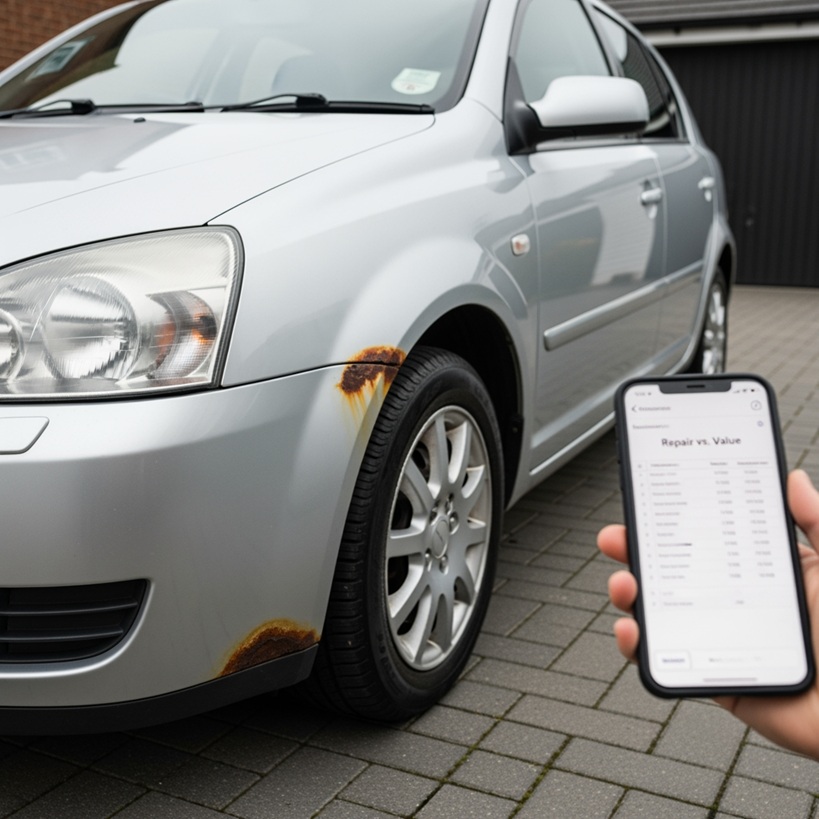
Body condition also heavily dictates final value. Surface rust on a scratched panel remains purely cosmetic. However, structural corrosion attacking the wheel arches, sills, and underbody presents a terminal issue that destroys residual value instantly.
When Scrapping Makes More Financial Sense
A simple financial principle guides this entire process. Utilising professional vehicle disposal services becomes the logical choice whenever necessary repair costs exceed the potential returns of a private sale. Understanding this threshold prevents owners from throwing good money into a machine that has reached the end of its economical life.
Consider a scenario where a decade-old vehicle holds a theoretical market value of £1,200. If that same vehicle requires £900 in essential maintenance to pass an annual inspection, the mathematics fail. Factoring in the immense time and effort required to sell the vehicle privately makes the negligible profit margin completely unjustifiable.
Major Mechanical Failures
Specific component failures absolutely decimate the value of older vehicles. Engine degradation tops this list. Correcting severe oil consumption or replacing worn crankshaft bearings easily costs thousands of pounds. These repair bills instantly exceed the entire worth of an average ten-year-old hatchback.
Transmission faults fall into the exact same category. Replacing a slipping automatic gearbox or installing a new dual-mass manual clutch system demands immense labour hours. When starting from a low base value, these massive garage invoices simply defy basic economic logic.
MOT Failures and Recurring Issues
Inspection failure costs become increasingly problematic as machinery ages past the decade mark. The test itself remains inexpensive, but the resulting list of mandatory repairs frequently spirals out of control. Escalating failure costs often serve as the final catalyst for vehicle disposal.
Structural rust represents the most severe failure point. Passing an inspection requires cutting out the rot and welding in fresh metal. This highly skilled labour costs hundreds of pounds, and the corrosion inevitably returns elsewhere the following year.
Furthermore, emission system failures plague older diesel engines. Replacing a clogged particulate filter costs a small fortune. These highly complex components cannot be patched or bypassed legally, requiring expensive complete replacements.
The Hidden Costs of Keeping an Old Car
The obvious costs involve direct repairs, but additional expenses lurk beneath the surface. Older engines burn fuel far less efficiently than modern alternatives. A heavily worn engine loses compression, resulting in significantly worse fuel economy and higher monthly petrol expenses.
Insurance premiums do not necessarily decrease alongside the vehicle’s value. An older car lacking modern safety assistance features often costs more to insure comprehensively. The risk of sudden mechanical breakdown also increases exponentially, bringing expensive emergency recovery charges and severe lifestyle disruption.
Keeping a fundamentally broken vehicle on the road resembles patching a sinking boat. Eventually, the owner spends more capital applying temporary fixes than the entire vessel is actually worth.
When Selling Privately Still Makes Sense
Not every older vehicle requires immediate recycling. Certain examples genuinely warrant the effort of a private sale. Sending a perfectly functional, desirable vehicle to a recycling centre leaves substantial money on the table.
Vehicles justifying a private sale typically feature very low mileage and boast a complete, stamped service history. They possess a recent inspection pass with zero advisories and display clean bodywork free from structural rust. These specific characteristics attract budget-conscious buyers seeking reliable, proven transport.
Assessing Sale Potential
Remaining brutally honest about the vehicle’s actual condition prevents deep frustration. Owners naturally overestimate value based on sentimental attachment. Buyers evaluate the metal purely objectively, assuming the worst until proven otherwise through documentation.
Researching accurate market values requires examining completed sales on major automotive platforms. Comparing identical models with similar mileage provides a realistic pricing baseline. Discovering very few similar vehicles nationwide indicates incredibly weak market demand.
Comparing the required effort against the convenience of recycling is essential. Private sales demand significant personal time. Listing the vehicle, responding to endless queries, and managing test drives takes weeks. Individuals researching to find out how to scrap your car easily often realise that a difference of merely £200 rarely justifies the immense hassle involved.
Preparing a 10-Year-Old Car for Sale
Presentation strongly influences final sale prices. Investing in a thorough professional valet drastically improves perceived value. A pristine interior and polished exterior suggest the vehicle benefited from meticulous mechanical care as well.
Rectifying minor, inexpensive faults removes easy negotiation points for buyers. Replacing blown bulbs and touching up small stone chips requires minimal investment. Gathering all documentation, including the V5C logbook and maintenance receipts, proves the vehicle possesses a transparent history.
The Scrapping Process for 10-Year-Old Vehicles
Disposing of a vehicle through proper channels ensures complete legal compliance. Authorised Treatment Facilities process vehicles safely, removing all hazardous fluids before crushing the metal shell. This highly regulated environmental process prevents toxic chemicals from contaminating local soil.
When scrapping your car, recycling centres calculate quotes primarily based on the sheer weight of the vehicle’s ferrous metal. A heavy estate car inherently commands a higher return than a lightweight city hatchback.
Getting the Right Price
Current metal prices fluctuate heavily based on global commodity markets. Daily shifts in international shipping rates and industrial demand dictate the exact quote provided by local facilities.
Arranging free collection for a non-running vehicle saves the immense expense of hiring a private recovery truck. Legitimate facilities build this collection service directly into the upfront quote. Those seeking to securely scrap my vehicle discover that reputable networks handle the entire logistical process from start to finish without hidden fees.
Legal Requirements When Scrapping
Vehicle disposal carries strict administrative obligations. Owners must permanently sever their legal connection to the vehicle’s registration record. Failing to complete this vital step leaves the original owner entirely responsible for future road tax demands and parking fines.
Owners must understand how to tell the DVLA when you sell or scrap your car using the specific 11-digit reference number located on the V5C logbook. This dual notification system ensures the national database accurately reflects the vehicle’s destruction.
A formal Certificate of Destruction arrives shortly after the vehicle enters the processing facility. This crucial document provides absolute legal proof that the chassis was crushed. Retaining this certificate securely prevents any future liability claims.
Making a Practical Decision
Cutting through the variables requires a structured framework. Securing three quotes from local recycling centres establishes a firm financial baseline. This represents the guaranteed capital available with zero effort or risk.
Researching realistic private sale prices follows next. Subtracting the cost of necessary repairs and the monetary value of personal time from that optimistic sale price reveals the true profit margin. If the resulting figure barely exceeds the recycling quote, arranging a scrap car collection becomes the clear winner.
The Repair Cost Threshold Formula
A specific calculation guides this economic decision. The industry-standard 50-70% rule provides clarity. Whenever necessary repairs cost more than half of the vehicle’s total market value, disposal represents the smartest financial choice.
This threshold accounts for the harsh reality of aging machinery. Spending £900 to fix a vehicle worth £1,500 equates to a 60% investment. Following the repair, the owner still possesses a decade-old machine completely prone to subsequent, equally expensive component failures.
Choosing to use Scrap Car Network connects owners with a trusted, professional service when this threshold is breached. The network ensures cars are processed strictly according to environmental agency guidelines, guaranteeing a seamless, nationwide collection service.
Practical Assessment Factors
Beyond pure mathematics, logistical realities demand attention. Private sales require weeks of patience, whereas recycling arrangements conclude within days. Owners requiring immediate removal to free up driveway space heavily favour the swift disposal route.
Risk tolerance also plays a massive role. Selling older vehicles privately involves managing cash payments and dealing with post-sale complaints from difficult buyers. Legitimate recycling centres provide guaranteed, immediate electronic payment with zero subsequent comebacks.
Conclusion
Deciding the fate of a decade-old vehicle relies entirely on objective assessment and simple mathematics. Significant repair costs, poor structural condition, and the sheer effort of private selling routinely tip the scales toward disposal.
Remaining realistic about actual market value prevents prolonged frustration. Most heavily worn vehicles deliver greater satisfaction through a rapid, guaranteed recycling transaction than through weeks of stressful private negotiation. Securing a baseline quote provides the necessary data to make an informed, emotionless decision.
Owners evaluating their options and seeking to understand current market values are encouraged to contact us for straightforward guidance. The network assists in arranging hassle-free collections whenever the time arrives to responsibly recycle an aging vehicle.