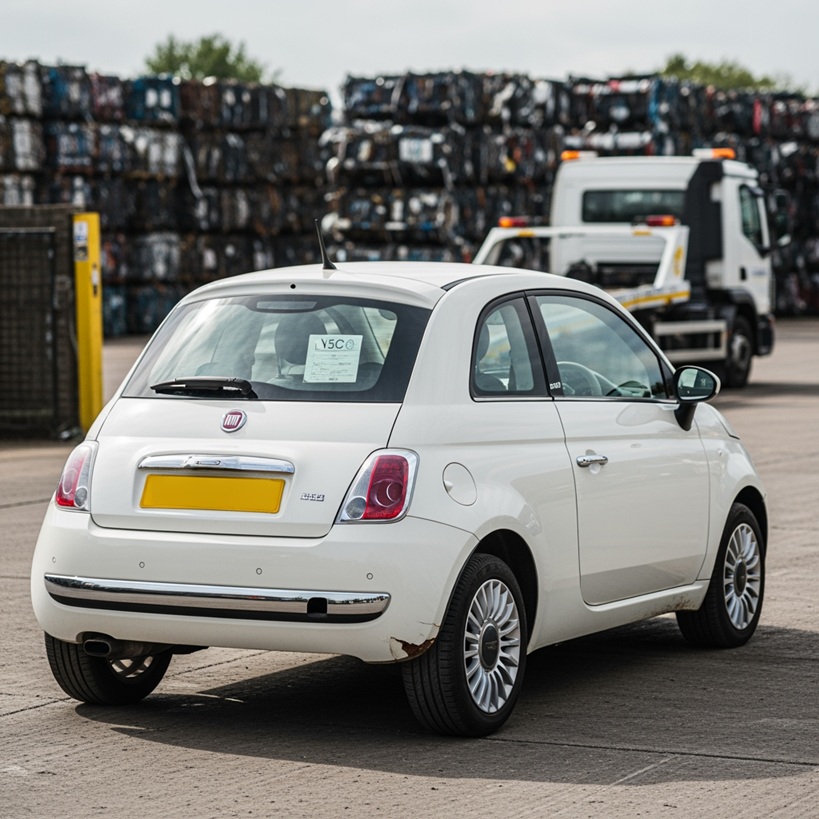
Fiat 500 Scrap Guide: Petrol vs Diesel Values
20th Apr, 2026
That little Fiat 500 sitting on your drive might not look like much anymore, but it’s worth more than you’d think. Whether it’s the peppy petrol model or the torquey diesel variant, these Italian city cars still hold decent scrap value – even when they’ve given up the ghost.
Scrap Car Network connects you with licensed Authorised Treatment Facilities that understand Fiat 500s inside and out. The difference between scrapping petrol and diesel versions comes down to weight, component value, and what breakers can salvage.
Let’s walk through exactly what each fuel type’s worth and how to maximize your payout.
Understanding Fiat 500 Scrap Values
Fiat 500 scrap value varies based on several factors, but diesel models typically fetch £20-50 more than petrol equivalents. This isn’t about one being better – it’s pure economics of weight and components.
Metal weight sits at the top of the list. A standard Fiat 500 weighs around 865-1,030kg depending on model and engine type. Think of it like weighing potatoes at the market – more weight means more money, regardless of variety.
Diesel variants pack more weight due to cast-iron engine blocks. Petrol models use lighter aluminium components. That weight difference translates directly into your pocket.
What Determines Your Fiat 500’s Scrap Value
Beyond basic weight, several factors influence your final payout:
Current scrap metal prices fluctuate based on global market conditions. Steel currently hovers around £150-200 per tonne in the UK, though this changes weekly. Your timing can swing values by £20-40 either way.
Salvageable parts add value beyond metal weight. Working engines, gearboxes, light clusters, dashboard instruments, doors, bonnets, alloy wheels, and audio systems all get removed and resold before crushing.
Vehicle condition plays a role too. A complete car with all parts intact fetches more than one that’s been cannibalised or accident-damaged.
I remember a customer from Southampton with a 2011 Fiat 500 1.2 petrol. She’d kept it immaculate – not a scratch, full service history, lovely condition. But the engine had seized due to an oil pump failure. Cost more to fix than the car was worth. She was gutted thinking it was worthless. Got her £240 because everything else was perfect – breakers could salvage doors, lights, interior, wheels. Completeness matters.
Petrol Fiat 500 Scrap Values
Scrap Fiat 500 petrol models remain the most common variant on UK roads. These nippy little runabouts typically house either 1.2-litre or 0.9-litre TwinAir engines.
Expected value: £180-280
The range depends on condition, completeness, and current metal prices. Complete cars in reasonable condition hit the upper end. Damaged or incomplete examples fetch lower figures.
Engine and Component Value
The 1.2-litre engines are simple, reliable units that don’t command much as spare parts – they’re too common. Everyone’s got one, so breakers aren’t desperate for them.
However, the TwinAir engines can be worth salvaging if they’re in decent nick. These two-cylinder turbocharged units have enthusiast followings. A working TwinAir might add £50-100 to your quote compared to a standard 1.2.
Petrol models weigh less overall, meaning less metal to sell. But they offset this disadvantage with cleaner exhaust systems. Catalytic converters in petrol cars contain precious metals like platinum, palladium, and rhodium. These fetch good money at specialist recyclers – typically £80-150 depending on condition.
Bodywork and Parts Demand
The bodywork on petrol 500s tends to rust less aggressively than diesel variants. Breakers can often salvage panels, bumpers, and trim pieces that still have resale value.
Pop-out windows, wing mirrors, and interior components from petrol models remain in steady demand. People restoring or repairing their petrol 500s need these parts, creating consistent breaker markets.
Dashboard instruments, control units, and audio systems from petrol variants get refurbished and resold regularly. Electronics hold value if they’re functioning.
Diesel Fiat 500 Scrap Values
Scrap Fiat 500 diesel models pack the 1.3-litre MultiJet engine – a workhorse found in dozens of Fiat Group vehicles. This commonality makes parts readily available, which paradoxically reduces their individual value.
Expected value: £200-320
The diesel premium comes from weight and specific components rather than overall superiority. If you’re scrapping, you’ll get more. If you’re buying parts, diesels aren’t necessarily better.
Weight and Engine Advantages
The extra weight comes from diesel engine construction. Where a petrol engine might weigh 90-100kg, the diesel lump tips the scales at 130-150kg. That’s an extra 40-50kg of recyclable metal straight away.
At £150 per tonne, that additional weight alone adds £6-8. Not huge, but combined with other diesel-specific factors, it compounds.
Diesel particulate filters (DPFs) add value too. These emissions control devices contain ceramic honeycomb structures coated with precious metals. A functioning DPF can be worth £50-150 on its own, depending on condition and metal prices.
The fuel injection system on diesel models uses high-quality components. Injectors, fuel pumps, and sensors can be refurbished and resold to owners needing replacements.
Common Diesel Issues Affecting Value
However, if your 500’s diesel engine has suffered common MultiJet failure (worn injectors or turbo issues), these parts might be worthless. Breakers won’t pay extra for broken components.
Diesel variants often show more corrosion around exhaust and undercarriage. The extra heat and soot take their toll. This can reduce the value of salvageable body panels and structural components.
Be honest about condition when getting quotes. “The turbo’s gone” or “injectors are knackered” helps assessors provide accurate valuations.
Age and Mileage Impact on Scrap Value
Here’s something that catches people out: age and mileage barely matter for pure scrap value. Once a car’s headed for crushing, a 2010 model with 150,000 miles isn’t worth much less than 2018 with 50,000.
What matters is salvageable components:
Under 60,000 miles: Engines, gearboxes, and suspension parts may be salvaged for resale.
60,000-100,000 miles: Selected components like alternators, starters, and body panels get retained.
Over 100,000 miles: Mostly just metal weight and precious metals from catalysts matter.
The 2007-2012 Fiat 500s are entering their final years. These early models suffer from rust issues around rear arches and sills. Breakers know this and adjust offers accordingly.
Newer models (2016 onwards) with low mileage might be worth repairing rather than scrapping. Before you commit, consider whether fixing costs less than its actual value. Sometimes it doesn’t make financial sense, but it’s worth checking.
Regional Price Variations Across the UK
Where you scrap your Fiat 500 affects the price you’ll get. Metal prices stay fairly consistent nationwide, but collection costs and local parts demand create regional differences.
London and South East
London and the South East typically offer £10-30 more than national average. Higher population density means more breakers competing for stock, plus greater demand for spare parts.
Competition drives prices up. When multiple operators want your car, you benefit.
Scotland Regional Considerations
Scotland presents mixed pictures. Urban centres like Glasgow and Edinburgh match southern prices, but rural areas face higher collection costs. These additional expenses often get deducted from payouts.
If you’re in remote Scottish locations, expect slight reductions to cover recovery logistics. It’s economics, not discrimination.
Northern England Markets
Northern England generally offers competitive rates. Cities like Newcastle and Preston have established scrap industries with efficient processing facilities.
This efficiency translates to better prices for sellers. Streamlined operations mean operators can afford to pay more whilst maintaining margins.
Rural Area Challenges
Rural areas everywhere face the same challenge: collection costs. If your Fiat 500’s stuck down a narrow country lane or on a farm track, expect offers to drop.
The scrapyard needs to factor in recovery expenses. A recovery truck driving 40 miles down single-track roads costs money. That comes off your payout.
Getting the Best Price for Your Fiat 500
Maximizing your scrap value takes minimal effort but can add £50-100 to your final payout.
Keep It Complete
Don’t strip parts before scrapping unless you’re confident you can sell them privately for more than the scrapyard would pay. A complete car’s always worth more than a shell.
Remove personal items but leave tools. Take out belongings, but leave the jack, spare wheel, and toolkit. These add weight and value.
Every missing component reduces value. That stereo you removed? Worth £20-30 to breakers. Those alloy wheels you swapped? That’s £40-80 gone.
Documentation Preparation
You’ll need your V5C logbook to prove ownership. Without it, legitimate Authorised Treatment Facilities won’t touch your car.
If you’ve lost your V5C, you can still scrap the car, but expect more paperwork. The ATF will need additional identification, and the process takes longer.
You can tell the DVLA when you sell or scrap your car online for additional confirmation.
Multiple Quote Comparison
Scrap prices vary between yards. Our free nationwide collection service connects you with competitive ATF partners who’ll collect your Fiat 500 at no extra charge.
Get quotes from at least three operators. Variations of £40-80 are common for identical cars. This reflects different inventory needs and parts buyer relationships.
Timing Considerations
Metal prices fluctuate throughout the year. Whilst you can’t predict markets perfectly, checking current scrap car prices gives you leverage when negotiating.
If your 500’s still driveable and you’re not desperate, monitoring prices for a few weeks might net an extra £20-40. But don’t let this become false economy – paying insurance, tax, or parking fees eliminates any gains.
Legal Requirements When Scrapping Your Fiat 500
Scrapping isn’t just about getting cash – it’s a legal process protecting you from future liability. Cut corners and you might face fines or worse.
Authorised Treatment Facility Requirement
Use an Authorised Treatment Facility. Only ATFs can legally scrap your car and issue Certificates of Destruction. This document proves your vehicle’s been properly recycled.
Our network of Authorised Treatment Facilities ensures compliant processing throughout the UK. Every operator holds proper environmental permits and meets Environment Agency standards.
Never sell to unlicensed operators. That bloke offering cash on Facebook might seem convenient, but if he’s not an ATF, you’re still legally responsible for your vehicle. If it turns up abandoned or used in crime, you’ll get the knock on the door.
V5C Logbook Completion
Complete your V5C correctly. Fill in Section 9 (for scrapping) and send it to the DVLA. Keep the yellow slip as proof.
This notifies the DVLA you’ve scrapped your car and removes you from liability for road tax, insurance, and any penalties. Without proper notification, you remain the registered keeper.
Certificate of Destruction Receipt
Get your Certificate of Destruction. The ATF must provide this within seven days of scrapping your car. Keep it safe – it’s your proof the job’s done properly.
Without a CoD, you can’t prove the car’s been legally scrapped. This leaves you exposed if anyone clones your registration or the vehicle gets used illegally.
Insurance and Road Tax Cancellation
Cancel your insurance and road tax once you’ve got confirmation the car’s scrapped. You’ll get a refund for any remaining road tax automatically from the DVLA.
Insurance refunds depend on your policy terms. Some providers charge cancellation fees, so check before scrapping.
Environmental Benefits of Proper Recycling
That Fiat 500 might be done with driving, but its materials have plenty of life left. Modern car recycling processes recover around 95% of vehicle weight.
Steel and Aluminium Recovery
Steel and aluminium get melted down and reformed into new products. Your 500’s body panels might become construction materials, appliances, or even parts for new cars.
This recycling uses 70% less energy than producing virgin steel. Multiply that by millions of cars scrapped annually, and the environmental savings are massive.
Precious Metal Recovery
Precious metals from catalytic converters and electronic components get refined and reused. With rhodium prices hitting £10,000+ per ounce, recovering these materials makes economic and environmental sense.
Platinum and palladium from your cat don’t get wasted. They’re extracted, purified, and sold to manufacturers needing them for new catalysts or industrial processes.
Plastics and Rubber Processing
Plastics and rubber from bumpers, trim, and tyres get processed into secondary materials. Whilst not all plastics are recyclable, ATFs separate what can be saved from what needs specialist disposal.
This careful sorting maximizes recovery and minimizes landfill waste.
Hazardous Material Handling
Fluids and hazardous materials get handled safely. Oil, coolant, brake fluid, and refrigerants can’t just be dumped. ATFs have systems to capture, process, or dispose of these substances without environmental harm.
Our environmentally responsible car recycling process ensures your Fiat 500’s depolluted correctly before crushing and recycling.
Common Fiat 500 Issues Leading to Scrapping
Some problems cost more to fix than the car’s worth. When these crop up, scrapping becomes sensible.
Rust and Structural Corrosion
Rust and structural corrosion plague older Fiat 500s. The rear wheel arches, sills, and tailgate are notorious rot spots.
Once structural integrity’s compromised, it’s game over. No MOT station will pass a car with serious corrosion in load-bearing areas. Welding costs £500-1,200 depending on severity. On a car worth £800-1,200, that doesn’t make sense.
Engine Failures
Engine failures in the 0.9 TwinAir petrol engines aren’t uncommon. These clever little two-cylinder units can suffer from oil consumption, timing belt failures, and head gasket problems.
A replacement engine costs £1,500-2,500 fitted – more than many older 500s are worth. At that point, scrapping’s the sensible choice.
Diesel engine issues centre on the 1.3 MultiJet’s fuel system. Injector failures cost £600-1,000 to fix properly. Turbocharger problems add another £800-1,200. When multiple issues hit simultaneously, repair bills exceed vehicle values.
Transmission Problems
Dual-clutch gearbox problems affect automatic models. The Dualogic transmission can be troublesome, with clutch wear and actuator failures costing £1,500+ to rectify.
Manual gearboxes are more robust but not immune to issues. Clutch replacements cost £400-600. On high-mileage cars worth £600-900, this becomes a scrapping decision.
Electrical Gremlins
Electrical gremlins multiply as these cars age. Window regulators fail, central locking plays up, and dashboard warning lights become permanent fixtures.
Tracking down intermittent electrical faults costs time and money. Garages charge diagnostic fees, and fixes aren’t guaranteed. Sometimes it’s just not worth chasing.
Alternatives to Scrapping Your Fiat 500
Before you commit to scrapping, consider whether other options might work better.
Private Sale Considerations
Private sale makes sense if the car still runs and has valid MOT. Even with faults, you’ll get more selling privately than scrapping.
A running Fiat 500 with problems might fetch £500-1,500, compared to £200-300 scrap value. That’s significant money worth pursuing if you’ve got time.
Part Exchange Options
Part exchange works if you’re buying another car. Dealers often take non-runners as part-exchange, though they’ll factor in collection and disposal costs.
You might get slightly more than pure scrap value as a gesture of goodwill. It’s convenient if you’re already buying from them.
Charity Donation
Donation to charity appeals to some owners. Several charities accept car donations, scrap them, and use proceeds for their causes.
You won’t get cash, but you’ll support good causes and still get the Certificate of Destruction protecting you legally.
Breaking for Parts Yourself
Breaking for parts yourself can maximize returns if you’ve got time, space, and mechanical knowledge. Selling parts individually might net £500-1,000 from a Fiat 500.
But it takes weeks or months, and you’re left with a shell to dispose of anyway. Most people don’t have the patience or facilities.
Repair Consideration
Repair and keep might cost less than you think. Get proper diagnostics and quotes before deciding. Sometimes what seems terminal is actually fixable for reasonable money.
If you love your 500 and it’s otherwise sound, fixing might make emotional and financial sense.
Petrol vs Diesel Comparison Summary
Let’s summarize the key differences:
Petrol Fiat 500:
- Lighter weight (less metal value)
- Valuable catalytic converters
- Less prone to corrosion
- Better parts demand for bodywork
- Typical value: £180-280
Diesel Fiat 500:
- Heavier engine (40-50kg more)
- Valuable DPF filters
- Refurbishable fuel system components
- More corrosion typically
- Typical value: £200-320
Neither’s dramatically better for scrapping. The £20-50 diesel premium reflects weight and component differences, not fundamental superiority.
Conclusion
Your Fiat 500’s scrap value depends on fuel type, condition, and completeness, but diesel models typically fetch £200-320 whilst petrol variants bring in £180-280. The difference stems from weight, component value, and salvageable parts rather than any fundamental superiority.
Getting the best price means keeping your car complete, shopping around for quotes, and using legitimate ATFs. Legal requirements aren’t complicated, but they’re essential – proper documentation protects you from future liability and ensures your car gets recycled responsibly.
Whether your 500’s succumbed to rust, engine failure, or simply old age, scrapping it properly puts cash in your pocket and gives its materials a second life. Modern recycling processes recover 95% of vehicle weight, turning your old car into raw materials for new products.
Don’t let that Fiat 500 sit gathering moss and losing value. Metal prices fluctuate, but they won’t magically jump 50% overnight.
If you’re ready to scrap your Fiat 500 and want competitive quotes from verified operators, contact us to get started. We’ll help you get fair value whilst ensuring everything’s handled legally and environmentally responsibly.