How to Spot Scrap Car Fraud in the UK and What a Legitimate Service Looks Like
7th Apr, 2026
Scrap car fraud UK is more widespread than most vehicle owners expect. The scrap sector, with its combination of high-value metals, cash transaction history, and relatively low public awareness, has historically attracted fraudulent and unlicensed operators who target owners looking for a quick, convenient vehicle disposal.
Knowing what unlicensed scrap dealers UK look like, understanding the cash in hand scrap car warning signs that indicate an illegal operation, recognising the risk of a fake Certificate of Destruction UK, and understanding scrap car identity theft UK exposure all significantly reduce the chance of becoming a victim of fraud during what should be a straightforward process.
The Scale of Scrap Car Fraud in the UK
Scrap car fraud UK isn’t a fringe problem. The Environment Agency investigates hundreds of illegal waste sites each year, a significant proportion of which are involved in vehicle scrapping without the required permits or documentation.
Why the Scrap Sector Attracts Fraudulent Operators
The scrap sector has characteristics that make it particularly attractive to fraudulent operators. The metal content of a vehicle has genuine and immediate cash value. Historically, the sector has operated with relatively informal documentation standards in some quarters. And the transactions often involve owners who are motivated by urgency, convenience, or simply getting an unwanted vehicle removed quickly.
Scrap car fraud UK operations typically exploit all three of these dynamics: offering a quick, convenient, cash-in-hand service at a price that seems competitive, without the licensing, paperwork, or accountability that a legitimate ATF provides.
Who Is Most at Risk
Owners of older, lower-value vehicles are the most frequently targeted group. The scrap offer on a high-mileage, non-running vehicle is modest, and fraudulent operators know that owners in this position are often more motivated by removal convenience than by scrutinising the credentials of who takes the car away.
Scrap Car Network provides a licensed, documented, bank-transfer-based alternative to the kind of informal, unaccountable collection that defines scrap car fraud UK operations across the country.
Unlicensed Scrap Dealers UK: The Warning Signs
Identifying an unlicensed scrap dealer UK before handing over a vehicle is straightforward with a few basic checks. The warning signs are consistent and recognisable once owners know what to look for.
How to Identify an Unlicensed Scrap Dealer UK
An unlicensed scrap dealer UK operation typically presents several identifiable characteristics:
- No Environment Agency permit: Cannot provide a permit reference or appears on no public register
- No fixed premises: Operates from a mobile phone number and a flatbed truck with no traceable business address
- Cash-only payment: Insists on cash rather than bank transfer despite legal prohibition
- No paperwork offered: Provides no written quote, no receipt, and no Certificate of Destruction
- Above-market quote: Offers a price significantly above current ATF market rates to override caution
Any single one of these indicators is reason for concern. Multiple indicators together are a reliable signal that the operator is unlicensed. The Environment Agency’s public register of permitted waste sites is freely accessible online and takes less than two minutes to check for any operator claiming to be a licensed ATF.
Door-to-Door Collections and Unsolicited Approaches
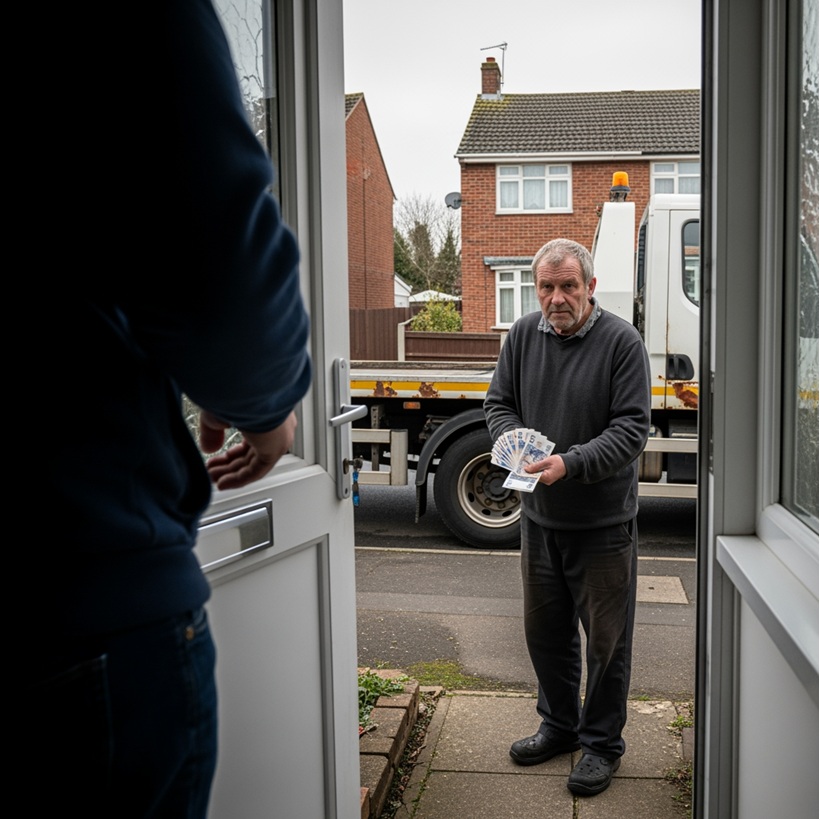
Legitimate ATFs don’t typically canvass door-to-door for vehicles. Their operations are premises-based, their collections are booked through established channels, and their customers find them through search, recommendation, or services like our scrap car collection service in London. An unsolicited knock at the door from someone offering to take a vehicle away immediately, for cash, is one of the most consistent presentations of an unlicensed scrap dealer UK operation.
Cash in Hand Scrap Car: Why It’s a Red Flag
The cash in hand scrap car warning is one of the clearest and most reliable indicators that something is wrong with a scrap transaction. It isn’t just a preference for bank transfer; it’s a legal requirement.
Cash in Hand Scrap Car Warning: What It Signals
The cash in hand scrap car warning matters because the Scrap Metal Dealers Act 2013 explicitly prohibits cash payments for scrap vehicles anywhere in the UK. Licensed scrap metal dealers and ATFs are legally required to pay by bank transfer or cheque, maintain records of all transactions, and provide written receipts. A cash in hand scrap car warning isn’t just a financial preference issue; it’s a legal compliance issue.
Any operator offering cash for a scrap vehicle is operating in breach of the Scrap Metal Dealers Act 2013, regardless of what they claim about being licensed or registered. The prohibition is absolute, and there are no exemptions for small operators, private collections, or any other circumstance.
The Legal Position on Cash Scrap Payments
Operators who pay cash for scrap metal face fines and licence revocation under the Scrap Metal Dealers Act 2013. The legislation was specifically introduced to tackle the theft and illegal trading of metal that flourished under a cash-based informal sector.
For the vehicle owner, accepting cash from an unlicensed operator creates its own complications. If the operator is subsequently investigated for illegal waste handling or metal theft, the owner may be asked to account for the transaction. A bank transfer leaves a clear, documented record that the vehicle changed hands legitimately.
Fake Certificates of Destruction: How to Protect Yourself
A fake Certificate of Destruction UK is among the most damaging tools in a fraudulent operator’s kit. It creates the appearance of a legitimate transaction while leaving the registered keeper fully exposed to ongoing liability. Owners in Scotland and across the UK can verify any CoD they receive through the DVLA’s vehicle enquiry service.
Fake Certificate of Destruction UK: What to Look Out For
A fake Certificate of Destruction UK document is designed to reassure the vehicle owner that the scrap process has been completed legitimately. In practice, it’s a fabricated document with no standing in the DVLA’s system. The vehicle remains registered in the keeper’s name, the operator retains the car and its components without any formal deregistration, and the keeper continues to be legally responsible for whatever happens to the vehicle.
A genuine Certificate of Destruction is issued by an ATF that is licensed under the End of Life Vehicles Regulations and is reported to the DVLA as part of the ATF’s legal obligation. The ATF’s information is linked to the CoD, and the DVLA records the vehicle as formally deregistered.
Verifying a Certificate of Destruction Is Genuine
The simplest way to confirm that a Certificate of Destruction is genuine is to check the vehicle’s registration status through the DVLA’s online vehicle enquiry service after the scrap is completed. If the vehicle still appears as registered to the keeper despite having been collected, the CoD received is not genuine and the scrapping process has not been completed legally.
A genuine CoD should result in the vehicle no longer appearing in the keeper’s name when the registration is checked through official DVLA channels. If it does, contacting the DVLA immediately and providing details of the collection is the correct next step.
Scrap Car Identity Theft UK: How Fraudsters Misuse Your Details
Scrap car identity theft UK is a consequence of unlicensed scrapping that most owners don’t anticipate until the consequences arrive in the post.
Scrap Car Identity Theft UK: What Happens After an Illegal Collection
Scrap car identity theft UK occurs when an unlicensed operator uses the details associated with a collected vehicle, and sometimes the keeper’s personal details obtained during the transaction, for fraudulent purposes. This can include applying for road tax in the keeper’s name using the vehicle registration, attaching the registration plates to another vehicle for use on the road, or selling the vehicle on with fabricated documentation.
The keeper’s details remain in the DVLA system until proper deregistration occurs. Toll road and traffic enforcement notices, parking fines, and even speeding tickets may arrive months after the vehicle was supposedly scrapped. Scrap car identity theft UK exposure isn’t theoretical; it’s a documented consequence of using unlicensed operators, reported by victims to the DVLA and Action Fraud on a regular basis.
Protecting Your Details During the Scrap Process
Limiting identity exposure during a scrap transaction is straightforward. A legitimate ATF needs the registration number, the V5C reference, and the keeper’s contact details for payment purposes. Nothing more. Be cautious of any operator who asks for financial details, National Insurance numbers, or personal documents beyond those required for the standard scrap process.
A registered keeper in the Midlands received a speeding fine six months after handing a vehicle to a cash-paying operator who had appeared at the door unsolicited. The registration had been transferred to another vehicle by the operator and was captured by a speed camera in a different county. Reporting the situation to the DVLA and Action Fraud eventually resolved the matter, but the process took several months and caused considerable disruption. A five-minute check of the operator’s legitimacy before the vehicle was handed over would have prevented the entire situation.
What a Legitimate Scrap Car Service Looks Like
Understanding what scrap car fraud UK looks like makes it considerably easier to recognise what a legitimate service looks like in comparison. Owners in North London and across the UK should apply the same legitimacy checks regardless of how a service is presented.
The Characteristics of a Licensed ATF Operation
A legitimate ATF has a verifiable Environment Agency permit, a fixed licensed premises, documented depollution procedures, and a requirement to pay by bank transfer for all transactions. Every step of the process is documented: the vehicle intake record, the depollution log, the DVLA notification, and the Certificate of Destruction.
Legitimate services also notify the DVLA on the keeper’s behalf as part of the standard process, removing the keeper’s legal responsibility for the vehicle without any additional action required. The entire process is traceable, accountable, and auditable by the relevant regulatory authorities.
How to Verify a Service Before Committing
Before agreeing to any scrap collection, carry out the following checks:
- Search the Environment Agency’s public register for the operator’s permit number
- Confirm the ATF has a fixed, licensed premises with a verifiable address
- Ask specifically about the payment method: bank transfer is the only legal option
- Confirm that a Certificate of Destruction will be issued within seven days
- Check online reviews from recent customers for any patterns of complaint
Owners in Newcastle and across the UK who run through this checklist consistently find that the few minutes it takes to verify a service is an entirely worthwhile investment before handing over any vehicle.
Conclusion
Scrap car fraud UK is avoidable with the right knowledge. Recognising the warning signs of unlicensed scrap dealers UK, treating any cash in hand scrap car warning as a definitive red flag, verifying that no fake Certificate of Destruction UK has been issued, and understanding scrap car identity theft UK risks all contribute to a scrap transaction that protects the registered keeper fully.
Choosing a licensed, documented, bank-transfer-paying ATF removes every one of these risks from the equation. For a verified, legitimate quote from a licensed ATF near you, contact us and we’ll connect you with a facility that operates to the full legal standard.