How Scrap Cars Support the Steel Industry
3rd Mar, 2026
After spending decades working on cars, countless vehicles reaching the end of their road have passed through workshops and garages. What many folks don’t realise is that when a trusty motor finally gives up the ghost, it’s not the end of the story – it’s actually the beginning of something quite remarkable.
Every year, millions of scrap cars become the backbone of Britain’s steel production. These old motors, whether they’re rusted Ford Fiestas or knackered BMWs, contain roughly 65% steel by weight. That’s a massive amount of raw material that would otherwise need to be dug out of the ground, processed, and refined at enormous environmental and economic cost.
The relationship between scrap car recycling and the steel industry runs deeper than most people imagine. When someone finally decides to scrap that old banger sitting on their drive, they’re not just getting rid of an eyesore – they’re feeding one of the most important recycling loops in modern manufacturing.
The Hidden Value in Your Old Motor
Every car that rolls off the production line is essentially a mobile steel repository. The average family car contains between 900 to 1,200 kilograms of steel, depending on its size and age. That’s roughly the same weight as a small horse, if you’ll pardon the comparison.
This steel isn’t just any old metal either. Modern automotive steel is specially formulated to be strong, lightweight, and resistant to corrosion. The metallurgical properties that made a car safe on the road make it incredibly valuable as scrap material.
Workshop professionals often tell customers that their car’s steel content is worth more than they thought. The body panels, chassis, engine block, transmission housing, and countless brackets and supports all represent high-grade steel that the industry desperately needs.
Here’s something that might surprise people: the steel in scrap cars is often higher quality than what comes from virgin ore. Car manufacturers demand precise specifications for their steel, which means automotive scrap contains fewer impurities than raw materials.
From Scrapyard to Steel Mill: The Processing Journey
The journey from a driveway to a functioning steel mill is more complex than most expect. It’s not simply a case of crushing cars and melting them down – though that’s certainly part of the process.
First, vehicles need to be properly processed at Authorised Treatment Facilities. These aren’t typical scrapyards from decades past. Modern ATFs are sophisticated operations that methodically strip cars of everything that isn’t steel or iron.
Fluids get drained and recycled separately. Batteries are removed for their own recycling stream. Plastics, rubber, and glass are sorted and sent to appropriate facilities. What remains is a clean steel shell ready for the next stage.
The cleaned steel then gets shredded into fist-sized chunks. These fragments are sorted using powerful magnets that separate ferrous metals from any remaining non-ferrous materials. It’s quite impressive to watch – like a massive, industrial-scale magic trick.
Once sorted, the steel fragments are bundled and shipped to steel mills across the country. Britain’s steel industry relies heavily on this steady stream of automotive scrap to keep production lines running efficiently. Using a nationwide network helps contribute to this essential supply chain through proper vehicle disposal.
Electric Arc Furnaces and Automotive Steel Recycling
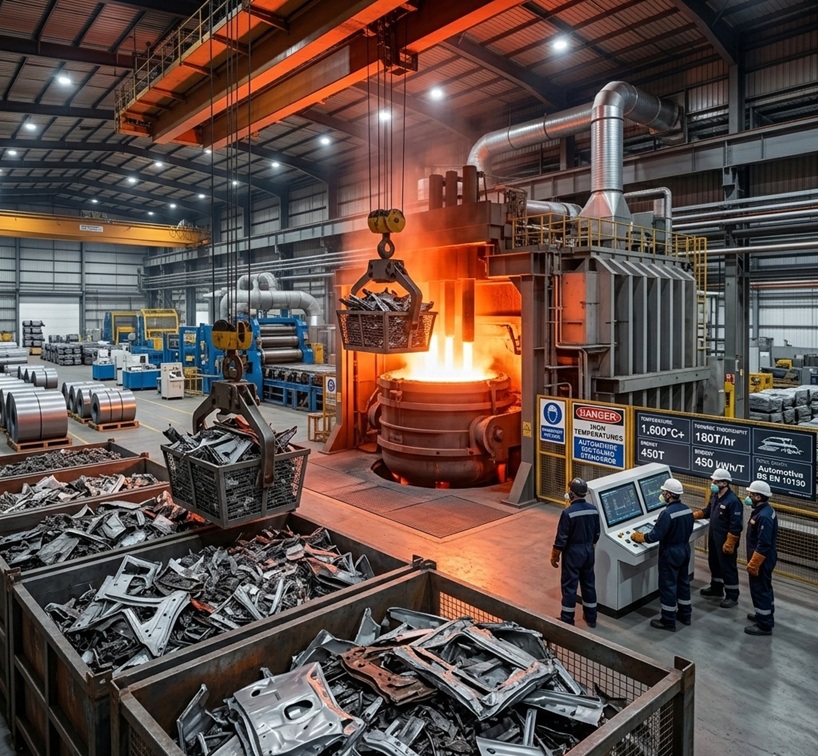
Most recycled automotive steel ends up in Electric Arc Furnaces (EAFs), which are perfectly designed to handle scrap metal. Unlike blast furnaces that require iron ore and coke, EAFs can produce high-quality steel using primarily recycled materials.
Think of an EAF as a massive electric kettle, but instead of boiling water, it’s melting steel at temperatures exceeding 1,600 degrees Celsius. The process is remarkably efficient – it takes about 90 minutes to transform an old car’s steel into new, usable material.
The beauty of this process is its flexibility. EAFs can adjust their “recipe” depending on what type of steel they need to produce. An old car might become part of a new building’s framework, railway tracks, or even components for new vehicles.
British steel mills using EAF technology can produce a tonne of new steel using roughly 1.1 tonnes of scrap metal. The slight increase accounts for oxidation and impurities that burn off during melting, but it’s still an incredibly efficient conversion rate.
Environmental Impact and Energy Savings
Here’s where the story gets really interesting from an environmental perspective. Using scrap steel instead of virgin materials saves approximately 74% of the energy normally required for steel production. That’s not a small saving – it’s enormous.
To put this in perspective, recycling one tonne of automotive steel saves about:
- 1,400 kilograms of iron ore
- 740 kilograms of coal
- 120 kilograms of limestone
- Roughly 2.3 tonnes of CO2 prevented from entering the atmosphere
When these savings are multiplied by the millions of cars scrapped annually in the UK, the environmental benefits become staggering. The automotive recycling industry prevents approximately 85 million tonnes of materials from entering landfills each year globally.
A conversation with an environmental engineer who worked for a major steel producer revealed something striking. She explained that without automotive scrap, their carbon footprint would increase by nearly 60%. The connection between how scrap cars support the steel industry simply couldn’t be stronger from an environmental standpoint.
The energy savings also translate into economic benefits. Lower energy costs mean British steel can compete more effectively in global markets, supporting jobs and economic growth across the country.
Connecting with certified facilities ensures vehicles are processed responsibly whilst supporting the UK steel industry through proper material recovery.
Steel Quality and Modern Manufacturing
One concern often heard from customers was whether recycled steel was somehow inferior to “new” steel. This is a complete misconception. Steel can be recycled indefinitely without losing its fundamental properties.
In fact, most steel products contain a mixture of recycled and virgin materials. The steel in new cars often contains 25-30% recycled content, including steel from previously scrapped vehicles. It’s a continuous cycle that’s been running for decades.
Modern steel mills have sophisticated quality control systems that ensure recycled automotive steel meets exact specifications. They can adjust chemical compositions, add alloying elements, and fine-tune properties to match whatever the customer needs.
The automotive industry itself is one of the largest consumers of recycled steel. The next car someone buys will likely contain steel from previously scrapped vehicles, creating a closed-loop system that’s both economically and environmentally sensible.
Economic Impact on UK Steel Production
The economics of automotive scrap are fascinating. Steel mills can produce finished products more cheaply using recycled materials than virgin ore, even accounting for collection and processing costs.
This cost advantage helps keep British steel competitive in international markets. Countries with abundant automotive scrap often have lower steel production costs, which translates into advantages across multiple industries.
The scrap steel market also provides price stability for manufacturers. Whilst iron ore prices can fluctuate dramatically based on global mining conditions and geopolitical factors, automotive scrap provides a more predictable supply with steadier pricing.
Steel mills typically maintain contracts with automotive recycling facilities to ensure consistent supply. This relationship provides economic security for both industries and helps maintain stable employment across the recycling and manufacturing sectors.
How Secondary Metal Markets Work
The role of secondary metal markets in determining scrap values can’t be overstated. These markets operate as the financial backbone connecting end-of-life vehicles to industrial steel production.
Secondary metal markets establish pricing based on supply, demand, and global economic conditions. When construction booms or manufacturing increases, scrap prices rise accordingly. During economic downturns, prices typically fall as industrial demand decreases.
Traders in these markets monitor everything from building projects to automotive production forecasts. These factors directly influence what vehicle owners receive when scrapping and how much steel mills pay for processed automotive scrap.
Understanding how secondary metal markets function helps explain why scrap car prices fluctuate throughout the year. It’s not arbitrary – it reflects real-time industrial demand for recycled steel globally. When someone gets a quote, current market conditions influence the valuation.
Regional Steel Production and Car Recycling in the UK
Different regions of Britain have developed specialised relationships between their automotive recycling and steel production facilities. Areas with high car ownership naturally generate more scrap, which often supports local steel production.
The Midlands, with its automotive manufacturing heritage, has particularly strong connections between car recycling and steel production. Many facilities in this region have co-located operations that streamline the process from scrap collection to steel production.
Scotland’s steel industry also relies heavily on automotive scrap, with efficient collection networks that gather material from across the region. The logistics of moving scrap steel are crucial to maintaining cost-effective production.
Whether in Preston, Scotland, or London, understanding how local areas fit into this system shows the true reach of automotive recycling networks. The environmentally responsible recycling that partner facilities practise ensures proper material recovery nationwide.
Innovation in Automotive Steel Recycling
The technology for processing automotive scrap continues to evolve. New sorting techniques can separate different grades of steel more precisely, allowing mills to produce higher-quality products from recycled materials.
Advanced shredding equipment can process vehicles more efficiently whilst better preserving the quality of the resulting steel fragments. This improves the economics for both recycling facilities and steel mills.
Some facilities are experimenting with artificial intelligence to optimise sorting processes. These systems can identify different types of steel and direct them to appropriate processing streams, maximising the value recovered from each vehicle.
Research into new steel alloys specifically designed for recycling is also ongoing. These materials maintain their properties through multiple recycling cycles whilst offering improved performance characteristics.
The Future of Scrap Cars and Steel Integration
As vehicle technology evolves, so does the recycling industry. Electric vehicles present both challenges and opportunities for steel recycling. Whilst they contain less steel overall, the steel they do contain is often high-grade material suitable for demanding applications.
The growing emphasis on sustainability in manufacturing means the relationship between scrap cars and steel production will become even more important. Car manufacturers are setting ambitious targets for recycled content in new vehicles, driving demand for high-quality recycled steel.
New processing technologies may allow for even more efficient extraction of steel from end-of-life vehicles. Some researchers are exploring ways to recover and reuse steel coatings and treatments that currently burn off during recycling.
The circular economy principles driving modern manufacturing policy strongly favour automotive steel recycling. Government initiatives supporting sustainable manufacturing often specifically mention the importance of maintaining and expanding automotive recycling capabilities.
Getting Your Car Into the System
When a car finally reaches the point where repair costs exceed its value, getting it into the steel recycling system is straightforward. The key is working with properly licensed facilities that can handle the entire process legally and efficiently.
Authorised Treatment Facilities ensure vehicles are processed according to environmental regulations whilst maximising the recovery of valuable materials. They handle all the paperwork, including DVLA notifications, so there’s no need to worry about administrative details.
The process typically starts with a simple online quote. Arranging convenient collection through certified partners handles the logistics of getting vehicles from any location to processing facilities.
Payment is received based on current scrap metal prices, vehicle weight, and local market conditions. Whilst people might not get rich scrapping an old car, fair compensation is provided whilst contributing to an important environmental and economic cycle. Understanding the benefits of proper disposal helps ensure responsible processing.
Supporting British Manufacturing
Every time someone chooses to properly scrap their car rather than abandoning it or attempting DIY disposal, they’re supporting British manufacturing. The steel recovered from that vehicle will likely stay within the UK economy, supporting local jobs and industrial capacity.
This domestic steel supply helps reduce Britain’s dependence on imported materials, improving economic resilience and reducing transportation-related emissions. It’s a win-win situation that benefits individual car owners, the recycling industry, steel manufacturers, and the broader economy.
The automotive recycling industry employs thousands of people across the UK, from collection drivers to facility operators to steel mill workers. These jobs are often well-paid, skilled positions that contribute significantly to local economies. The same professional processing applies to commercial vehicles, ensuring comprehensive material recovery across all vehicle types.
By choosing responsible car disposal through certified facilities, participation in one of the most successful recycling programmes in modern history occurs. The automotive recycling industry has achieved recycling rates exceeding 80%, making it a model for other industries to follow.
The relationship between scrap cars and the steel industry represents one of the most efficient resource recovery systems ever developed. An old car, which might seem worthless sitting on a drive, contains materials that are essential to modern manufacturing and construction.
Understanding this connection helps explain why proper car disposal matters beyond just clearing space or following regulations. Contributing to a circular economy that reduces environmental impact whilst supporting domestic manufacturing and employment creates real value. This principle extends across all vehicle types, including motorcycles and smaller vehicles that also contain valuable steel components.
The steel from a scrapped vehicle might end up in construction projects, new vehicles, or industrial equipment. It’s a tangible example of how individual actions contribute to broader environmental and economic goals.
Next time someone sees an old car heading for the scrapyard, it’s worth remembering that it’s not really the end of the road. It’s just the beginning of a new chapter in the endless cycle of steel production and manufacturing that keeps our modern world running smoothly.
For those ready to dispose of a vehicle responsibly, getting expert guidance helps ensure the steel returns to productive use, supporting British industry and protecting the environment.