Will Autonomous Cars Change the Scrap Industry?
10th Feb, 2026
The introduction of autonomous cars is set to transform several industries, and the scrap industry is no exception. As technology advances, the process of scrapping autonomous vehicles will bring both challenges and opportunities. Understanding how these changes might unfold helps prepare recyclers, manufacturers, and vehicle owners for a new era in car disposal and recycling.
The Rise of Autonomous Vehicles
Autonomous vehicles are steadily becoming part of modern transport systems. Their design focuses on safety, precision, and efficiency, reducing the need for human control. Manufacturers are continually refining self-driving technology, aiming to lower accident rates and enhance energy efficiency.
This evolution directly influences the autonomous cars scrap industry. Smarter cars may experience less mechanical wear, potentially extending their lifespan, but their electronic components could become obsolete faster than traditional vehicle parts. The result is a complex balance between longevity and technological advancement.
It’s a bit like smartphones, isn’t it? The hardware might last years, but the software stops being supported and suddenly you’re stuck with a perfectly good device that can’t do what you need anymore.
Vehicle Lifespan and Technological Obsolescence
The careful driving patterns of autonomous cars could theoretically extend vehicle lifespan. Reduced braking and smoother operation may limit component degradation. However, the reliance on digital systems introduces another challenge: rapid technological turnover.
Software updates and hardware compatibility will play major roles in determining when a vehicle is ready for scrapping. When manufacturers end support for older systems, those vehicles could become functionally redundant despite being mechanically sound. The situation is comparable to maintaining older computer hardware that no longer runs modern applications.
I remember working on a 2005 Mercedes that still ran beautifully. Engine was sound, gearbox smooth, bodywork decent. But the electronics? Nightmare. Half the systems couldn’t talk to modern diagnostic equipment anymore. Owner eventually scrapped it not because it was broken, but because nobody could service it properly. That’s the future we’re looking at with autonomous vehicles, except on steroids.
Usage Patterns and Maintenance Complexity
Autonomous vehicles are expected to operate more consistently throughout the day, particularly in commercial applications such as ride-sharing or delivery fleets. Increased utilisation means components may experience higher overall wear, even if driving patterns are efficient.
Maintenance requirements will also shift. Advanced diagnostics, specialised sensors, and complex control units will demand new skill sets among technicians. Repair costs could rise due to expensive parts and software dependencies, potentially making scrapping autonomous vehicles more cost-effective in certain cases.
Changing Materials and Design in Autonomous Cars
The structure and materials used in autonomous vehicles are already diverging from traditional builds. Lightweight materials such as aluminium and carbon fibre improve fuel efficiency and range but create recycling challenges. These materials require new separation and processing techniques compared to steel-bodied vehicles.
The increasing use of electric drivetrains introduces high-voltage battery packs containing valuable but hazardous materials. Safe removal and recycling of these components are crucial to environmental protection. Modern recycling processes are adapting to meet these demands.
Additionally, modular vehicle designs are emerging, allowing individual components to be replaced or upgraded easily. Such innovation may simplify dismantling procedures, improving material recovery efficiency once vehicles reach the end of their usable life.
Understanding how vehicle recycling works today provides insight into how facilities will need to adapt for autonomous vehicles tomorrow.
Regulation and Compliance in the Scrap Industry
The growth of autonomous cars will drive the development of new legislation for end-of-life processing. Authorised Treatment Facilities (ATFs), responsible for dismantling and recycling vehicles, will need to comply with updated environmental and safety requirements.
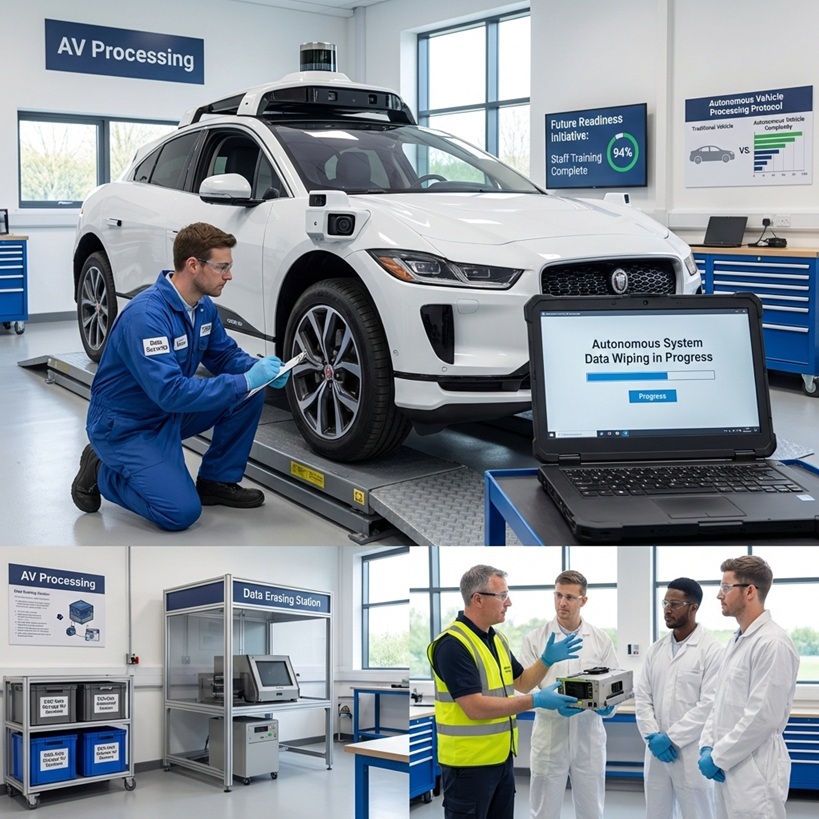
Data protection is another emerging concern. Autonomous systems store detailed journey information and personal data. Before scrapping, this information must be completely erased to prevent misuse. Proper data sanitisation will become an essential part of compliant scrappage.
The principle of extended producer responsibility may also expand, obliging manufacturers to oversee vehicle disposal. Scrap Car Network works with certified facilities across the UK that ensure compliance with current regulations whilst preparing for future autonomous vehicle requirements.
Preparing ATFs for the Transition
Authorised Treatment Facilities play a crucial role in the autonomous cars scrap industry. As technology develops, facilities must invest in advanced dismantling equipment, robotic tools, and digital data handling systems. Staff training will be essential to ensure safety and compliance with environmental regulations.
Facilities that adapt early can position themselves as leaders in autonomous vehicle recycling. Investments in new recycling technologies and secure data management systems will define future competitiveness.
The mechanics I trained with would struggle with these vehicles. It’s not just spanners and diagnostics anymore. You need software engineers, data security specialists, battery technicians. The whole skillset’s changing.
For businesses managing commercial fleets, our specialised van recycling programme already addresses the complexity of modern vehicle technology and will continue adapting for autonomous systems.
Collaboration and Innovation for the Future
The transformation of the scrap industry through autonomous cars will occur gradually. Collaboration among recyclers, manufacturers, and regulators will be key to building an efficient, sustainable recycling ecosystem.
Technological innovation will drive improvements in material recovery, data management, and environmental protection. Establishing a circular economy, where components are continually reused, will reduce waste and conserve natural resources. The recycling process is already shifting from manual dismantling to precision-led, technology-based operations.
To understand this approach, explore the advantages of choosing responsible partners for both current and future vehicle recycling.
Steps Toward Sustainable Adaptation
Businesses and recycling centres must begin preparing for the widespread arrival of autonomous vehicles. Key steps include monitoring developments in autonomous and electric vehicle design, investing in modern recycling infrastructure, adopting robust data-wiping and environmental compliance systems, and building partnerships across the recycling and automotive sectors.
Vehicle owners and fleet operators can already benefit from compliant disposal services. For those exploring responsible disposal options, you can obtain a valuation for your vehicle through trusted services that understand evolving technology requirements.
When quick turnaround matters, we coordinate prompt collection services, ensuring your vehicle is processed according to current standards.
For straightforward vehicle disposal, we handle the entire process efficiently while our facilities prepare for autonomous vehicle requirements.
Conclusion: Preparing for the Autonomous Future
The autonomous cars scrap industry represents the future of vehicle recycling. Whilst challenges exist around technology obsolescence, complex materials, and data protection, these also present opportunities for innovation and improved sustainability.
The industry must adapt now to be ready for tomorrow. Facilities that invest in technology, training, and partnerships will lead the market. Vehicle owners benefit from choosing services that understand both current regulations and future requirements.
Scrapping autonomous vehicles will be fundamentally different from scrapping traditional cars, but the core principle remains the same: responsible disposal that protects the environment whilst recovering maximum value. The mechanics might change, but the mission doesn’t.
If you have questions about responsible vehicle disposal or how we’re preparing for autonomous vehicle recycling, feel free to contact us for guidance.