Why Scrapping Your Car Through a Licensed ATF Supports UK Environmental Goals
9th Apr, 2026
The decision to scrap a car might feel like a purely personal one, but it sits within a much larger environmental picture. Licensed ATF car recycling UK is a regulated, accountable process specifically designed to minimise environmental harm, recover valuable materials, and ensure hazardous substances are handled responsibly.
When that process is bypassed in favour of an unlicensed operator, the consequences extend well beyond the driveway. Environmental vehicle disposal UK done properly contributes to national recycling targets, reduces carbon emissions associated with primary material production, and prevents toxic substances from entering the environment. Done improperly, it does the opposite. Here’s why the choice of facility matters more than most owners expect.
The Environmental Case for Proper Car Disposal
A scrapped car isn’t just old metal. It’s a complex object containing dozens of substances that require careful management at every stage of disposal.
What Happens When Cars Are Scrapped Illegally
At an unlicensed operation, environmental vehicle disposal UK standards simply don’t apply. Engine oil is drained and dumped. Refrigerant gas is vented directly to atmosphere. Battery acid is tipped on site. These aren’t hypothetical risks; they’re documented practices at illegal sites identified by the Environment Agency across the UK. The environmental vehicle disposal UK legal framework exists precisely because these outcomes have been observed repeatedly at unregulated operations.
A single car’s engine oil, if poured onto open ground, can contaminate vast volumes of groundwater. Air conditioning refrigerants are potent greenhouse gases. Battery acid is corrosive to soil, concrete, and aquatic environments. The cumulative impact of thousands of vehicles processed this way each year is significant and entirely preventable.
Scale of the Problem in the UK
The UK processes roughly 1.7 million end of life vehicles annually. A meaningful minority still ends up at unlicensed operators or abandoned entirely. The Environment Agency investigates hundreds of illegal waste sites each year, many of which handle vehicles alongside other waste streams.
This isn’t a fringe issue. It’s a persistent compliance challenge that requires responsible choices from vehicle owners at every point in the chain.
What Makes an ATF Different from an Unlicensed Operator
The difference between a licensed ATF and an unlicensed operation isn’t merely administrative. It’s structural, enforceable, and consequential. Owners across the country, from scrap car services in London to rural Scotland, all have access to licensed, accountable facilities.
ATF Certification Requirements Explained
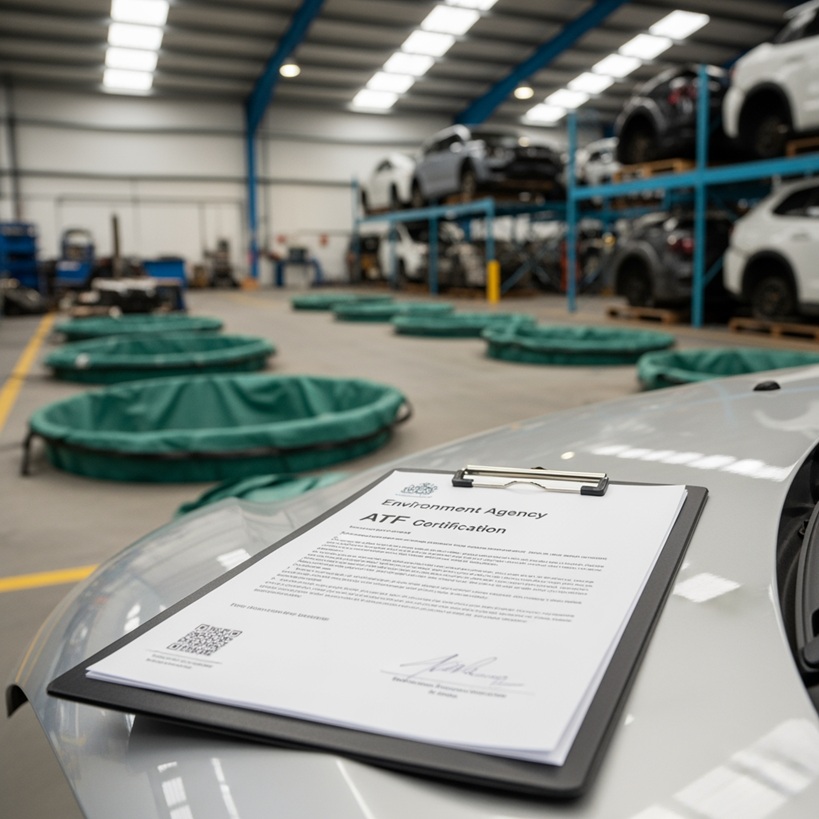
ATF certification requirements in the UK are set under the Environmental Permitting Regulations and the End of Life Vehicles Regulations. To operate as an ATF, a facility must meet specific ATF certification requirements covering:
- A valid environmental permit from the Environment Agency (or SEPA in Scotland, NRW in Wales)
- Site infrastructure standards, including impermeable surfaces and contained drainage systems
- Trained operatives for depollution procedures
- Detailed records of every vehicle received and processed
- Certificates of Destruction issued within the legally required timeframe
- Annual reporting on processing volumes and material recovery rates
These ATF certification requirements create a documented, traceable chain of responsibility for every vehicle that passes through a licensed facility.
Scrap Car Network connects vehicle owners exclusively with facilities holding current, valid ATF authorisations, ensuring every vehicle is handled in full compliance with all environmental permit conditions.
Inspections, Accountability, and Compliance
Licensed ATFs are subject to regular inspection by the relevant environmental regulator. These checks cover site conditions, depollution practices, record integrity, and material handling procedures. Facilities falling below standard face improvement notices, permit suspensions, or prosecution.
This accountability structure is what genuinely separates the licensed sector from the illegal trade. Unlicensed operators face none of these checks, which is precisely why their environmental practices tend to be so much more damaging.
How Licensed ATF Car Recycling UK Supports Environmental Goals
The environmental benefits of licensed ATF car recycling UK are substantial, measurable, and worth understanding clearly. Facilities serving North London and across the wider network apply these standards consistently.
Depollution and Hazardous Waste Prevention
Every vehicle processed through a licensed ATF goes through a structured depollution stage before any crushing or shredding. Hazardous fluids and materials are systematically removed and sent to appropriate treatment facilities. The UK’s licensed ATF car recycling UK sector collectively manages millions of litres of hazardous automotive fluids each year, all of which are treated rather than released.
The environmental benefit of this work is largely invisible to most vehicle owners, which is precisely why it tends to be underappreciated.
Material Recovery and Circular Economy Contribution
Beyond hazardous waste prevention, licensed ATFs are legally required to meet a 95% reuse and recycling target for each vehicle processed. Steel and aluminium recovered from end of life vehicles re-enter the production cycle, reducing demand for primary material extraction and all the energy and emissions that accompany it.
Think of it this way: every tonne of steel recovered from scrapped vehicles is a tonne that doesn’t need to be produced from iron ore through an energy-intensive blast furnace process. At the scale of 1.7 million vehicles per year, that represents a meaningful, ongoing contribution to national carbon reduction efforts.
The Carbon Footprint of Car Scrapping
The carbon footprint of car scrapping receives considerably less attention than it deserves. The choices made at end of life have genuine climate implications that connect individual decisions to national targets. Owners from South West London to the far north of Scotland contribute to these aggregate outcomes through the facilities they choose.
Carbon Benefits of Steel and Aluminium Recycling
Reducing the carbon footprint of car scrapping through proper recycling delivers measurable results. Recycled steel production through electric arc furnaces uses approximately 75% less energy than primary steel production. Aluminium recycling uses around 95% less energy than primary production from bauxite ore. These are not marginal differences; they’re transformational at scale.
When a car is properly recycled through a licensed facility, the recovered metals feed into lower-carbon manufacturing processes that reduce emissions across multiple sectors. The carbon footprint of car scrapping at an unlicensed facility is substantially worse, because the same metals may eventually be recovered through less efficient routes with higher associated emissions.
Comparing Licensed vs Unlicensed Environmental Impact
An unlicensed operator typically focuses on stripping the most immediately valuable components and then crushing or abandoning what remains without completing proper depollution. Hazardous materials are released or dumped. Less valuable metal may be exported to lower-regulation markets where processing standards are weaker.
The overall environmental footprint of this route is substantially worse than licensed processing. This isn’t abstract. It’s the real-world difference between two routes that look superficially similar but have fundamentally different outcomes for the environment.
Illegal Scrapyard Risks: What Owners Face
Beyond the environmental consequences, using an unlicensed operator creates genuine legal risks for the vehicle’s registered keeper. Those arranging scrap car collection in Scotland and across the UK should verify facility licensing before handing over any vehicle.
Legal Liability for Registered Keepers
Illegal scrapyard risks UK owners face are the kind of thing most people don’t consider until they become a problem. If a car is handed to an unlicensed operator, the registered keeper remains on the DVLA’s records until the vehicle is formally deregistered through a legitimate process. An unlicensed operator is unlikely to complete this correctly. That means:
- DVLA correspondence may continue arriving for a vehicle no longer owned
- If the vehicle is involved in any incident, the registered keeper’s details remain on file
- If the operator is prosecuted for illegal waste handling, questions may arise about where the car went
The illegal scrapyard risks UK legislation exposes owners to are compounded by the complete absence of a Certificate of Destruction, which is the only legal proof of proper disposal.
How to Avoid Unlicensed Operators
Protecting against illegal scrapyard risks UK regulations create exposure to is straightforward with a few basic checks:
- Verify the ATF is listed on the Environment Agency’s public register of licensed waste facilities
- Confirm they will issue a Certificate of Destruction before agreeing to anything
- Never accept cash-in-hand arrangements that lack formal documentation
- Check that DVLA deregistration is included as part of the service
- Be cautious of quotes significantly above current market rates
A vehicle owner once handed a car to someone knocking door-to-door with a flatbed and a competitive price. No paperwork, gone in twenty minutes. Six months later, DVLA letters were arriving about unpaid motorway tolls linked to the old plates. Sorting it out took months and considerable frustration. A basic check on facility legitimacy would have prevented the entire situation at no cost whatsoever.
UK Environmental Goals and the Vehicle Recycling Sector
The vehicle recycling sector plays a specific, documented role in the UK’s broader environmental commitments. Facilities from Newcastle to the south coast contribute to these national targets through every vehicle they process correctly.
Net Zero Commitments and End of Life Vehicles
The UK’s net zero target requires emissions reductions across every sector, including manufacturing. The circular economy approach to vehicle materials, recovering and reusing steel, aluminium, copper, and plastics rather than producing them from scratch, contributes directly to industrial decarbonisation.
As the UK transitions to electric vehicles, licensed ATFs are central to developing the capability needed for EV battery recovery and end of life management. The regulatory framework for EV disposal is evolving, and licensed ATF car recycling UK facilities are at the forefront of preparing for that next stage.
How Individual Choices Add Up
It might feel like one car in 1.7 million doesn’t make a meaningful difference. But the aggregate impact of individual choices across millions of vehicles is exactly how national environmental outcomes are determined.
When owners consistently choose licensed ATF car recycling UK facilities over unlicensed alternatives, the unlicensed market shrinks, enforcement becomes more effective, and the overall quality of environmental vehicle disposal UK improves. The choice of where to scrap is a small decision with disproportionate collective significance when repeated at scale.
Conclusion
Licensed ATF car recycling UK isn’t bureaucratic box-ticking. It’s the mechanism through which hazardous materials are safely managed, valuable resources are recovered, and the carbon footprint of car scrapping is kept within acceptable limits. The ATF certification requirements that underpin the licensed sector exist because the environmental vehicle disposal UK consequences of bypassing them are real, documented, and significant. And the illegal scrapyard risks UK owners face when using unlicensed operators are entirely avoidable with a bit of due diligence upfront.
To connect with a licensed ATF and scrap a vehicle with full legal protection, contact us and we’ll take care of the rest.