Scrap My Car in Edinburgh: Scottish Regulations Explained
13th Apr, 2026
Got an old car you need rid of in Edinburgh? You’re in the right place. Whether it’s failed its MOT, costs more to keep running than it’s worth, or you simply don’t need it anymore, scrapping’s often the sensible choice.
Scrap Car Network connects Edinburgh residents with licensed Authorised Treatment Facilities across Scotland. Whether you’re in Leith, Morningside, or anywhere across the Lothians, you’ll get competitive quotes and free collection without the hassle.
Let’s walk through exactly how to scrap your car in Edinburgh, what regulations apply in Scotland, and what sort of money you can expect for your vehicle.
Understanding Scottish Car Scrapping Regulations
Here’s the thing about Scottish car scrapping regulations: they’re the same as the rest of the UK. You might wonder if there’s some Scottish-specific rule you need to worry about, but the core requirements apply across England, Scotland, Wales, and Northern Ireland.
The main difference is that Scotland uses the Scottish Environmental Protection Agency (SEPA) instead of the Environment Agency to regulate ATFs. Different organisation, identical standards.
SEPA’s Role in Scottish ATF Licensing
SEPA licenses and regulates Authorised Treatment Facilities in Scotland. They ensure these facilities meet environmental standards for depolluting vehicles, handling hazardous materials, and recycling components properly.
The licensing requirements are the same as those south of the border. Scottish ATFs must follow identical procedures for removing fluids, dismantling vehicles, and recovering materials. There’s no Scottish exception or different process.
Think of it like driving licences. The DVLA issues them for the whole of Great Britain, and the rules are the same whether you’re driving in Edinburgh or Exeter. Car scrapping works the same way.
UK-Wide Legal Requirements
Every car scrapped anywhere in the UK must go to an Authorised Treatment Facility. This isn’t optional. It’s the law, backed by substantial fines for using unlicensed yards.
You’ll receive a Certificate of Destruction proving your car was legally scrapped. This protects you from future liability if someone misuses your old registration or if the vehicle somehow ends up back on the road.
The DVLA (based in Swansea) handles vehicle registration for all of Great Britain, including Scotland. When your car’s scrapped in Edinburgh, the notification goes to the same DVLA database as scrapped cars from anywhere else in Britain.
Why Edinburgh Cars Get Scrapped
Edinburgh’s weather isn’t as harsh as some parts of Scotland, but it’s not exactly gentle on vehicles either. Cold winters, wet conditions, and road salt all take their toll over time.
Scottish Weather Impact on Vehicles
Scotland’s climate means vehicles face damp conditions much of the year. Rain, frost, and temperature fluctuations all accelerate corrosion, particularly on older cars with less advanced rust protection.
Winter road salt is brilliant for keeping roads safe, but it’s murder on car undercarriages. That salt spray gets into every crevice and speeds up rust development on exhaust systems, brake lines, and structural components.
I remember a customer from Portobello who brought in what looked like a decent ten-year-old Vauxhall. Bodywork was fine, interior was clean, drove smoothly. Put it on the lift for an MOT check and the rear suspension mounting points had corroded right through. The salt had done its work where you couldn’t see it. That car was finished, and the owner had no idea until we showed him.
MOT failures due to corrosion are common in Edinburgh, just like anywhere in the UK. When repair costs run to £800-1,000 and the car’s only worth £600, scrapping makes financial sense.
Economic Scrapping Decisions
Sometimes cars simply reach the point where they’re costing more than they’re worth. Failed MOT with multiple expensive repairs needed? Engine problems that’d cost more to fix than the car’s value? That’s when scrapping becomes the practical choice.
Accident damage can write off older vehicles even when they’re still running. Insurance companies declare cars total losses when repair costs exceed a certain percentage of the vehicle’s value. You’re left with a damaged car that’s not economical to fix.
Second cars that sit unused for months still cost money. Insurance, tax (if it’s not SORNed), and MOT all add up. Eventually, getting rid of a vehicle you don’t use makes more sense than keeping it around.
Edinburgh Scrap Car Valuations
Scrap car values in Edinburgh follow the same pattern as anywhere else in the UK: weight, condition, and current metal prices determine what you’ll receive.
A standard family car weighing about 1,200kg might fetch £200-400. Smaller cars get less because there’s less metal. Larger vehicles get more because they weigh more.
What Affects Your Edinburgh Quote
Weight’s the biggest single factor. Steel’s sold by weight, so a heavier car means more money. A wee Fiat 500 might weigh 900kg, while a big BMW 5 Series could be 1,600kg. That’s a significant difference.
Working components add value beyond straight scrap weight. If your engine’s still sound, your gearbox works, or you’ve got an intact catalytic converter, you’ll get more than just metal value. ATFs can sell these parts on, so they’ll pay you for them.
Catalytic converters contain precious metals: platinum, palladium, and rhodium. Diesel vehicles and certain makes (Hondas, Toyotas, premium German cars) have particularly valuable cats. These can be worth £100-300 on their own.
Current scrap metal prices fluctuate based on global markets. When steel demand’s high, you get better quotes. When it drops, prices follow. Edinburgh quotes reflect these market conditions just like anywhere else.
Edinburgh Market Considerations
Edinburgh benefits from Scotland’s strong industrial infrastructure. The Glasgow-Edinburgh corridor has excellent recycling facilities and metal processors, which means competitive pricing for Scottish residents.
Transport costs stay reasonable because you’re close to major facilities. Head up into the Highlands or out to remote Scottish islands, and collection costs increase. Edinburgh’s position keeps things competitive.
Our network of Authorised Treatment Facilities covers Edinburgh and the surrounding Lothians thoroughly. You’ll get fair market rates without inflated transport charges.
ATF Coverage Across Edinburgh
Edinburgh’s well-served by scrap car collection services. Whether you’re in the city centre, the suburbs, or surrounding towns, free collection’s available.
You don’t need to know where the nearest ATF is or how to get your car there. Our free collection service means they come to you, wherever you are.
Edinburgh City Centre and New Town
Living in the Old Town, New Town, Stockbridge, or central Edinburgh? Collection drivers handle these areas regularly. They’re used to navigating narrow streets, restricted parking, and the general chaos of city centre logistics.
Georgian terraces, tenement buildings, and limited parking don’t prevent collection. You might need to arrange on-street parking for the collection time, but that’s straightforward enough.
City centre postcodes like EH1, EH2, and EH3 are all covered with free collection. You don’t pay extra for being in the heart of Edinburgh.
Edinburgh Suburbs and Surrounding Areas
Leith, Morningside, Corstorphine, Portobello, Gorgie, Craigmillar, Dalkeith, Musselburgh, Livingston, South Queensferry – all covered with free collection. Distance from the city centre doesn’t affect your quote or collection charges.
The Lothians villages and towns get the same service. East Lothian, Midlothian, and West Lothian residents benefit from Edinburgh’s proximity without paying extra for their location.
Access to Fife and Scottish Borders
Cross the Forth bridges into Fife, and you’re still covered. Dunfermline, Kirkcaldy, Glenrothes, and other Fife towns all have access to the same free collection service.
Head south into the Scottish Borders – Peebles, Galashiels, Selkirk – and collection’s still available. You might wait an extra day for scheduling compared to central Edinburgh, but there’s no additional charge.
The Edinburgh Scrapping Process
Let’s walk through how this actually works from start to finish. It’s genuinely straightforward.
Requesting Quotes for Edinburgh Vehicles
You’ll need basic vehicle information: registration number, make, model, year, and current condition. Be honest about the state it’s in because accuracy affects the quote you receive.
Is it running or not? Are all parts present? Has the catalytic converter been stolen? Missing wheels? The more accurate your description, the more precise your quote will be.
Compare quotes from multiple Edinburgh ATFs through Scrap Car Network. Takes a couple of minutes and might get you an extra £50-100. Don’t just accept the first offer you see.
Once you’ve got a price you’re happy with, accept it and arrange collection.
Scheduling Collection in Edinburgh
Collection typically happens within 24-48 hours of accepting a quote in Edinburgh. Same-day or next-day collection’s often available depending on driver schedules and your availability.
Make sure you’ve removed all personal belongings before collection day. Check everywhere: boot, glove box, door pockets, under seats, in the centre console. People lose surprising things in cars.
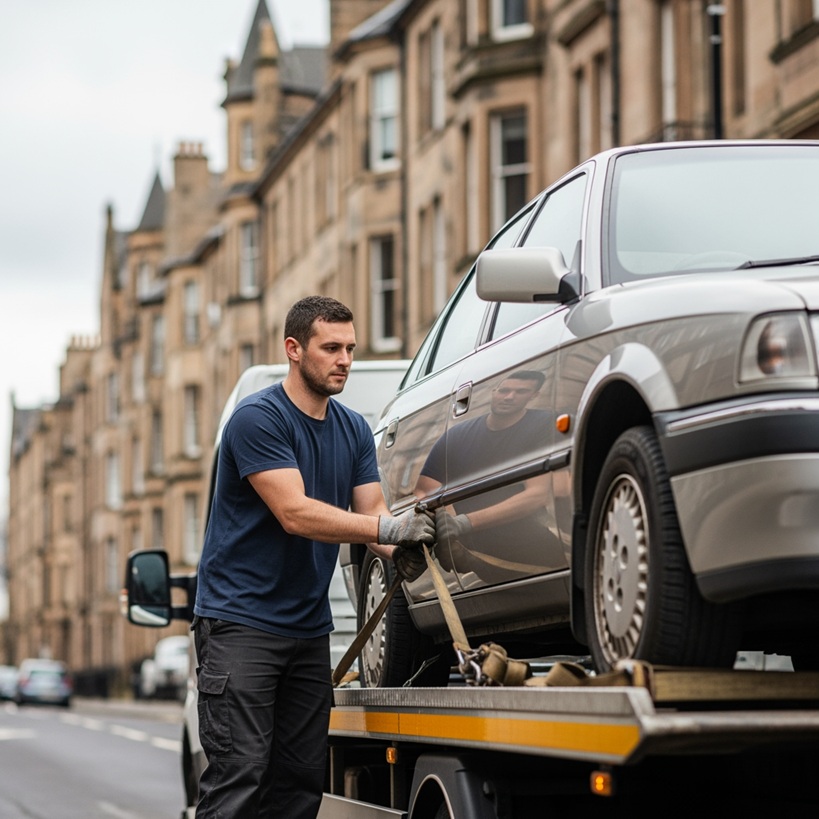
The driver arrives with proper recovery equipment, loads your car, completes paperwork with you, and sorts payment. The whole process takes 15-20 minutes.
Living in a tenement or somewhere with tricky parking? Mention this when arranging collection. You might need to have the car parked on the street during a specific time window, but collection drivers are used to Edinburgh’s quirks.
Required Documentation
You’ll need your V5C logbook if you’ve got it. The ATF uses section 9 (the green slip) to notify the DVLA that your car’s been scrapped.
Proof of identity helps confirm you’re the registered keeper. Your driving licence works perfectly. If the car’s registered at a different address from where you currently live, bring something showing your current address.
Lost your V5C? It’s not a deal-breaker. Edinburgh ATFs handle this situation regularly. You’ll need alternative proof of ownership: insurance documents, recent MOT certificates, or purchase receipts.
You can also tell the DVLA your car’s been scrapped online through GOV.UK if you don’t have the logbook.
Payment Methods and Confirmation
Most ATFs pay by bank transfer, either immediately or within 24 hours of collection. Some offer cash payment on collection, though this is less common these days.
Ask about payment methods when accepting your quote. If you specifically need cash, make sure the facility offers that option.
You’ll sign paperwork confirming you’re the registered keeper and authorising the scrapping. Keep copies for your records until you’ve received the Certificate of Destruction.
DVLA Notification from Scotland
When you scrap your car in Edinburgh, the DVLA in Swansea needs to know. This ensures the vehicle’s officially taken off the road and you’re removed as the registered keeper.
The ATF handles this notification for you by sending in the V5C/3 section (or notifying electronically). You don’t need to do anything separately unless you want to speed things up by notifying online yourself.
How Scottish ATFs Handle DVLA Notification
When the ATF receives your car, they complete the V5C/3 section. This tells the DVLA the vehicle’s been destroyed at a licensed facility.
They post this to DVLA Swansea (or submit electronically if they’ve got that capability). Within a few weeks, you should receive confirmation that the vehicle’s been removed from their records.
This notification stops you receiving tax reminders, SORN notices, or penalty charges if the vehicle’s somehow found abandoned. It officially ends your connection to that vehicle.
Alternative Notification Methods
You can notify the DVLA online yourself through the GOV.UK website. You’ll need the vehicle registration number and details of the ATF where it’s been scrapped.
This can speed things up slightly, though the ATF’s notification should handle everything anyway. Some people prefer doing it themselves for peace of mind.
Keep confirmation of the notification. Whether the ATF handles it or you do it yourself, you want proof the DVLA was informed.
Certificate of Destruction Importance
The Certificate of Destruction is absolutely crucial. It’s your legal proof the car was properly scrapped at a licensed facility.
Legal Protection for Scottish Residents
Once you’ve got the Certificate of Destruction, you’re completely protected from anything that happens with that vehicle. If someone tries to use your old registration plates illegally, you’ve got proof the car was destroyed.
If the vehicle’s found abandoned somewhere, the CoD proves you disposed of it legally. You’re not liable for recovery costs or penalties.
The certificate confirms the DVLA was notified and you’re no longer the registered keeper. This is important for your records and for any future queries about the vehicle.
Timeline for CoD Receipt
Legally, ATFs must issue Certificates of Destruction within seven days of receiving your vehicle. Most arrive within 2-4 days by email or post to Edinburgh addresses.
If you’ve not received yours after a week, contact the ATF directly. They should be able to resend it or confirm when it was issued.
Keep this certificate somewhere safe. You probably won’t need it, but if there’s ever a question about the vehicle’s disposal, you’ll be glad you’ve got it.
Common Edinburgh Scrapping Questions
Let’s tackle some questions Edinburgh residents ask regularly.
Do Scottish Regulations Differ from Rest of UK?
No. The core regulations are identical across England, Scotland, Wales, and Northern Ireland. SEPA regulates Scottish ATFs instead of the Environment Agency, but the standards are the same.
You follow the same legal process scrapping a car in Edinburgh as you would in Birmingham or Cardiff. The DVLA system’s UK-wide, and the End-of-Life Vehicles regulations apply equally across Britain.
Don’t worry about Scottish-specific rules because there aren’t any that differ from the rest of the UK for car scrapping.
Can I Scrap a Car Registered in England?
Absolutely. The DVLA handles all Great Britain registrations from their Swansea office. Whether your car’s registered in London, Manchester, or Edinburgh makes no difference to the scrapping process.
You can scrap an English-registered car in Scotland or vice versa without any issues. The documentation requirements stay the same regardless of where the car was originally registered.
What About Tenement Parking Issues?
Edinburgh tenements can complicate vehicle collection slightly, but it’s manageable. If you don’t have dedicated parking, you’ll need to arrange for the car to be on the street during the collection window.
Most collection drivers will work with you on timing. If you can park it on your street between 9am and 11am, for example, they’ll schedule accordingly.
Mention your parking situation when arranging collection. It’s not a problem, but it helps them plan the logistics properly.
How Quickly Can Collection Happen?
In Edinburgh, collection usually happens within one to three days of accepting a quote. Same-day or next-day collection’s often possible if you’re flexible with timing.
The actual collection takes 15-20 minutes. The driver loads the car, you complete paperwork, and they leave with the vehicle.
Factors affecting timing include the ATF’s current workload, driver availability in your specific area, and weather (though severe weather delays are rare in Edinburgh).
Choosing Legitimate Edinburgh ATFs
Not every business offering scrap car services operates legally. Some lack proper licensing, others reduce quotes on collection day, and a few operate dodgy schemes that leave you legally exposed.
Verifying SEPA Licensing
Check the Scottish Environmental Protection Agency public register to verify ATF licensing. Every licensed facility in Scotland appears on this database with their permit details and compliance history.
Legitimate ATFs will happily provide their licence number. If someone’s vague about this or refuses to give you the information, walk away.
Our network only includes properly licensed facilities, but if you’re contacting scrap yards directly, always verify their credentials.
Warning Signs to Avoid
Watch for these red flags:
- Refusing to provide an ATF licence number
- Offering quotes that seem unrealistically high
- Not mentioning the Certificate of Destruction
- Vague about company details or location
- Pressuring immediate decisions without written quotes
Legitimate services operate transparently. They explain the process, provide written confirmation of offers, and issue proper documentation without pressure tactics.
Environmental Considerations in Scotland
Scotland’s got some of the most beautiful landscapes in Britain. Protecting them means disposing of vehicles properly.
Licensed ATFs prevent environmental damage by following strict depollution procedures. All fluids get safely extracted before the vehicle’s dismantled. Batteries, tyres, and airbags receive specialist treatment.
Protecting Edinburgh’s Environment
Edinburgh’s got the Water of Leith running through it and the Forth estuary nearby. Abandoned vehicles leak fluids that eventually reach waterways, causing environmental damage.
Using licensed ATFs prevents this contamination. The facility’s required to recover 95% of the vehicle by weight for recycling or reuse. Only 5% can go to landfill, and that’s materials that genuinely can’t be recovered.
This isn’t just bureaucracy. It’s protecting Scotland’s environment while recovering valuable materials for reuse in manufacturing.
Why Edinburgh Residents Choose Professional Services
Trying to sell a non-running car privately is a hassle. You advertise for weeks, field enquiries from time-wasters, and deal with people who don’t show up. Professional scrapping takes 24-48 hours from quote to collection.
You get guaranteed legal compliance. Proper documentation, licensed ATF handling, and no risk of the vehicle being dumped with your name still attached.
The convenience is brilliant. One phone call or online form gets things started. The car disappears from your driveway within days, and you’re completely done with it.
Fair pricing without negotiation makes everything straightforward. You get a quote based on current market rates, and that’s what you receive. No last-minute reductions, no hidden charges.
Conclusion
Scrapping your car in Edinburgh follows the same process as anywhere else in the UK. Don’t worry about Scottish-specific regulations because the core requirements are identical across Britain.
Choose a licensed Authorised Treatment Facility, receive your Certificate of Destruction, and notify the DVLA properly. Three simple steps that protect you legally and ensure your old car gets recycled responsibly.
Edinburgh’s well-served by collection services, so wherever you are in the city or surrounding Lothians, free collection’s available. The whole process takes days, not weeks.
If you’re ready to scrap your car in Edinburgh, contact us to get started. We’ll help you compare quotes from licensed Scottish ATFs and arrange free collection at a time that suits you. Simple, straightforward, and hassle-free.