Is It Legal to Remove Parts from Your Car Before Scrapping It in the UK?
7th Apr, 2026
Many vehicle owners wonder whether stripping parts before scrapping is allowed, financially worthwhile, or legally complicated. The straightforward answer is that it’s generally permitted to remove parts before scrapping a car UK, but there are specific exceptions, and one component in particular requires careful handling to stay on the right side of the law.
Understanding the rules around legal car dismantling before scrap, the specific nuances of catalytic converter removal legality UK, which salvage parts scrap car UK are worth the effort of removing, and the stripped vehicle scrap acceptance UK position that different ATFs take helps owners make the most of a vehicle that’s heading for the scrap pile.
The Short Answer: Yes, With Important Exceptions
A private individual removing parts from a vehicle they own before handing it to an ATF is not committing any offence. The vehicle is their property until it’s transferred to the ATF, and what they remove from it beforehand is largely their own business.
What Private Owners Are Legally Permitted to Remove
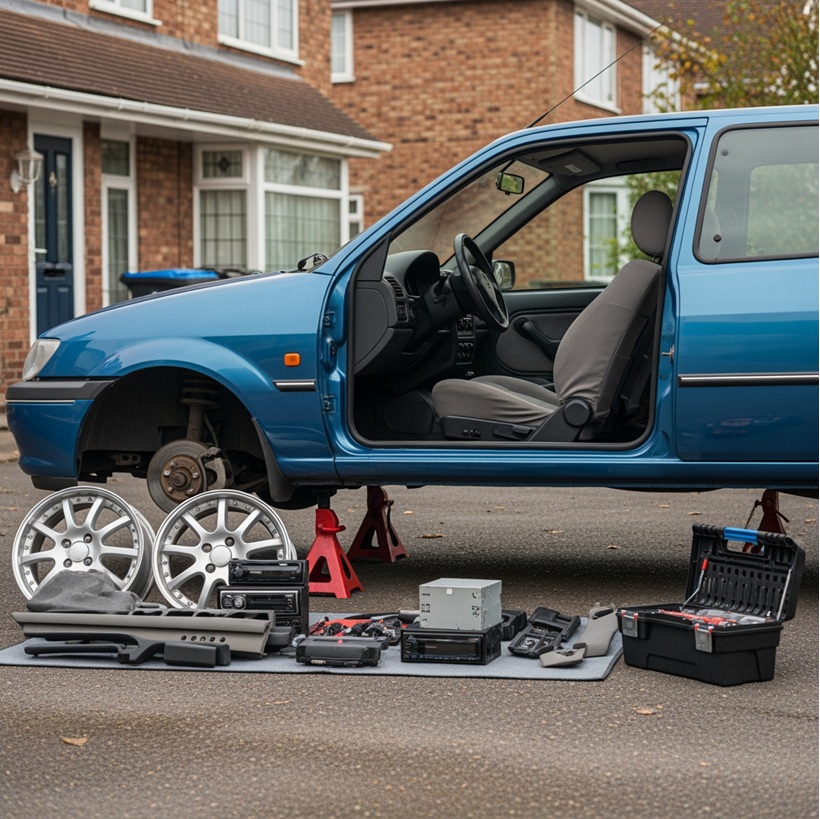
Personal and aftermarket additions are the most straightforward category. Anything that was added to the vehicle after manufacture and isn’t part of the original specification can be removed without any legal concern: aftermarket stereos, dash cameras, custom wheels, tow bars, roof racks, bike carriers, and similar items.
Original equipment components are also generally removable: seats, interior trim, carpets, and even mechanical components like engines and gearboxes, provided the vehicle can still be safely transported to the ATF. Legal car dismantling before scrap at a private level is a normal and financially sensible step for any owner who knows the salvage market for their specific vehicle’s components.
Where the Legal Boundaries Lie
The general permission to remove parts before scrapping a car UK isn’t unlimited. Specific components sit in a more complex legal position, and one, the catalytic converter, is subject to its own specific regulatory framework that must be understood before it’s removed and sold.
Scrap Car Network advises owners on pre-scrap part removal best practice and works with ATFs that have clear, transparent positions on stripped vehicle scrap acceptance UK so owners know exactly what to expect before collection day.
Legal Car Dismantling Before Scrap: What’s Permitted
Legal car dismantling before scrap covers a broad range of components for private individuals, but the practical and financial case for stripping every possible part before scrapping varies significantly depending on what the vehicle is and what the salvage market for those parts looks like. Owners arranging scrap car collection in London and across the UK who have already stripped their vehicle should inform the ATF before booking.
Components That Can Be Removed Without Restriction
For private owners, legal car dismantling before scrap without restriction covers:
- Aftermarket audio and entertainment systems including amplifiers, speakers, and navigation units
- Dash cameras and parking sensors added after purchase
- Aftermarket alloy wheels (original wheels should be returned if the aftermarket set is being kept)
- Roof racks, tow bars, and external accessories
- Interior components including seat covers, floor mats, and fitted organisers
- Personal items stored in the vehicle
- Aftermarket lighting and auxiliary electrical components
These items have no bearing on the vehicle’s roadworthiness or scrap valuation and can be removed entirely at the owner’s discretion.
Components That Require More Careful Consideration
OEM mechanical components, body panels, and structural parts are technically removable by the owner, but their removal has practical implications that are worth thinking through carefully. Removing an engine, for example, significantly reduces the vehicle’s weight and therefore the scrap offer. It also creates logistical challenges for collection if the vehicle can’t be safely loaded onto a transporter.
Stripped vehicle scrap acceptance UK varies between ATFs. Some facilities will accept heavily stripped vehicles without issue. Others may decline if the vehicle’s condition makes safe handling or transport impractical. The key rule is to inform the ATF about the vehicle’s condition before booking the collection, not on the day the collection team arrives.
Catalytic Converter Removal: The Most Important Exception
The catalytic converter is the single component where remove parts before scrapping car UK freedom is most constrained. It’s not illegal to remove one before scrapping, but it is an area where the regulations require careful compliance.
Catalytic Converter Removal Legality UK: The Legal Position
Catalytic converter removal legality UK is governed by the Scrap Metal Dealers Act 2013 and subsequent amendments that were introduced specifically to address the epidemic of catalytic converter theft that affected UK vehicle owners in the late 2010s and early 2020s.
Under the current regulatory framework, catalytic converter removal legality UK rules require any sale of a catalytic converter to a scrap metal dealer to be accompanied by documentation proving lawful ownership of the converter and the vehicle it was removed from. Payment must be by bank transfer, not cash. The dealer must record the transaction and retain the documentation.
Removing a catalytic converter from a vehicle before scrapping and selling it privately or to a licensed scrap metal dealer is legal when done correctly. The converter must be sold with documentation proving it came from the owner’s own vehicle, and the sale must be conducted through the proper documented, bank-transfer-based channel.
Why This Component Requires Extra Care
The regulatory tightening around catalytic converter removal legality UK exists because these components were stolen from parked vehicles at an alarming rate, and cash-based informal markets made the stolen parts very difficult to trace. The current rules are designed to eliminate the informal cash market by requiring full documentation for every transaction.
An owner who removed the catalytic converter from an older Honda before scrapping it, sold it properly through a licensed dealer with full documentation, and then collected the ATF’s scrap offer on the remaining vehicle without the converter received more in total than the single combined scrap offer would have been. The converter’s precious metal value, documented and sold correctly, meaningfully exceeded what the ATF would have attributed to it within the overall offer. Done correctly, the process is entirely legal and financially sensible.
Salvage Parts: What Has Value and Where to Sell
Beyond the catalytic converter, there’s a meaningful market for salvage parts scrap car UK from a range of vehicle types. Knowing which components are worth the effort of removal and where to sell them makes the decision considerably more straightforward. Owners in Scotland and across the UK exploring this route will find online platforms, specialist dismantlers, and marque-specific forums are the most active channels.
Salvage Parts Scrap Car UK: Which Components Are Worth Removing
Salvage parts scrap car UK with the strongest market value typically include:
- Engines and gearboxes in confirmed working condition
- Alloy wheels in good structural condition without significant kerb damage
- Body panels with low rust and good paint, particularly for models with active enthusiast followings
- Interior trim components for popular models where OEM parts are expensive or discontinued
- Headlights, tail lights, and mirrors for models where replacements command premium prices
- Suspension components with remaining service life for track day or motorsport applications
The salvage parts scrap car UK market is highly model-specific. A component that’s in constant demand for one vehicle might be completely unsaleable for another.
Realistic Expectations for Salvage Returns
Salvage return is genuinely worthwhile for specific components on the right vehicle. It requires time to list, photograph, and sell parts, and not every component attracts the kind of buyer interest that makes the effort worthwhile.
Focus salvage effort on components with documented demand, either by searching current listings for the same part or by checking marque-specific forums for recurring requests. A broad strip of everything on a low-value vehicle rarely justifies the time involved. A targeted removal of two or three high-demand components usually does.
Stripped Vehicle Scrap Acceptance UK: What ATFs Will Accept
Stripped vehicle scrap acceptance UK isn’t universal. Different facilities have different policies, and confirming the position before booking avoids complications on collection day. Owners in North London and across the UK should treat this confirmation as a standard part of the booking process whenever the vehicle has been partially stripped.
What ATFs Expect When a Vehicle Has Been Partially Stripped
Most licensed ATFs will accept a partially stripped vehicle provided it can be safely loaded onto a transporter and processed at the facility. The practical minimum requirements are:
- The vehicle must be safe to handle during loading, even if it needs to be winched
- Brakes and suspension should not have been removed, as this creates handling and safety risks during transport
- The vehicle’s basic structural integrity should be intact enough for the ATF’s equipment to process it safely
Stripped vehicle scrap acceptance UK problems typically arise when owners remove suspension components, wheel assemblies, or other parts that make the vehicle unsafe to move, or when they fail to disclose the vehicle’s condition before the collection team arrives.
How Stripping Affects the Scrap Offer
Every kilogram of component removed from the vehicle before scrapping reduces the weight-based scrap offer proportionally. For lightweight components like stereos and trim panels, the reduction is negligible. For heavier components like engines, gearboxes, and alloy wheels, the reduction can be meaningful.
The calculation to run before removing any component is straightforward: does the salvage value realised through a separate sale exceed the reduction in the scrap offer that removing the component creates? For high-value salvageable parts on the right model, the answer is frequently yes.
How to Remove Parts Without Creating Problems
Getting the pre-scrap part removal process right protects the owner, ensures the ATF quote is accurate, and avoids complications on collection day. Owners in Newcastle and across the UK who follow a clear process consistently have smoother collection experiences.
Practical Steps for Legal Car Dismantling Before Scrap
For legal car dismantling before scrap that protects everyone involved:
- Remove only components that have been sold or have a confirmed buyer to avoid stripping parts that won’t actually generate return
- Keep catalytic converter sales fully documented with proof of vehicle ownership and bank transfer payment records
- Photograph the vehicle’s condition before and after any part removal for your own records
- Inform the ATF of the vehicle’s condition when requesting a quote, not on collection day
- Confirm the ATF’s stripped vehicle scrap acceptance UK position before booking if significant components have been removed
Informing the ATF Before Collection
The most important practical step in the entire process is informing the ATF accurately about what has been removed before the collection team arrives. The scrap offer is calculated on the vehicle’s condition as described at the time of quoting. If the collection team arrives and finds a vehicle in significantly different condition from what was described, the offer may be revised or the collection may not proceed.
Transparency about pre-scrap part removal protects both the owner and the ATF from an avoidable dispute on collection day. It takes no more than a straightforward description of what has been removed when the quote is requested.
Conclusion
The right to remove parts before scrapping a car UK is broad, but not without limits. Legal car dismantling before scrap for personal and aftermarket components is entirely unrestricted. Catalytic converter removal legality UK requires proper documentation and bank transfer payment when selling the unit. Salvage parts scrap car UK opportunities are real but model-specific, and focusing effort on high-demand components makes the most financial sense. And stripped vehicle scrap acceptance UK depends on the ATF’s specific terms, which should always be confirmed before booking when significant components have been removed.
For a straightforward quote on a partially stripped vehicle or guidance on how to handle pre-scrap part removal, contact us and we’ll walk through the options.