How to Scrap Your Car with Scrap Car Network: A Simple Step-by-Step Guide
19th Mar, 2026
Getting rid of an old motor does not have to be a massive headache. If you are sitting there wondering exactly how to scrap a car UK regulations require, you are in the right place. The rules have changed quite a bit since the old days. You cannot simply tow a rusty shell to the local yard and walk away with a pocket full of notes.
Today, the entire process is highly regulated. These rules exist to protect you, the environment, and your local community. It might sound complicated at first glance. However, the actual steps you need to take as a vehicle owner are very straightforward.
Let us walk through the exact procedure together. We will look at how to secure a fair valuation, handle the paperwork, and arrange a legal collection. You will learn everything you need to know to turn that driveway eyesore into useful money in your bank account, completely legally and without any unnecessary stress.
Why Choosing the Right Scrapping Route Matters
It is incredibly important to choose a legitimate route for your old vehicle. You cannot just hand your car over to anyone with a flatbed truck and a high-vis jacket. The government keeps a very close eye on vehicle disposal these days.
If your car ends up dumped in a country lane, you are the one getting the knock on the door from the local council. Your name remains on the legal paperwork until the vehicle is officially processed. Therefore, choosing a certified buyer is your absolute first priority.
Every single legal vehicle disposal must happen at an Authorised Treatment Facility. These are highly specialised, government-approved sites. They have the right equipment to handle hazardous fluids safely. They also have the legal authority to update the national vehicle database. Choosing proper vehicle disposal services gives you total peace of mind because your liability ends the moment that car is correctly processed.
The Scrap Metal Dealers Act 2013 Explained
You need to know about a major legal shift that happened a few years back. The Scrap Metal Dealers Act 2013 completely outlawed cash payments for scrap cars. If a bloke turns up offering you crisp banknotes for your old motor, shut the door.
This law was brought in to stop metal theft and shut down rogue traders. Legitimate buyers must pay you via traceable methods. This is usually a direct bank transfer or a business cheque.
This protects you from automotive fraud. It ensures there is a concrete paper trail proving you sold the vehicle to a registered business. Anyone offering cash is operating completely outside the law.
Understanding Your Vehicle Valuation
The very first step is finding out exactly what your old motor is worth. You do not need to spend hours ringing round different local yards anymore. The online valuation process is incredibly straightforward.
The system looks up your car’s make, model, and crucially, its weight. The global price of heavy steel fluctuates daily. Therefore, the quote you receive is based on the current market value of the raw materials sitting on your driveway.
Thanks to the Scrap Metal Dealers Act 2013, quotes must be paid via traceable methods, which protects you entirely. Because scrap metal prices change so rapidly, your quote might vary if you wait a week to accept it. Sometimes, if your car has highly sought-after salvageable parts, the quote might be slightly higher.
Market Fluctuations and Salvageable Parts
Many people wonder if their broken car is worth more because it has a nearly new alternator or fresh tyres. Sometimes this is true. Certain specific parts are highly requested by local mechanics.
However, extracting, testing, and storing used parts takes a massive amount of labour. In many cases, the sheer weight of the metal shell is where the true value lies. A heavy estate car will often fetch a higher price than a tiny city hatchback, simply because there is more steel to recycle.
Getting Your Initial Quote
This is where things get really easy. When you use the Scrap Car Network, you do not have to negotiate with multiple different buyers. The system connects you directly with fully vetted, local partners in your area.
You simply punch your registration number and your postcode into the quote generator. Your postcode plays a surprisingly big role in the final price you are offered. Heavy recovery trucks are not cheap to run, so keeping transport distances short saves money.
The network automatically connects you with the closest appropriate buyer. This drastically cuts down on recovery mileage. Ultimately, lower transport costs mean a better price goes directly into your pocket.
Preparing Your Vehicle for the Collection Day
Once you accept a quote and arrange a date, you need to get the car ready. This is where a little bit of preparation saves a massive amount of hassle on the day. First things first, you need to clear the car out completely.
Check the boot, check the glovebox, and look under the seats. Take out your sunglasses, your emergency jump leads, and any loose change in the centre console. Once the car is loaded onto the truck, it is gone for good.
I remember a customer from my workshop days who scrapped an old Rover 400. He rang up in an absolute panic three hours after the truck left. He had left a highly sentimental, custom-made mixtape from his wedding in the cassette deck. We had to literally halt the crushing machine and pry the stereo apart with a crowbar to get it back for him. Always double-check your interior before the driver arrives!
Dealing with Missing Keys or Flat Tyres
Cars waiting to be scrapped are rarely in showroom condition. Sometimes they have four flat tyres, a dead battery, or the keys went missing three years ago. You need to be totally honest about the car’s condition when you book the collection.
If the car has no wheels, the driver needs to bring a specialist truck with a crane to lift it. If it is buried at the bottom of a muddy garden, they need a winch with a long cable. Tell the collection team exactly where the car is and what state it is in. It ensures they send the right equipment for the job the very first time.
Sorting Your Essential Documentation
The driver will need to see some specific paperwork when they arrive. The most important document is your V5C registration logbook. This proves you are the registered keeper and have the right to dispose of the vehicle.
You should also dig out any locking wheel nut keys if the car has alloy wheels. If you have the original owner’s manual or any service history, leave that in the passenger seat. If you cannot find your V5C registration logbook, do not panic completely. Many buyers will still take the car, providing you can show a valid photo ID and a recent utility bill to prove your address.
The Actual Collection Process Explained
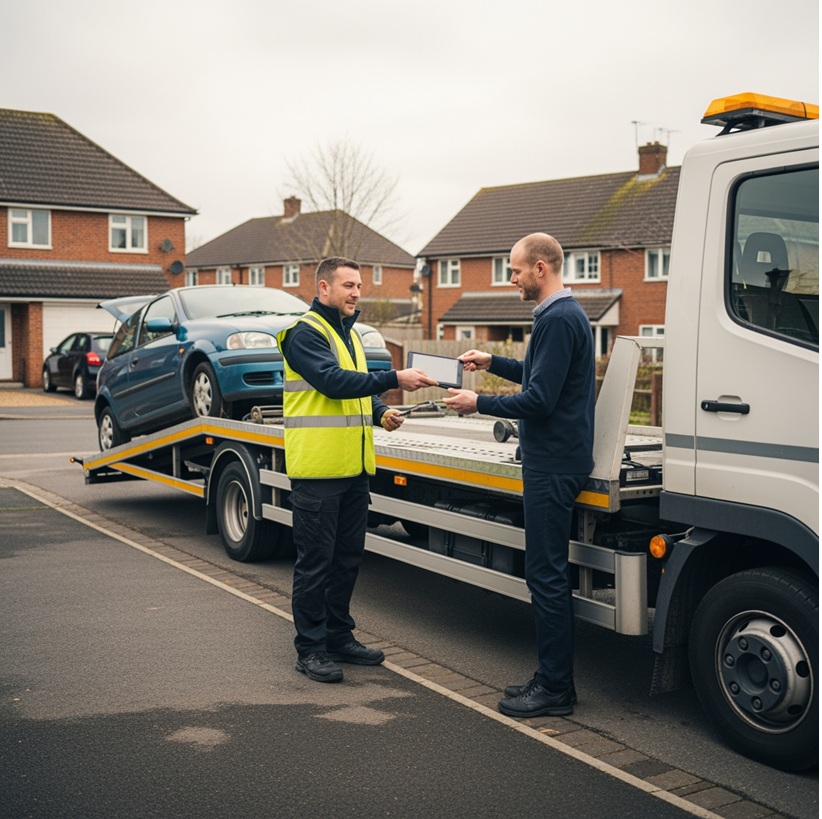
Collection day is surprisingly quick and straightforward. The recovery driver will give you a ring when they are on their way. When they pull up, the very first thing they will do is verify your identity.
They will check the vehicle matches the quote details you provided online. After that, they will inspect the V5C registration logbook and help you fill out the relevant section. Once the paperwork is sorted, they will load the vehicle onto the flatbed.
If you need a reliable scrap car collection, the driveway process is usually over in less than twenty minutes. The payment is typically triggered the moment the vehicle is loaded. Because of the strict rules in the Scrap Metal Dealers Act 2013, the funds will be sent via bank transfer, usually arriving the very same day.
Understanding the Legal Paperwork
This is the part where many people trip up. Handing the keys to the recovery driver does not magically end your legal responsibility for the car. The government still thinks you own it until you explicitly tell them otherwise.
Think of it like handing over the deeds to a house. You do not just give the buyer the front door keys and walk away. You have to do the proper legal conveyancing to remove your name from the property register. The DVLA paperwork is your automotive conveyancing. Plus, doing it right ensures you get your automatic vehicle tax refund without any delays.
If you fail to update the records, you could be hit with an automatic fine of £1,000. You might also continue receiving demands for vehicle tax. It is entirely your responsibility as the registered keeper to ensure the government records are updated.
Securing Your Legal Proof of Scrapping
When a car is permanently dismantled, a highly specific document is generated. This document is known as a Certificate of Destruction. It is an official DVLA document generated directly by the processing facility.
It proves beyond any doubt that the car has been crushed and recycled. Keep your Certificate of Destruction safe in your files indefinitely. It completely severs your legal ties to the vehicle.
Without a Certificate of Destruction, you are still legally responsible if the car’s registration plates are cloned and used in a crime. You should expect this document to arrive via email or post within seven days of the car arriving at the yard.
The DVLA Notification Process
You have two ways to handle the paperwork to notify the government. The old-fashioned way involves tearing out section 9 of your V5C registration logbook. You fill in the buyer’s details, sign it, and post it to the main office in Swansea.
The much better way is completing the DVLA notification process online. You simply input the 11-digit reference number from your logbook and the details of the buyer into the official government website.
The online system updates the national database instantly. You will receive a confirmation email immediately, which is brilliant for your peace of mind.
What Happens to Your Car After It Leaves
Ever wondered what actually happens to that old motor once it leaves your driveway? It does not just get squashed into a cube immediately. Modern car recycling is an incredibly complex, highly regulated industrial operation.
When the driver takes it straight to a local Authorised Treatment Facility, it enters a rigorous dismantling line. Before any crushing happens, the car must undergo a strict environmental depollution process.
The goal is to recover, reuse, or recycle up to 95% of the vehicle’s total weight. This is a massive shift from the old days where cars were just left to rust in open fields. Today, your old car is viewed as a valuable resource of raw materials.
The Environmental De-pollution Stage
Before a car can be crushed, it must be completely depolluted. Cars are full of incredibly nasty, toxic substances. Every Authorised Treatment Facility must follow strict rules during this environmental depollution process.
A trained technician puts the car on a specially designed rig and begins draining it. They extract the engine oil, gearbox fluid, brake fluid, and engine coolant. They safely drain any remaining petrol or diesel from the fuel tank.
They remove the lead-acid battery, which is highly corrosive. They even safely deploy and neutralise the explosive charges hidden inside the steering wheel airbags. This environmental depollution process stops highly toxic chemicals from leaking into the soil and local water tables.
Crushing and Material Separation
Once the car is completely dry and safe, the heavy machinery takes over. The stripped shell is placed into a massive baler. It is crushed down into a compact cube to save space for transport to a larger shredding facility.
At the shredder, the car is ripped into tiny pieces in mere seconds. The resulting mixture travels along massive conveyor belts. Large industrial magnets pull all the heavy steel out of the mix.
Special machines then sort the lighter metals like aluminium and copper into different bins. Even the shattered glass, dashboard plastics, and rubber tyres are collected and sent off to be remade into new products. Almost nothing goes to a landfill site.
Claiming Back Your Motor Insurance and Tax
There is a brilliant financial bonus to doing the paperwork correctly. The moment you notify the DVLA online that the car has been sold to the trade, their computers automatically trigger a vehicle tax refund.
Any full months of vehicle tax you have remaining will be refunded to you. You do not need to fill out a separate vehicle tax refund form, as it happens in the background. The DVLA will send a cheque to the address listed on the logbook, usually within a few weeks.
Do not forget to ring your motor insurance provider, too. You need to cancel your policy immediately so you are not paying to insure a cube of crushed metal. They will often refund you for the remaining months on your policy as well, depending on your specific contract terms.
Common Pitfalls to Avoid When Scrapping
Listen, the industry is heavily regulated now, but a few rogue operators still slip through the cracks. You need to keep your wits about you. The biggest red flag is anyone asking you to hand over the entire V5C registration logbook without tearing off your section. Never do this.
Another massive warning sign is a buyer trying to charge you a hidden administration fee on the driveway. A reputable network ensures the price you are quoted is a fair reflection of the vehicle’s worth. There should be no aggressive haggling on the driveway unless you deliberately hid major problems, like the car missing its entire engine.
Always use a trusted, nationwide service to protect yourself. If you are looking to scrap my vehicle safely, relying on fully vetted local partners is your best defence against rogue traders.
Ready to Begin Your Scrapping Journey
Scrapping a car really is that simple when you follow the rules and use the right people. You clear the car out, you hand over the keys, you do a quick bit of paperwork online, and you watch the payment arrive safely via bank transfer.
It is a straightforward process that protects the environment and puts a fair price in your pocket. If you are tired of looking at that old motor taking up valuable space, it is time to take action. The advantages of choosing our service include transparent quotes, free collections, and total peace of mind.
We connect you with trusted local buyers who handle everything legally and professionally. If you have any questions about the paperwork, the collection process, or how we calculate our prices, feel free to contact us for friendly, expert guidance today.