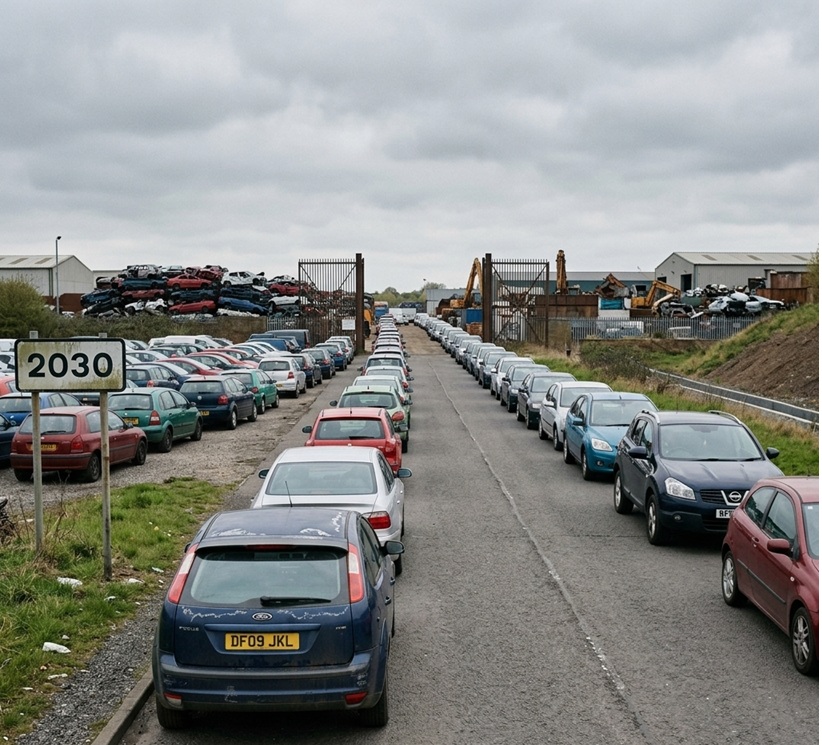
The End of Petrol Cars: How Scrap Demand Will Spike After 2030
11th Mar, 2026
The automotive industry stands at a crossroads. With the UK government’s commitment to ban the sale of new petrol and diesel cars by 2030, the nation is witnessing the beginning of the end for internal combustion engines. This seismic shift isn’t just changing what drivers choose – it’s about to create the biggest wave of scrap car demand in British history.
The petrol car ban scrap demand surge that’s coming will dwarf anything the industry has experienced before. Consider this: if the government suddenly announced that all VHS players would stop working in 2030 and everyone needed to switch to DVD, the rush to dispose of old technology would be enormous. That’s essentially what’s happening with petrol cars, except these obsolete items weigh over a tonne and contain valuable materials requiring proper handling.
Why 2030 Marks the Tipping Point
The government’s 2030 deadline isn’t just a suggestion – it’s a hard stop on new petrol and diesel car sales. This creates what economists call a “cliff edge effect” where demand for traditional vehicles will plummet as the deadline approaches.
Car manufacturers are already scaling back petrol car production. Ford announced they’re going all-electric in Europe by 2030. Volvo’s doing the same. Even luxury brands like Bentley are ditching petrol engines entirely.
Most drivers don’t realise what this means for their current vehicles. As fewer new petrol cars become available, the used market will initially see a price spike. But then something dramatic happens: the value cliff.
Once 2030 hits, petrol cars become yesterday’s technology. It’s like trying to sell a flip phone when everyone’s got smartphones. The residual value of internal combustion vehicles will nosedive, making scrapping the most sensible option for millions of car owners.
The Numbers Behind the Surge
Currently, the UK scraps roughly 1.5 million vehicles annually. But there are approximately 32 million cars on British roads right now, and about 95% of them run on petrol or diesel.
The maths is striking. If even half of these vehicles need scrapping between now and 2040, that’s roughly 15 million cars. Spread that over a decade, and the industry is looking at an additional 1.5 million vehicles per year on top of normal scrappage rates.
That’s potentially doubling the current scrap car market. The infrastructure simply isn’t ready for this volume.
When the government introduced the scrappage scheme in 2009 to boost car sales during the financial crisis, processing centres were overwhelmed with just 400,000 additional vehicles. Multiply that by ten, and the scale of what’s coming becomes clear.
How Electric Vehicles Change Everything
The transition to electric vehicles isn’t just about swapping engines – it’s completely reshaping the scrap car industry. Electric vehicles contain different materials, require different processing methods, and create new opportunities for recycling valuable components.
Traditional petrol cars are relatively straightforward to scrap. Operators drain the fluids, remove the battery, extract valuable metals, and crush what’s left. Electric vehicles are more complex beasts entirely.
Battery recycling alone represents a massive new industry. A single electric car battery contains lithium, cobalt, nickel, and rare earth elements worth hundreds of pounds. These materials are so valuable that some companies are building entire business models around battery recycling.
But processing electric vehicle batteries requires specialised facilities and trained technicians. They can’t simply be crushed like petrol engines. The infrastructure needs to be built from scratch, adding another layer to the ICE phase-out consequences facing the industry.
Regional Variations Across the UK
The petrol car ban scrap demand won’t hit every part of the UK equally. Urban areas with good charging infrastructure will see faster electric vehicle adoption, meaning earlier scrappage of petrol cars.
London’s Ultra Low Emission Zone has already accelerated this trend. Many older vehicles simply can’t meet the emissions standards, pushing owners towards scrapping rather than upgrading. This pattern will spread to other major cities as they introduce their own clean air zones.
Rural areas face different challenges. Charging infrastructure remains patchy outside major population centres, which might delay electric vehicle adoption. However, when the transition does happen, it could be more sudden and dramatic as rural drivers finally make the switch en masse.
Scotland’s ambitious climate targets mean they’re pushing even harder for electric vehicle adoption. The Scottish government has set aside additional funding for charging infrastructure, which could accelerate the transition north of the border. For those looking to understand our environmentally responsible car recycling process, proper handling becomes increasingly crucial as volumes rise.
What Car Owners Need to Know
For those currently driving a petrol or diesel car, timing will be everything. Smart car owners will start planning their transition now rather than waiting until 2029 and finding themselves in a panic.
The closer the deadline approaches, the harder it’ll become to sell petrol cars privately, and the lower the trade-in values will drop. A 2018 Ford Focus worth £12,000 today might only fetch £3,000 by 2029 because everyone knows these vehicles are about to become obsolete.
The key is understanding depreciation curves. Newer petrol cars (2020 onwards) will hold their value better initially but face steeper drops as 2030 approaches. Older vehicles (pre-2015) might actually see their scrap value increase due to higher metal content and simpler recycling processes.
Those considering their options can get an instant quote to scrap any car to understand current market values and plan accordingly.
Infrastructure Challenges Ahead
The UK’s Authorised Treatment Facilities (ATFs) – the licensed centres that handle end-of-life vehicles – are already operating near capacity. Adding millions more vehicles to the system without significant infrastructure investment is like trying to pour a gallon of water through a teacup.
Currently, there are around 1,500 ATFs across the UK. Industry experts estimate the country will need at least double that capacity to handle the coming surge. That means new facilities, additional staff training, and upgraded equipment – all of which takes time and money to implement.
Scrap Car Network works with a comprehensive network of these authorised facilities, ensuring proper processing even as demand increases. But the industry as a whole needs to prepare for unprecedented volumes.
Processing electric vehicles also requires different skills and equipment. ATF workers need training in high-voltage systems, battery handling, and new recycling techniques. It’s not just about scaling up – it’s about fundamentally changing how the industry operates.
Economic Opportunities in the Transition
Every major industry shift creates winners and losers. The coming scrap car boom will generate significant economic opportunities for those prepared to seize them.
Metal recovery will become increasingly valuable as global demand for raw materials continues rising. A typical car contains about £300-£400 worth of recyclable metals at current prices. Multiply that by millions of additional vehicles, and billions of pounds worth of recoverable materials are at stake.
New job opportunities will emerge across the supply chain. From collection and transport to processing and materials recovery, the expanded scrap car industry will need thousands of additional workers. Skilled technicians who can safely handle electric vehicle components will command premium salaries.
Regional economic development will also benefit. Areas that invest early in scrap processing infrastructure will attract businesses and jobs from across the supply chain. It’s similar to how some regions became centres for renewable energy manufacturing by getting in early.
Environmental Benefits and Challenges
While the logistics of scrapping millions of petrol cars present challenges, the environmental benefits are substantial. Proper vehicle recycling prevents harmful substances from entering the environment while recovering valuable materials for reuse.
Modern cars are roughly 85% recyclable by weight. Steel, aluminium, copper, and precious metals all find new life in other products. Even seemingly worthless components like plastic bumpers and interior trim can be processed into new items.
The shift to electric vehicles amplifies these environmental benefits. Not only are tailpipe emissions eliminated, but the valuable materials in electric car batteries create strong economic incentives for proper recycling rather than landfill disposal.
However, the sheer volume of vehicles entering the waste stream simultaneously could overwhelm environmental protections if not managed properly. This represents one of the more significant ICE phase-out consequences that requires careful planning.
Planning Your Vehicle’s Future
Whether driving a 2005 Vauxhall Corsa or a 2022 BMW 3 Series, now’s the time to start thinking about end-of-life planning. The traditional approach of “drive it until it dies” might not be optimal in this changing market.
For older vehicles (pre-2010), the decision timeline is shorter. These cars are already approaching natural end-of-life, and their scrap value might actually increase as processing facilities gear up for the coming boom. If major repairs are needed, scrapping might make more financial sense than fixing.
Newer vehicles require more strategic thinking. A 2020 petrol car still has several years of useful life, but its resale value will start declining rapidly after 2027. The sweet spot might be selling or scrapping around 2028-2029, before the market becomes completely saturated.
But what actually happens after collection? The process is more sophisticated than many people realise. Licensed facilities first remove all fluids – engine oil, brake fluid, coolant, and fuel. These are either recycled or disposed of safely according to environmental regulations.
Next comes component removal. Batteries, tyres, and catalytic converters are extracted separately. Catalytic converters alone contain platinum, palladium, and rhodium worth significant money. The remaining shell is then crushed and sent to steel mills for recycling into new products. Understanding how to tell the DVLA when you sell or scrap your car ensures the legal process is handled correctly.
The Price Factor
Scrap car prices will fluctuate significantly during this transition period. Basic economics suggests that increased supply (more cars being scrapped) should drive prices down. However, several factors complicate this simple equation.
Global metal prices continue rising due to infrastructure development in emerging economies. Steel, aluminium, and copper remain in high demand, supporting scrap values. Additionally, if processing capacity becomes constrained, competition among scrap dealers could actually drive prices up temporarily.
The composition of scrapped vehicles will also change. Older cars generally contain more metal and fewer complex components, making them cheaper to process. As newer, more complex vehicles enter the scrap stream, processing costs increase, potentially affecting the prices offered to car owners.
Those interested in current valuations can explore our guide on scrap car prices in the UK to understand the factors influencing market rates.
Government Policy Implications
The 2030 petrol car ban is just the beginning. Government policy will continue shaping the scrap car market through various mechanisms over the coming decade.
Extended Producer Responsibility regulations are likely to place greater obligations on car manufacturers for end-of-life vehicle management. This could lead to manufacturer-sponsored scrappage schemes or take-back programs, potentially offering better deals for consumers.
Local authorities are also implementing policies that accelerate vehicle turnover. Clean Air Zones, congestion charges for older vehicles, and parking restrictions all push owners towards earlier scrapping or replacement.
Tax policy represents another lever. The government could introduce scrappage incentives similar to the 2009 scheme, or conversely, impose additional taxes on keeping older, more polluting vehicles. These policy changes will create waves of demand that savvy car owners can anticipate and plan for.
Regional Processing Capacity
The distribution of scrap processing facilities across the UK creates interesting regional dynamics. Areas with established automotive industries – like the Midlands and North East – have more processing capacity than rural regions.
This geographic imbalance means that professional collection services become increasingly valuable as demand spikes. Rather than owners struggling to find local processing facilities, our free nationwide scrap car collection service can transport vehicles to areas with available capacity.
Scotland faces particular challenges due to its geography and lower population density. However, the Scottish government’s commitment to environmental goals means they’re investing heavily in processing infrastructure. For those in specific regions, understanding local scrap options in Scotland can help with planning.
Wales and Northern Ireland have their own unique considerations. Wales’s mountainous terrain makes transportation more expensive, while Northern Ireland’s separation from the mainland creates additional logistics challenges. These factors will influence how the scrap car boom affects different regions.
Technology’s Role in Processing
Advanced technology will play a crucial role in handling the coming scrap car surge. Automated dismantling systems can process vehicles faster and more efficiently than manual methods, though the initial investment is substantial.
Artificial intelligence is beginning to optimise scrap processing by identifying the most valuable components for removal and determining the most efficient processing sequences. Some facilities are experimenting with robotic systems for dangerous tasks like battery removal from electric vehicles.
Digital tracking systems will become essential for managing the increased volumes while maintaining regulatory compliance. Every end-of-life vehicle must be properly documented through the DVLA notification process, and digital systems can streamline this bureaucracy.
The companies that invest early in these technologies will have significant advantages as volumes increase. However, the upfront costs mean that only larger, well-funded operations will be able to make these investments. Connect with our network of Authorised Treatment Facilities to ensure compliance and professional handling.
International Lessons
Other countries facing similar transitions offer valuable lessons for the UK. Norway, which has achieved over 80% electric vehicle market share for new cars, provides insights into how the transition unfolds in practice.
Norwegian scrap car volumes initially declined as people held onto petrol cars longer, knowing they couldn’t easily replace them with similar vehicles. However, once electric vehicle infrastructure reached critical mass, scrappage rates spiked dramatically as people finally felt comfortable making the switch.
The Netherlands implemented a comprehensive scrappage scheme that included trade-in bonuses for electric vehicles. This smoothed the transition but created processing bottlenecks that took years to resolve. The lesson: infrastructure investment must precede policy implementation.
Germany’s approach focused on building recycling capacity before implementing transition policies. Their methodical approach avoided the boom-bust cycles seen elsewhere but required significant upfront government investment in processing facilities.
Preparing for the Surge
For car owners, preparation means understanding options before they’re needed. Research reputable scrap car services, understand the legal requirements for vehicle disposal, and keep track of changing value propositions.
The legal side isn’t complicated, but it’s important to get right. When scrapping a car, owners must notify the DVLA to avoid ongoing liability for the vehicle. Using authorised processors ensures this happens correctly.
Documentation becomes crucial during high-volume periods. Keep the V5C logbook safe and ensure all vehicle details are current with the DVLA. Processing delays during peak periods could leave owners liable for vehicles they no longer own if paperwork isn’t handled properly.
Consider timing carefully. While it’s impossible to predict exact market conditions, understanding broader trends helps inform decision-making. Cars approaching major repair needs might be candidates for earlier scrapping, especially if their post-2030 value looks questionable.
Looking Beyond 2030
The 2030 petrol car ban is just the beginning of a longer transformation. By 2040, the UK aims for carbon neutrality, which will require even more aggressive changes to transportation systems.
Autonomous vehicles, car-sharing schemes, and new mobility models will all influence future scrap car demand. The traditional model of individual car ownership is already changing, particularly among younger generations who view cars as services rather than possessions.
These changes suggest that the post-2030 scrap surge might be followed by a longer-term decline in total vehicle numbers. Shared autonomous vehicles could replace multiple individually-owned cars, reducing overall vehicle demand.
However, this transition will take decades to fully unfold. In the meantime, the immediate challenge remains managing the largest vehicle scrappage event in British history while building the infrastructure for whatever comes next.
The companies, regions, and individuals who prepare thoughtfully for these changes will navigate them successfully. Those who ignore the signs will find themselves scrambling when the deadline arrives. For anyone needing guidance or assistance, contact us to discuss individual circumstances and explore available options.
The ICE phase-out consequences extend far beyond simple vehicle replacement. They represent a fundamental restructuring of automotive infrastructure, recycling industries, and consumer behaviour. Understanding these dynamics now allows for better planning and smoother transitions when the time comes.