Why Car Scrapping Is Recession-Proof
6th Mar, 2026
When times get tough financially, most industries feel the pinch. Restaurants see fewer bookings, luxury retailers watch sales plummet, and even essential services tighten their belts. But there’s one industry that seems to thrive regardless of economic storms – and that’s where Scrap Car Network comes into its own.
Recession-proof car scrapping isn’t just a theory – it’s a reality demonstrated through decades of economic ups and downs. When money’s tight, people don’t buy new cars; they get rid of old ones. The pattern repeats with remarkable consistency, creating opportunities even when other sectors struggle.
The beauty of this industry lies in its counter-cyclical nature. While other businesses struggle, car scrapping actually benefits from economic hardship. It’s a bit like being an umbrella salesman in a thunderstorm – the worse the weather gets, the better business becomes.
Economic Downturns Drive Demand
During recessions, households face a simple choice: spend thousands keeping an aging vehicle roadworthy or scrap it for immediate cash. Most choose the latter, especially when repair bills exceed the car’s value.
Consider a typical scenario from the 2008 financial crisis. A twelve-year-old Vauxhall needed a new gearbox costing £1,800, but the car was worth maybe £600 on a good day. The owner couldn’t afford the repair, couldn’t afford to replace it, and desperately needed the space on the driveway for a work van.
That’s when recession-proof car scrapping shows its true colours. The owner received £150 for the Vauxhall, cleared the driveway, and avoided throwing good money after bad. The scrap dealer got valuable materials, and everyone won.
This scenario plays out thousands of times during economic downturns. MOT failures become blessings in disguise rather than expensive problems to solve. Failed emissions tests, worn brake discs, and corroded suspension components all lead to the same conclusion – scrapping makes more financial sense than repairing.
The mathematics are straightforward. A comprehensive MOT failure might require £800-1,200 in repairs for a vehicle worth £500-700. Rational economics favour scrapping every time.
Rising Material Prices Boost Profitability
Here’s where the economics get interesting. During recessions, governments often implement stimulus measures and infrastructure spending. This drives up demand for steel, aluminium, and copper – the very materials that make up average cars.
A typical family car contains roughly 65% steel by weight. When steel prices rise due to increased demand from construction and manufacturing sectors, that old banger gathering dust suddenly becomes more valuable as scrap metal.
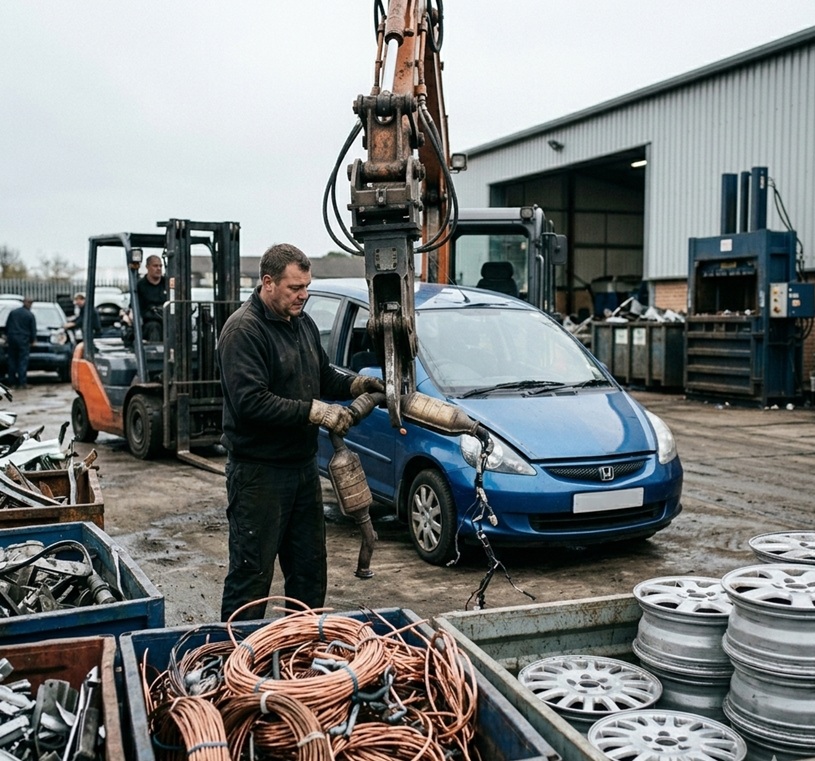
The copper in a car’s wiring harness alone can be worth £20-30 when copper prices spike. Add the catalytic converter (containing precious metals like platinum, palladium, and rhodium), the aluminium engine block, and various other recyclable components, and the value adds up quickly.
Aluminium components have become increasingly valuable as manufacturers use more lightweight materials to improve fuel efficiency. Engine blocks, wheels, and body panels all contribute to the total scrap value, with aluminium prices often remaining stable or increasing during economic downturns.
Even non-metallic components find new purposes through our environmentally responsible car recycling process. Plastics become fuel for cement kilns, glass gets reprocessed, and rubber finds applications in playground surfaces and road construction.
Consumer Behaviour Changes Dramatically
Recessions fundamentally alter how people think about their vehicles. Instead of viewing cars as status symbols or lifestyle choices, they become purely functional tools – and expensive ones at that.
When household budgets tighten, that second car gathering dust becomes a liability rather than an asset. Insurance, road tax, and maintenance costs don’t disappear just because someone’s not driving it. Many families realise they can manage with one vehicle and scrap the spare.
The average UK household spends approximately £162 per month on car insurance alone. Add road tax (£165-200 annually for most vehicles), servicing costs, and unexpected repairs, and the annual expense of keeping an unused car easily exceeds £2,500-3,000.
Young drivers, traditionally a key market for older vehicles, often delay getting their licences during tough economic times. This removes a significant portion of demand for older cars, making scrapping the more attractive option for sellers.
First-time buyers typically purchase vehicles aged 10-15 years old. When this demographic shrinks during recessions, the private sale market for older vehicles collapses, pushing more owners toward scrapping as their only viable option.
Insurance Write-Offs Increase Substantially
During recessions, insurance companies become more aggressive about writing off damaged vehicles. When repair costs approach or exceed a car’s market value, insurers choose the cheaper option – declaring it a total loss.
This creates a steady stream of vehicles entering the scrap market. Even minor accidents that might have resulted in repairs during prosperous times now lead to write-offs. Category S and N vehicles (formerly C and D) flood the market, many heading straight for authorised treatment facilities.
Insurance companies follow strict financial calculations. If repairs exceed 60-70% of pre-accident value, most insurers declare a total loss. During recessions, when used car values drop, this threshold is reached more quickly and frequently.
The result? A consistent supply of relatively modern vehicles entering the scrapping system, boosting volumes for the industry whilst other sectors contract. Connect with our network of Authorised Treatment Facilities to ensure proper disposal and recycling.
Government Scrappage Schemes Provide Support
Governments worldwide have discovered that car scrappage schemes serve multiple purposes during recessions. They stimulate new car sales, reduce emissions, and support both automotive and recycling industries simultaneously.
The UK’s 2009 scrappage scheme offered £2,000 towards new car purchases when scrapping vehicles over ten years old. Similar programmes appeared across Europe and beyond, creating artificial demand that supported the entire ecosystem.
France implemented a scheme offering up to €5,000 for electric vehicle purchases when scrapping older diesels. Germany provided similar incentives, recognising that scrappage schemes deliver multiple economic benefits whilst addressing environmental concerns.
Even without formal schemes, governments often relax environmental regulations or provide incentives for recycling industries during downturns, recognising their economic importance. These counter-cyclical industries receive support precisely because they can create jobs and economic activity when traditional sectors struggle.
The political appeal is obvious – scrappage schemes look proactive, support employment, and deliver environmental benefits all at once. This makes them attractive policy tools during economic crises.
Low Barriers to Entry Support Growth
Unlike many industries, car scrapping doesn’t require massive capital investment or specialised skills to get started. This accessibility means the industry can quickly scale up to meet increased demand during recessions.
Small operators can enter the market relatively easily, while established players can expand operations without enormous risk. This flexibility allows the industry to respond rapidly to changing economic conditions.
A basic scrap operation requires vehicle recovery equipment, secure storage space, and connections with metal processors. Compared to manufacturing or retail operations requiring extensive premises and stock, the capital requirements remain manageable.
However, working with established networks ensures compliance with environmental regulations and proper documentation – something increasingly important as authorities crack down on illegal operations. The Environment Agency actively monitors the sector, making professional compliance essential.
Metal Commodity Cycles Work Differently
The global metals market operates on cycles that often run counter to general economic trends. When manufacturing slows in developed countries, emerging markets may increase infrastructure spending, maintaining demand for raw materials.
Scrap metal prices can actually rise during recessions in developed countries because reduced industrial production means less new metal entering the market. This scarcity increases the value of recycled materials, benefiting the entire scrapping industry.
China’s massive infrastructure investments during the 2008 global recession kept metal prices relatively high, supporting scrap industries worldwide even as other sectors struggled. Similar patterns emerged during subsequent economic downturns.
The London Metal Exchange tracks these commodity prices, providing transparency and stability for the recycling sector. During the 2008 crisis, whilst stock markets plummeted, copper prices fell only temporarily before recovering strongly.
This demonstrates why car scrapping belongs among counter-cyclical industries – its raw materials maintain value even when finished goods markets collapse. The fundamental demand for metals persists regardless of economic conditions.
Regional Variations Create Opportunities
Whilst car scrapping shows recession-proof characteristics nationally, regional variations can be significant. Areas with heavy manufacturing might see different patterns compared to service-based economies.
Scrapping vehicles in London might follow different patterns due to congestion charges and emissions zones encouraging older car disposal. The Ultra Low Emission Zone alone has pushed thousands of non-compliant vehicles toward scrapping.
Similarly, if you’re looking to get an instant quote to scrap any car in Preston, local industrial demand might keep prices higher than in purely residential areas. Manufacturing centres maintain steady metal consumption even during downturns.
Scotland’s renewable energy investments maintain steady demand for metals even during broader economic downturns, supporting local scrap prices. Wind turbine construction and grid infrastructure projects create sustained demand for copper and steel.
Understanding these regional differences helps explain why recession-proof car scrapping works differently across the country, though the overall principle remains sound. Local economic factors influence pricing but rarely eliminate demand entirely.
Environmental Regulations Drive Constant Demand
Increasingly strict environmental regulations create constant pressure to remove older, more polluting vehicles from roads. This regulatory push continues regardless of economic conditions – in fact, it often accelerates during recessions as governments seek ways to stimulate green industries.
Low Emission Zones, congestion charges, and emissions testing requirements make older vehicles expensive to operate in urban areas. Many owners choose scrapping over compliance costs, creating steady demand that economic cycles can’t eliminate.
The environmental benefits of proper vehicle recycling also attract government support and public approval, providing political protection for the industry during tough times. ULEZ compliance costs can exceed £12.50 daily in London – over £3,000 annually for regular commuters.
Euro 4 diesel vehicles (registered before 2006) face particularly high costs in emission zones. For owners of older vehicles worth perhaps £1,000-2,000, the annual compliance costs make scrapping the only economically rational choice.
This regulatory pressure ensures consistent vehicle supply to the scrapping industry, reinforcing its position among counter-cyclical industries that benefit from environmental policy regardless of economic conditions.
Cash-in-Hand Appeal Grows During Hardship
During recessions, the immediate cash payment offered by scrap dealers becomes particularly attractive. Unlike selling privately (which can take weeks or months), scrapping provides instant money when people need it most.
This cash-in-hand model works especially well during economic uncertainty when people prefer immediate payment over promises of future value. There’s no waiting for cheques to clear, no risk of buyers backing out, and no ongoing costs whilst trying to sell.
Discover our free nationwide scrap car collection service that removes even the cost and hassle of delivery, making the entire process as painless as possible for cash-strapped vehicle owners.
Private sales require advertising, viewings, test drives, and negotiations – all time-consuming activities that yield uncertain results. During recessions, when buyers are scarce and cautious, this process becomes even more frustrating and lengthy.
Scrapping eliminates all these complications. A phone call or online form generates a quote, collection is arranged, and payment arrives immediately upon collection. For families facing financial pressure, this simplicity and certainty prove invaluable.
Supply Chain Resilience Provides Stability
The car scrapping industry benefits from remarkably resilient supply chains. Unlike manufacturing industries that depend on complex international networks, scrap dealers work with local supply (old cars) and have multiple outlets for their products.
This local focus means the industry can continue operating even when global supply chains face disruption. Cars need scrapping regardless of what’s happening in international markets, and local metal processors need raw materials regardless of global economic conditions.
Domestic supply chains proved crucial during the COVID-19 pandemic. Whilst international manufacturing ground to a halt, the scrapping industry continued processing vehicles because both supply (end-of-life cars) and demand (domestic metal processors) remained local.
The industry doesn’t rely on imported components, foreign labour, or complex logistics networks. This simplicity makes it inherently more stable than industries dependent on international trade and complex supply arrangements.
Future-Proofing Through Electric Vehicles
The transition to electric vehicles might seem like a threat to traditional car scrapping, but it actually reinforces the industry’s recession-proof nature. Electric vehicle batteries contain valuable materials like lithium, cobalt, and rare earth elements worth more than traditional automotive materials.
As EV adoption accelerates, the scrapping industry is adapting to handle these new materials. The higher value of EV components means the industry will likely become even more profitable and recession-resistant in future.
Early EVs are already reaching end-of-life, creating new opportunities for specialised recycling services. First-generation Nissan Leafs and similar vehicles are now entering scrapyards, and their batteries retain significant value even when depleted.
A typical EV battery contains 5-10kg of lithium, 10-20kg of cobalt, and various other valuable materials. Recycling these components generates more revenue than scrapping a comparable petrol or diesel vehicle, improving the industry’s economic fundamentals.
This evolution ensures the industry remains relevant and profitable regardless of technological changes. Whether cars run on petrol, diesel, or electricity, they eventually reach end-of-life and require proper disposal – and the materials become increasingly valuable.
The Human and Economic Reality
Behind all these economic factors lies a simple truth: people form emotional attachments to their cars, but they also know when to let go. During tough times, that old car represents both memories and much-needed cash.
The recession-proof nature of car scrapping isn’t just about economics – it’s about providing a valuable service when people need it most. Whether times are good or bad, old cars need proper disposal, valuable materials need recycling, and people need fair prices for their vehicles.
Get in touch with professionals who understand both the financial and emotional aspects of scrapping to make the process easier for everyone involved.
This combination of practical necessity, environmental responsibility, and economic opportunity creates an industry that doesn’t just survive recessions – it thrives during them. As long as cars wear out and people need money, recession-proof car scrapping will continue providing essential services to communities across the country.
The evidence spans decades and multiple economic cycles. From the early 1990s recession through the 2008 financial crisis and beyond, the car scrapping industry has demonstrated remarkable resilience. Whilst other sectors contracted, scrapping volumes increased, prices remained stable, and employment held steady.
This isn’t luck or coincidence – it’s the natural result of fundamental economic forces that make car scrapping one of the most reliable counter-cyclical industries in the modern economy. The combination of regulatory pressure, material value, consumer necessity, and low barriers to entry creates a perfect storm of recession resistance.