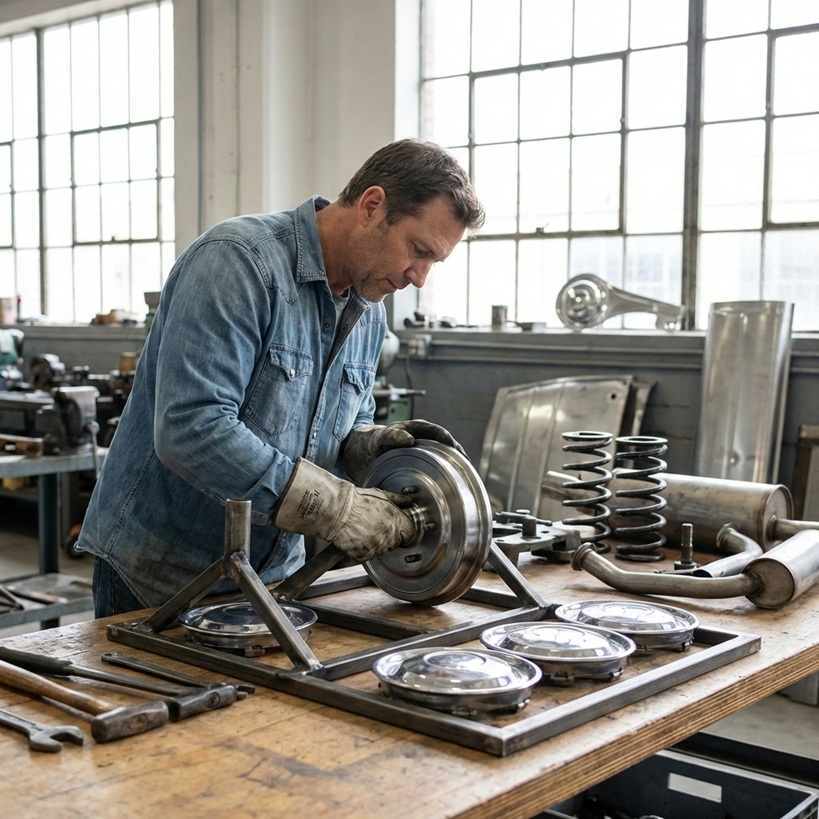
When Scrap Meets Music – Instruments Made from Car Parts
25th Feb, 2026
Creative minds have discovered remarkable possibilities when scrapyards meet musical innovation. The steel, aluminium, and various metals found in vehicles offer unique tonal qualities that traditional instrument makers struggle to achieve with conventional materials.
Musicians, artists, and major orchestras worldwide are transforming automotive components into instruments that rival traditional equipment. From exhaust pipe trumpets to brake drum percussion, car parts instruments represent sustainability with a proper soundtrack.
Scrap Car Network connects vehicle owners with responsible recycling, but before your old car becomes raw materials, it’s worth appreciating the unexpected musical potential hiding in those components. Decades of automotive work have revealed countless examples of clever individuals creating extraordinary sounds from ordinary car parts.
The Acoustic Science of Automotive Components
Car parts make excellent musical instruments because they’re already engineered for specific acoustic properties. Exhaust systems manage sound waves and vibrations – automotive engineers have inadvertently done half the musical work already.
Steel brake discs ring with clear, bell-like tones when struck properly. Aluminium wheels produce bright, metallic percussion sounds that cut through any musical arrangement. Even mundane coil springs become unique stringed instruments when tensioned correctly.
The beauty lies in the variety of metals used in modern vehicles. Each alloy has its own resonant frequency, creating a palette of sounds impossible to achieve with conventional instrument materials. It’s rather like having an entire orchestra hidden in your car’s parts bin.
Engineered Resonance and Tonal Properties
Automotive manufacturers invest heavily in metallurgy research, though they’re thinking about durability and weight reduction rather than music. These engineering decisions create metals with remarkably consistent tonal properties.
Exhaust manifolds withstand extreme temperatures through specific alloy compositions. These same properties produce rich, warm tones when repurposed as wind instruments. Catalytic converter housings, once emptied and cleaned, create resonating chambers rivalling expensive brass instruments.
Body panels undergo precision stamping that creates uniform thickness and density. When mounted as resonating chambers for stringed instruments, they amplify vibrations with surprising efficiency.
Think of it like this: traditional instrument makers spend years perfecting metal alloys for specific sounds. Automotive engineers accidentally create those same properties whilst solving completely different problems.
Percussion Instruments from Vehicle Components
Brake drums make fantastic percussion instruments that any drummer would appreciate. Musicians have transformed worn brake drums into complete drum kits, with different sizes creating full tonal ranges from deep bass to sharp accents.
Small car brake drums produce higher-pitched sounds perfect for snare-like accents. Heavy truck versions deliver deep, resonant bass tones. Arrange six or seven drums of varying sizes, and you’ve assembled a percussion set with remarkable tonal variety.
Hubcaps and Alternative Cymbals
Hubcaps work brilliantly as cymbals without the premium price tag. Pressed steel varieties deliver classic crash sounds, whilst aluminium ones produce brighter, more cutting tones.
Professional cymbals costing hundreds of pounds often don’t sound half as interesting as a properly selected hubcap. The manufacturing variations create unique sonic characteristics that factory-produced cymbals deliberately eliminate.
I remember a street performer in Manchester years back who’d built an entire kit from scrap parts. His hubcap crashes had this brilliant, slightly trashy sound that cut through the busy shopping district noise better than any traditional cymbal. Sometimes imperfection creates exactly the character you need.
Oil Drums and Steel Pan Heritage
Oil drums represent the most famous automotive percussion connection. Steel drums from Trinidad originated from discarded oil barrels, proving the relationship between cars and music spans decades.
The traditional steel pan crafting process involves careful hammering and heating, creating distinct pitch zones across the drum’s surface. Modern practitioners apply these same techniques to various automotive components with excellent results.
Tuned Brake Rotors for Melodic Sequences
Brake rotors can be tuned by carefully grinding them to specific thicknesses. Each rotor becomes a precisely pitched bell, allowing musicians to create melodic sequences rather than just rhythmic patterns.
It’s mechanical engineering meeting musical theory. The rotor’s diameter determines the fundamental pitch range, whilst thickness affects the specific note. Patient craftspeople create entire chromatic scales from properly selected and modified rotors.
Wind Instruments from Exhaust Systems
Exhaust pipes function as natural wind instruments with minimal modification. Length and diameter determine pitch, following the same principles as traditional brass instruments.
Musicians create everything from simple horns to complex multi-pipe arrangements using exhaust components. The key lies in understanding back pressure and resonance – concepts exhaust designers already optimised for automotive purposes.
A straight exhaust pipe produces one fundamental tone. Add bends, chambers, or multiple pipes, and you’ve essentially assembled a proper wind section. The engineering that made your car run quietly now creates deliberate musical expression.
Catalytic Converters as Resonating Chambers
Catalytic converter housings, once thoroughly emptied and cleaned, make excellent resonating chambers. Combined with appropriate exhaust piping, they produce surprisingly rich, warm tones.
The internal structure that once cleaned emissions creates acoustic complexity that musicians find valuable. Multiple chambers and baffles add harmonic overtones impossible to achieve with simple tubes.
The “Car-inet” Design Innovation
One particularly creative musician developed what they termed a “car-inet” – essentially a clarinet made from various exhaust components. The reed mechanism came from a modified air filter housing, with tone holes precisely drilled along a straight exhaust pipe.
The result produced sounds distinctly different from traditional clarinets, with a slightly industrial edge that worked perfectly for experimental music. It demonstrates how automotive materials can create entirely new instrument categories rather than just copying existing designs.
Stringed Instruments Using Automotive Components
Car springs make excellent stringed instruments when properly tensioned and mounted. Coil springs stretch to create unique harps with distinctive metallic timbres. Leaf springs work brilliantly for bass instruments, producing deep resonances traditional strings struggle to match.
Brake Cables as Guitar Strings
Brake cables, once cleaned and properly maintained, serve as incredibly durable guitar strings. They produce distinctive metallic tones that electric guitar players particularly appreciate.
The steel composition differs from purpose-made guitar strings, creating harmonic characteristics all their own. They’re practically indestructible compared to traditional strings, though tuning stability requires careful attention.
Body Panels as Resonating Chambers
Real innovation emerges from using car body panels as resonating chambers. A properly shaped bonnet or boot lid amplifies string vibrations similarly to traditional guitar bodies, but with completely different tonal characteristics.
The metal construction adds sustain and harmonic complexity that wooden guitars can’t achieve. The sound becomes brighter and more cutting, perfect for certain musical styles where guitars need to compete with loud percussion and brass sections.
Car Doors as Unique Guitars
Artists have converted old car doors into functional guitars, with window mechanisms becoming unique tuning systems. Interior panels provide excellent sound projection, whilst the door’s inherent structure creates unexpected resonances.
These instruments challenge conventional guitar design whilst proving that musical innovation often comes from looking at familiar objects differently. Your car door isn’t just an entryway – it’s a potential musical instrument waiting for imagination.
Electronic Music and Automotive Electronics
Modern vehicles pack electronic components that electronic music creators prize highly. Alternators can be modified to generate specific frequencies for synthesiser applications, creating sounds unavailable from traditional electronic sources.
Car stereo systems, even damaged ones, contain amplifiers, speakers, and electronic components perfect for experimental music creation. The 12-volt systems work brilliantly for portable electronic instruments, eliminating mains power requirements.
Automotive Sensors as Controllers
Sensors from modern vehicles – parking sensors, ABS wheel speed sensors, throttle position sensors – convert into unique electronic controllers. They respond to movement, proximity, or rotation in ways traditional music controllers simply can’t match.
Even windscreen wiper motors become part of mechanical music boxes or automated percussion systems. The automotive industry’s innovation in electronic control creates countless musical possibilities beyond original engineering intentions.
Famous Examples and Industry Recognition
The Blue Man Group has incorporated automotive concepts into performances for years. Their signature PVC instruments might not be car parts, but the industrial musical instrument movement owes considerable debt to automotive recycling pioneers.
In Detroit – fitting, given the city’s automotive heritage – the Detroit Symphony Orchestra commissioned pieces specifically written for car parts instruments. The resulting compositions demonstrated surprising sophistication, proving automotive music extends beyond novelty into legitimate artistic expression.
Street musicians worldwide have adopted automotive instruments enthusiastically. In developing countries, musicians create entire orchestras from discarded vehicle parts, proving musical creativity knows no economic boundaries. Working with authorised scrap car dealers ensures these components are recovered responsibly.
Environmental Benefits Beyond Music
Creating instruments from car parts represents genuine environmental recycling. Instead of melting down metals for new products, these components get second lives making music.
The energy savings prove considerable. Manufacturing new musical instruments requires significant resources, whilst converting existing car parts uses minimal additional materials or energy.
It’s changing perceptions about waste fundamentally. When people hear beautiful music created from discarded car parts, they start thinking differently about what constitutes rubbish.
This connects perfectly with broader responsible vehicle disposal goals. Understanding how proper disposal works ensures materials enter recycling streams where creative reuse becomes possible before final recycling.
Getting Started with Automotive Instruments
Safety comes first when working with car parts for any purpose. Always ensure components are properly cleaned and free from hazardous materials before conversion begins.
Brake components may contain asbestos in older vehicles. Fuel system parts require thorough decontamination before handling. Proper safety equipment and procedures aren’t optional – they’re essential for protecting your health.
Simple Starting Projects
Start simple – a brake drum and some basic strikers create your first automotive percussion instrument without complex modifications. You don’t need welding equipment or advanced metalworking skills to produce interesting sounds.
Experiment with different striking techniques and materials. A rubber mallet produces different tones than wooden drumsticks. Metal beaters create yet another sonic character. Half the fun lies in discovering what sounds different components and techniques produce.
Sourcing Materials Responsibly
Consider material sources carefully. Working with certified recycling partners ensures parts are safely and legally obtained, with proper documentation and environmental compliance throughout. Our free nationwide vehicle collection handles vehicle processing responsibly whilst ensuring components reach appropriate recycling channels.
Basic tools handle most conversions adequately. Angle grinders for cutting, welding equipment for joining components, and standard hand tools for assembly work. Nothing too specialised required to start exploring automotive musical instrument creation.
Sound Quality and Professional Applications
The metallurgy of car parts often produces superior sound quality compared to cheaper traditional instruments. Steel brake discs ring with remarkable clarity and sustain that professional musicians genuinely appreciate.
Tuning requires patience and experimentation, though. Unlike traditional instruments with established tuning methods, automotive instruments often need custom approaches developed through trial and error. But that’s part of their charm – each instrument becomes unique.
Recording Challenges and Solutions
Recording these instruments can be challenging initially. The metallic tones sometimes don’t translate well through standard microphones designed for traditional instruments.
Experimentation with microphone placement and types often yields the best results. Dynamic microphones handle the sharp transients better than condensers in many cases. Positioning matters enormously – small movements create significant tonal changes.
Many musicians find automotive instruments work particularly well in ensemble settings. The unique tones cut through traditional instrument sounds, creating interesting textural contrasts that producers value highly. Understanding environmentally responsible car recycling helps appreciate how these materials reach creative reuse channels.
The Business of Automotive Instruments
There’s actually a growing market for professionally crafted automotive instruments. Musicians willingly pay premium prices for well-made pieces with unique sounds and reliable playability.
Several companies now specialise in creating high-end instruments from car parts. They’re not curiosities anymore – they’re legitimate musical tools used in professional recordings and live performances worldwide.
The key to commercial success lies in combining automotive materials with proper instrument-making techniques. You need both automotive knowledge and musical understanding to create truly playable instruments that musicians will actually purchase and use.
Custom commissions prove particularly popular. Musicians want instruments reflecting their personal style and musical needs, and automotive materials offer almost unlimited customisation possibilities.
Challenges and Limitations
Not all car parts make good instruments, unfortunately. Plastic components rarely produce satisfying musical sounds, and some metals don’t resonate well enough for musical applications.
Durability can present issues too. Car parts weren’t designed for repeated striking or plucking, so reinforcement becomes necessary for instruments seeing regular use. A brake drum that survives thousands of stops might crack after a month of enthusiastic drumming without proper mounting.
Transportation and Maintenance Considerations
Transportation becomes complicated with larger automotive instruments. A brake drum kit takes up considerably more space than traditional drums, limiting portability for touring musicians.
Maintenance requires both musical and automotive knowledge. When your exhaust pipe trumpet develops a leak, you need welding skills rather than traditional instrument repair techniques.
But what happens when creative resourcefulness meets environmental consciousness? The results prove genuinely fascinating and increasingly mainstream.
Cultural Impact and Educational Value
Automotive instruments represent a fascinating intersection of industrial culture and artistic expression. They celebrate the mechanical heritage that shaped modern society whilst transforming it into something beautiful.
Different cultures approach automotive music differently. In some places, it’s viewed as resourceful recycling. In others, it’s considered high art. Both perspectives have genuine merit and contribute to the movement’s growth.
The sound of automotive instruments often evokes specific emotional responses. There’s something primal about music created from the machines that transport us through daily life, connecting industrial utility with artistic beauty.
Educational Applications
Educational institutions are beginning to incorporate automotive instrument making into their curricula. It combines practical skills, environmental awareness, and artistic creativity in ways traditional subjects sometimes can’t match.
Students learn metalworking, acoustic principles, environmental responsibility, and creative problem-solving simultaneously. It’s education that feels relevant to real-world challenges whilst developing genuinely useful skills.
Future Possibilities and Mainstream Adoption
As vehicles become more complex, new possibilities emerge for musical applications. Electric vehicle components offer different materials and electronic possibilities compared to traditional combustion engines.
Hybrid vehicle batteries, once safely decommissioned, contain materials that could revolutionise electronic music creation. The precision manufacturing in modern vehicles also means more consistent musical properties across components.
3D printing technology allows for custom connectors and modifications that make automotive instrument creation more accessible to amateur builders worldwide. Design files can be shared globally, democratising access to instrument-making techniques.
The growing emphasis on sustainability suggests automotive instruments will become more mainstream as environmental awareness increases across generations. What once seemed eccentric now appears forward-thinking.
Professional Orchestra Integration
Orchestra composers are writing pieces specifically for automotive instruments. The unique tonal qualities add colours to musical palettes that traditional instruments simply cannot provide.
Recording studios are beginning to stock automotive instruments alongside traditional ones. Producers value the distinctive sounds for adding character to recordings, particularly in experimental and electronic genres.
Music therapy programmes have found that building instruments from car parts provides therapeutic benefits beyond just playing music. The construction process itself offers valuable psychological benefits to participants working through various challenges. The advantages of choosing our service include connecting vehicles with facilities that identify creative reuse opportunities.
Making the Connection to Responsible Recycling
The relationship between automotive recycling and music creation represents perfect creative reuse. Instead of viewing end-of-life vehicles purely as waste problems, we can see them as repositories of musical potential.
When cars reach the point where repair costs exceed their value, those brake drums might have second careers in local school music programmes. Body panels could become resonating chambers for community orchestras. Understanding the advantages of professional recycling services helps ensure vehicles reach facilities capable of identifying components with creative reuse potential.
The process starts with proper vehicle disposal. Working with facilities that can safely remove and prepare automotive components for creative reuse through a professional car recycling process supports both environmental protection and artistic innovation.
This represents sustainability in action – taking industrial waste and transforming it into cultural enrichment. It’s resourcefulness demonstrating how creativity and environmental consciousness work together beautifully.
Whether you’re a musician looking for unique sounds, an artist interested in recycled materials, or simply someone who appreciates creative problem-solving, automotive instruments offer fascinating possibilities. They prove that with imagination, even mundane industrial components can sing. When you’re ready to get an instant quote, remember that proper recycling creates opportunities for components to find surprising new lives.
The next time you hear music with an unusual metallic ring or particularly distinctive percussion sound, remember – you might be listening to the second life of someone’s old car. Contact our team if you’d like to learn more about how responsible vehicle disposal supports these creative recycling opportunities. And honestly, that’s a pretty wonderful way for any vehicle to spend its retirement.