How Scrap Cars Inspire Video Game Worlds
24th Feb, 2026
Decades of automotive experience reveal something rather fascinating about the gaming industry. Those rusty old bangers that most people see as worthless have become the stars of some of the biggest video games in the world.
Scrap cars in video games aren’t just background decoration anymore. They’re central characters, plot devices, and sometimes the entire point of the game. From the apocalyptic wastelands of Fallout to the chaotic demolition derbies of Wreckfest, game developers have discovered what automotive professionals have always known, there’s something deeply compelling about a car that’s seen better days.
Think about it like this: a shiny new Ferrari tells you one story, wealth, perfection, untouchability. But a battered Ford Escort with mismatched panels and a door that doesn’t quite close? That car has lived a life. It’s got stories to tell, and game designers have cottoned on to this in a big way.
The industry sees this transformation potential every day, watching vehicles move from roads to virtual worlds.
The Psychology Behind Virtual Scrapyards
There’s something oddly therapeutic about virtual destruction that game developers understand better than most. When playing a game like Burnout Paradise or watching a carefully modified ride get absolutely demolished in BeamNG.Drive, players experience a kind of cathartic release that’s impossible in real life.
Customers genuinely mourn bringing their old cars to be scrapped. One fellow brought in a 1987 Vauxhall Cavalier that had been in his family for twenty years. The thing was held together with hope and cable ties, but he stood there for ten minutes just looking at it before signing the paperwork.
Video games give players the chance to experience that destruction without the emotional weight. Cars can crash, burn, explode, and rebuild without any real consequences. It’s like having a massive scrapyard where everything resets at the touch of a button.
The psychological appeal goes deeper than just destruction, though. Scrap cars in video games represent transformation and possibility. In games like My Summer Car or Car Mechanic Simulator, players aren’t just working with virtual vehicles, they’re engaging in digital archaeology, uncovering the potential hidden beneath layers of rust and neglect.
Post-Apocalyptic Landscapes and Automotive Graveyards
The connection between abandoned vehicles and dystopian settings is so strong it’s practically a gaming cliché at this point. But there’s a reason for that. Derelict cars are visual shorthand for a world that’s gone wrong.
Post-apocalyptic game design has embraced this aesthetic wholeheartedly. Mad Max, probably the most famous example, built its entire visual identity around modified scrap vehicles. The game developers at Avalanche Studios spent months studying real scrapyards, understanding how metal degrades, how cars naturally settle when abandoned, and what happens when desperate people start cannibalising vehicles for parts.
Proper scrapyards from the early 2000s, acres of cars stacked three high, slowly returning to the earth, looked exactly like something from a science fiction film. The way nature starts to reclaim these metal shells, how they become homes for wildlife, how they create their own strange ecosystem, game designers have captured all of this brilliantly.
Fallout’s vehicle graveyards are particularly well-observed. The way cars are scattered along highways, the selective scavenging that’s left some vehicles intact whilst others are stripped to the chassis, it all rings true to anyone who’s seen how people actually behave around abandoned cars.
But what happens in reality when vehicles reach end of life? It’s far more systematic than these games suggest, but considerably less dramatic than the explosive endings you’ll see on screen.
Racing Games Embrace the Banger
Racing games have discovered banger racing, and they’ve done it with the enthusiasm of someone who’s just found out about demolition derbies for the first time. This shift has revolutionised how developers approach vehicle damage and gameplay mechanics.
Wreckfest, developed by Bugbear Entertainment, is probably the finest example of this trend. The developers clearly understand that there’s a particular joy in racing cars that are already half-broken. Every dent, every missing panel, every bit of gaffer tape holding the bumper on, it all affects how the car handles.
The physics of damaged vehicles in these games has become surprisingly sophisticated. A car with a bent chassis doesn’t just look different, it drives differently. The steering pulls, the suspension geometry goes wonky, and suddenly players are fighting the car as much as they’re fighting other drivers.
A customer once brought in a Mondeo that had been rear-ended so hard the rear axle was sitting at a five-degree angle. The car still ran, technically, but driving it was like wrestling a particularly stubborn shopping trolley. Games like Wreckfest capture that feeling perfectly, the way a damaged car becomes its own unique challenge.
Demolition derby games have also found their niche. There’s something deeply satisfying about the strategic element: aggressive tactics going for quick knockouts whilst risking early damage, defensive approaches letting others destroy each other first, strategic positioning using arena layout, and damage management protecting vulnerable components whilst maximising impact.
It’s chess, but with more twisted metal and fewer rules.
The Art of Virtual Rust and Decay
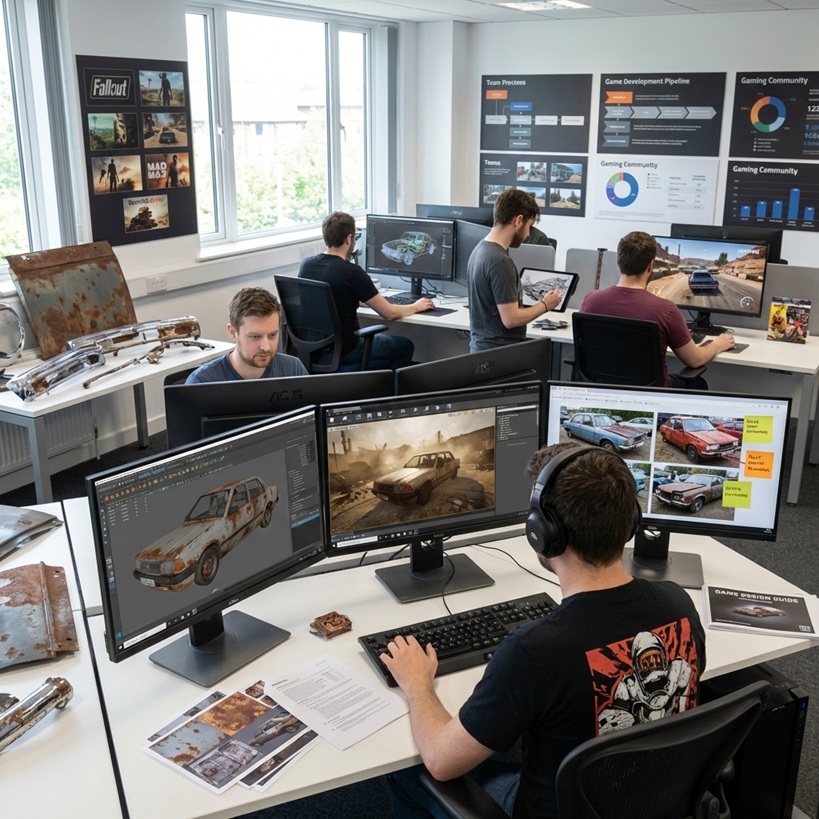
Game artists have become absolute masters at rendering automotive decay. The way rust spreads along panel joints, how paint fades and peels, the particular way that chrome pitting catches light, they’ve studied all of this with the dedication of forensic scientists.
Take a game like The Last of Us Part II. The abandoned cars scattered throughout the environment aren’t just randomly placed props, each one tells a story about how long it’s been there, what happened to it, and how the elements have taken their toll.
Weathering techniques in games have become so sophisticated that they’re now used as storytelling devices. A car with rust only on the upper surfaces has been sitting in flood water. A vehicle with all its glass intact but severe body damage was abandoned after an accident. Cars with stripped interiors but intact engines show different scavenging priorities. Vehicles with plant growth indicate years of abandonment.
These details matter because they create believable worlds. Different metals age differently, aluminium doesn’t rust the same way as steel, chrome pitting has its own distinctive pattern, and plastic components fade and crack in predictable ways. Understanding how vehicles actually age helps game designers create authentic environments.
The texture work on some of these virtual scrap heaps is genuinely impressive. Observers can see where someone’s tried to patch a hole with fibreglass, where body filler has been applied and failed, where different paint jobs have been layered over each other. It’s like reading the biography of a car through its surface imperfections.
Sandbox Games and Creative Destruction
Sandbox games have taken the concept of scrap cars in video games and run with it in directions that would make a health and safety inspector weep. Games like Garry’s Mod or BeamNG.Drive give players the tools to create their own automotive disasters, and the results are both horrifying and hilarious.
BeamNG.Drive, in particular, has become something of a phenomenon among car enthusiasts. The soft-body physics system means that when a car crashes, it doesn’t just explode or disappear, it crumples, bends, and breaks in ways that are disturbingly realistic.
Grown mechanics spend hours in BeamNG.Drive, setting up elaborate crash scenarios just to see how the physics engine handles different types of impacts. It’s like having a crash test facility where budgets and safety regulations don’t exist.
The modding community around these games has created an entire ecosystem of scrap car content. People are recreating specific real-world vehicles, complete with accurate damage modelling and realistic wear patterns. Some of these virtual cars are more detailed than their real-world counterparts.
Creative destruction in these games serves a different purpose than the structured chaos of racing games. It’s more experimental, more about understanding cause and effect. What happens if a car drops from 500 feet? How does the damage model handle being hit by a train? These aren’t questions easily answered in real life, but games make them accessible.
The Economics of Virtual Scrap
Game economies built around scrap cars present fascinating parallels to real-world markets. Games like Car Mechanic Simulator have created entire progression systems based on buying broken cars, fixing them up, and selling them on.
The virtual scrap market in these games often mirrors real-world dynamics in surprisingly accurate ways. Rare parts are expensive, common components are cheap, and the labour involved in restoration is often the biggest cost factor. It’s like running a proper garage, but without the constant smell of WD-40 and the inevitable cuts on your knuckles.
Some games have taken this even further. In Crossout, players build combat vehicles from scrap parts, and the in-game economy revolves entirely around salvaging, trading, and upgrading components. It’s created a virtual marketplace where a rusty exhaust pipe might be worth more than a pristine bumper, depending on what other players need.
The progression mechanics in these games often reward players for understanding automotive systems. Parts can’t just be randomly bolted together and expected to work, there’s a logic to it that mirrors real-world mechanical principles.
Young customers have learned more about car maintenance from these games than they ever did in school. When someone understands that engine power needs to balance with transmission capacity because they’ve experienced the consequences of getting it wrong in a game, they’re already ahead of most drivers.
Environmental Storytelling Through Abandoned Vehicles
Environmental storytelling is where scrap cars in video games really shine. A single abandoned vehicle can communicate volumes about a game world without a single line of dialogue or text description.
Consider the narrative power of finding a family car with child seats still installed, sitting abandoned on a highway in a zombie apocalypse game. Or discovering a luxury vehicle stripped of all valuable components in a post-economic collapse setting. These details create emotional connections that pure exposition simply can’t match.
Game designers have learned to use automotive archaeology as a storytelling technique. The way cars are positioned, what’s been removed from them, how they’ve been damaged, all of these factors contribute to the player’s understanding of what happened in that virtual world.
Post-apocalyptic game design relies heavily on this visual language. The placement and condition of virtual scrap cars has become an art form in itself. Environmental artists study real-world abandoned vehicles, understanding how they settle, how they’re typically stripped for parts, and how different climates affect their deterioration.
Visual storytelling through vehicles is particularly effective because cars are such personal objects in real life. We form emotional attachments to our vehicles, so seeing them abandoned or destroyed in games triggers genuine emotional responses.
Technical Challenges of Rendering Decay
From a technical standpoint, rendering realistic vehicle decay presents unique challenges for game developers. Unlike pristine showroom models, damaged cars have irregular surfaces, complex material interactions, and unpredictable wear patterns.
Procedural weathering systems have become increasingly sophisticated, allowing developers to simulate years of environmental exposure in real-time. These systems consider factors like climate conditions and seasonal variations, exposure to sun, rain, and salt, human interaction and scavenging patterns, and natural biological growth and colonisation.
The computational complexity of accurate damage modelling is enormous. Every dent, scratch, and rust spot affects how light interacts with the surface. Modern games are essentially running complex physics simulations to determine how virtual metal should look after years of neglect.
Level-of-detail systems for damaged vehicles require special consideration. A car that looks appropriately weathered from a distance might reveal inconsistencies when viewed up close, so artists must create multiple versions of each asset.
Texture streaming becomes more complex when dealing with high-resolution decay textures. The amount of data required to represent realistic rust, dirt, and wear patterns can quickly overwhelm system memory, requiring clever optimisation techniques.
The Future of Scrap Cars in Gaming
Looking ahead, emerging technologies are opening new possibilities for representing scrap cars in video games. Ray tracing technology is making realistic rust and weathering effects more achievable, whilst improved physics engines are enabling more accurate damage simulation.
Virtual reality applications are beginning to explore automotive graveyards as immersive experiences. Imagine walking through a virtual scrapyard, examining vehicles up close and understanding their stories through environmental clues.
Machine learning is being applied to damage modelling, with AI systems learning from real-world examples to create more believable virtual decay. These systems can generate unique weathering patterns for each vehicle, ensuring that no two abandoned cars look identical.
Augmented reality applications might soon allow people to overlay virtual damage onto real vehicles, helping with everything from insurance assessments to special effects in film production. Modern recycling facilities could even use AR for vehicle assessment.
The integration of real-world data into virtual scrapyards is another emerging trend. Some developers are using satellite imagery and street view data to create accurate representations of actual automotive graveyards.
Cultural Impact and Artistic Expression
Scrap cars in video games have transcended their utilitarian origins to become forms of artistic expression. Players create elaborate automotive sculptures, design custom paint schemes for vehicles destined for destruction, and share their creations with online communities.
The aesthetic appeal of automotive decay has influenced real-world art and design. The weathered, battle-scarred look popularised by games like Mad Max has appeared in everything from fashion to architecture.
Community creativity around virtual scrap cars has spawned entire subcultures. Online forums dedicated to sharing crash videos, discussing damage physics, and showcasing custom vehicle builds have thousands of active members.
Educational applications are emerging as well. Some driving schools are using games with realistic damage modelling to demonstrate the consequences of poor driving decisions in a safe environment.
The cultural significance of these virtual automotive graveyards reflects our complex relationship with technology, consumption, and obsolescence. They’re digital museums of industrial archaeology, preserving the memory of vehicles that might otherwise be forgotten.
Bringing Virtual Lessons to Reality
After years working with actual scrap cars, the way video games have captured something essential about these vehicles is remarkable. They’ve recognised that every damaged car has a story, every rust pattern has a history, and every dent represents a moment in time.
The attention to detail in modern games often exceeds what people notice about real vehicles. Game artists spend weeks perfecting the way light reflects off oxidised chrome, whilst most drivers never really look at their own cars closely enough to notice similar details.
Virtual appreciation for automotive decay has led some players to develop a genuine interest in real-world car restoration and maintenance. It’s created a bridge between digital entertainment and practical skills that benefits everyone involved.
When someone brings their old car in, it’s worth considering the virtual second life it might have in some game designer’s imagination. These vehicles that seem worthless to their owners might inspire the next great racing game or post-apocalyptic game design.
The environmental responsibility that’s increasingly important in real-world vehicle disposal is also starting to appear in games. Some titles now include mechanics around proper recycling and waste management, helping players understand that even virtual resources have consequences.
Understanding proper disposal in reality remains both more mundane and more important than virtual counterparts. The legacy of these games will likely be their role in helping people appreciate the beauty in automotive decay.
They’ve taught us that rust can be beautiful, that damage tells stories, and that sometimes the most interesting cars are the ones that have lived the hardest lives. For those ready to give their real-world vehicle a proper send-off, exploring available options ensures it’s handled with the same respect these games have taught us to show automotive history.
The Intersection of Virtual and Real Worlds
The intersection of scrap cars in video games represents something uniquely modern, the digitalisation of decay, the gamification of destruction, and the artistic celebration of obsolescence. It’s a reminder that even in our increasingly virtual world, the physical objects that surround us continue to inspire, educate, and entertain in ways their creators never imagined.
For vehicle owners wondering about end-of-life options, connecting with authorised recycling partners provides clarity on both practical recycling and potential creative alternatives. Every vehicle deserves proper consideration of its remaining potential.
The gaming industry’s fascination with automotive decay highlights something fundamental about our relationship with technology. We’re drawn to stories of transformation, whether they’re digital or physical. Games simply make those stories more accessible and interactive than ever before.
If you’re ready to ensure your vehicle receives appropriate handling, whether for standard recycling or potential creative reuse, contact us to tailor our services to your specific situation. We understand that every vehicle has its own story, and we’re here to help write the final chapter properly.